

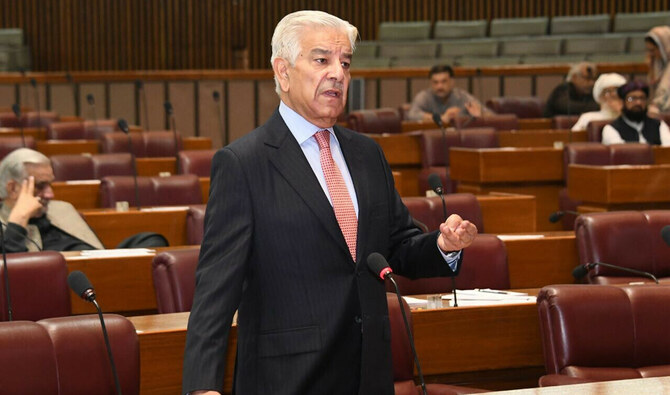

ISLAMABAD: Pakistan’s Defense Minister Khawaja Asif on Thursday criticized Ali Amin Gandapur, the chief minister of the Khyber Pakhtunkhwa (KP) province, for his decision to hold talks with Kabul for action against Afghanistan-based militant groups, describing it as a “direct attack on the federation” of Pakistan.
Gandapur this week said he would hold direct talks with Kabul and send an emissary to Afghanistan to arrange a meeting to resolve the issues, citing that Pakistan shares a 1,200km border with Afghanistan and people living on both sides speak the same language. After his meeting with Afghan consul-general Hafiz Mohibullah in Peshawar on Wednesday, the KP chief minister stressed the need for serious efforts for peace in the region and called on the federation to constitute a jirga, or tribal council, for talks with Afghanistan.
Pakistan has seen a rise in militant attacks in recent weeks, with many of them taking place in KP where groups like the outlawed Tehreek-e-Taliban Pakistan (TTP), or Pakistani Taliban, have stepped up attacks, daily targeting security forces convoys and check posts, and carrying out targeted killings and kidnappings of law enforcers and government officials.
In 2024, over 75 policemen have been killed in ambushes and targeted killings in KP that borders Afghanistan. In the latest killing, unidentified gunmen shot dead a policeman in the Bannu district.
Police, joined by representatives of civil society and political parties as well as tribal elders and public members, are currently holding protests in several districts of KP against the spike in militancy and attacks on officers.
Speaking in parliament on Thursday, Defense Minister Asif clarified that no Pakistani province was authorized to hold talks with any foreign country on its own.
“The KP CM gave a statement that he will speak to Afghanistan on his own,” the defense minister said in his televised comments. “This is a direct attack on the federation. No province can hold direct talks with any country.”
Pakistan says militants mainly associated with the TTP frequently launch attacks from hideouts in neighboring Afghanistan, targeting police and other security forces. Islamabad has even blamed
Kabul’s Afghan Taliban rulers for facilitating anti-Pakistan militants. Kabul denies the charges.
Islamabad says it has consistently taken up the issue of cross-border attacks with the Taliban administration, which denies allowing Afghan soil to be used for attacks.
The matter has led to clashes between the border forces of the two countries on multiple occasions in recent months, including on Sunday when security forces in Pakistan killed eight Afghan
Taliban fighters in a border clash, following what Islamabad described as “unprovoked firing” on Pakistani checkpoints.
Terming Gandapur’s statement a continuation of his fiery speech at a recent rally of his Pakistan Tehreek-e-Insaf (PTI) party, Asif said the path being trodden by the KP chief minister was a “deadly poison,” which he wanted other PTI members to follow as well.


