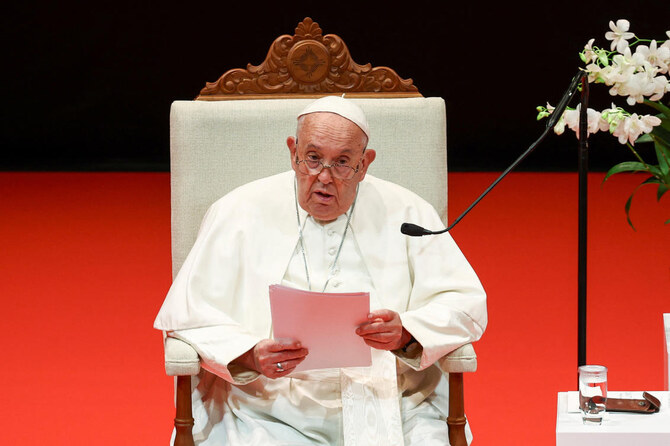
SINGAPORE: Pope Francis made a plea for migrant workers to be paid fairly on Thursday, as he visited the affluent city-state of Singapore on the last stop of his marathon Asia-Pacific tour.
The 87-year-old pope said “special attention” should be paid to “protecting the dignity of migrant workers,” in an address to local political leaders and dignitaries.
“These workers contribute a great deal to society and should be guaranteed a fair wage,” he said.
There are an estimated 170 million migrant workers around the world — about five percent of the global workforce — according to the International Labour Organization.
Most live in the Americas, Europe and Central Asia.
But cheap labor has been instrumental in the rapid growth of gleaming metropolises such as Dubai, Doha and Singapore.
About 300,000 low-wage migrant workers are estimated to work in Singapore.
Advocates say they lack adequate protection against exploitation and sometimes endure poor living conditions, charges the government denies.
The issue shot to the fore during the Covid-19 pandemic, when tens of thousands of migrant workers were forcibly locked down in dormitories.
Many migrants in Singapore come from South Asia and from the Philippines, which has a large and notably devout Catholic majority.
“I’m so happy that the pope has chosen to speak on this topic,” a 34-year-old Filipino domestic helper told AFP, asking not to be named because she did not have permission from her employer.
“Even if they don’t raise my salary, I’m still happy to know that the pope himself is fighting and praying for us” she said.
The woman said she earned $460 a month, in a nation where the median gross income is $3,985, according to Ministry for Manpower statistics for 2023.
Another South Indian worker welcomed the pope’s comments, but said he was happy after five years in the city state.
“Yes, the work is very hard and a higher salary would be better but I’m happy.”
The pope did not refer to workers in Singapore explicitly. But his comments are likely to cause unease inside a government which is fiercely protective of its image.
Still, the Argentine pontiff was otherwise glowing about his hosts, praising the “entrepreneurial spirit” and dynamism that built a “mass of ultra-modern skyscrapers that seem to rise from the sea.”
“Singapore is a mosaic of ethnicities, cultures and religions living together in harmony,” he said, painting the population of almost six million as a shining light for the world.
“I encourage you to continue to work in favor of the unity and fraternity of humanity and the common good of all peoples and all nations,” he said.
About 30 percent of Singaporeans are Buddhist, 20 percent have no religion and the rest are a mix of Catholic, Protestant, Taoist and Hindu.
Singapore is the last stop on the pope’s 12-day, four-nation Asia-Pacific trip aimed at boosting the Catholic Church’s standing in the world’s most populous region.
Francis has defied doubts about his health during a journey that has taken him from a Jakarta grand mosque to a remote jungle of Papua New Guinea.
Despite recently undergoing hernia surgery and dealing with a string of respiratory issues, he has carried out dozens of public engagements, energized congregations and repeatedly sat for hours in the brutal tropical heat.
In East Timor, he held a mass for 600,000 faithful — almost half the nation’s population.
Although the crowds were markedly smaller in Singapore, groups of enthusiasts still lined the main roads trying to get a glimpse of the head of the Catholic Church.
Security was tight, with roads closed and police manning a string of roadblocks.
Welinda Elorde, a 56-year-old cancer survivor traveled from the Philippines for the occasion.
“I think I’m going to cry when I see him. I can feel the emotions now,” she said.
“I’m hoping for complete healing.”


![]()

Pope Francis says migrant workers need ‘a fair wage’
Short Url
https://arab.news/bcqyx
Pope Francis says migrant workers need ‘a fair wage’
- There are an estimated 170 million migrant workers around the world – about five percent of the global workforce
- Cheap labor has been instrumental in the rapid growth of gleaming metropolises such as Dubai, Doha and Singapore


Latest updates


© 2026 SAUDI RESEARCH & PUBLISHING COMPANY, All Rights Reserved And subject to Terms of Use Agreement.