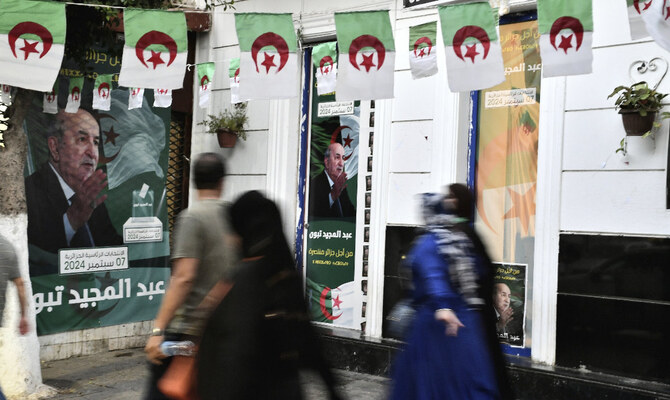
Algerians expected an uneventful election that would bestow President Abdelmadjid Tebboune a second term. Instead, they got the president himself calling into question the vote count and legal challenges from his opponents alleging fraud.
Such a surprising turn of events marks a departure for Algeria, where elections have historically been carefully choreographed by the ruling elite and military apparatus that backs it.
The country’s constitutional court has until next week to rule on the appeals from Tebboune’s two opponents. But it’s anyone’s guess how questions about the election will be resolved, whether tallies will be re-tabulated and what it means for Tebboune’s efforts to project an image of legitimacy and popular support.
WHAT’S THE CONFUSION?
Algeria’s National Independent Election Authority, or ANIE, published figures throughout election day showing a low turnout. By 5 p.m. on Saturday, the reported turnout in Algeria was 26.5 percent — far fewer than had voted by that time in the election five years ago. After unexplained delays, it said “provisional average turnout” by 8 p.m. had spiked to 48 percent.
But the next day, it reported that only 5.6 million out of nearly 24 million voters had cast ballots — nowhere near 48 percent.
It said 94.7 percent voted to re-elect Tebboune. His two challengers — Abdelali Hassani Cherif of the Movement of Society for Peace and Youcef Aouchiche of the Socialist Forces Front — won a dismal 3.2 percent and 2.2 percent of the vote, respectively.
Cherif, Aouchiche and their campaigns subsequently questioned how results were reported and alleged foul play including pressure placed on poll workers and proxy voting.
None of that surprised observers.
But later, Tebboune’s campaign joined with his opponents in releasing a shared statement rebuking ANIE for “inaccuracies, contradictions, ambiguities and inconsistencies,” legitimizing questions about the president’s win and aligning him with popular anger that his challengers had drummed up.
Cherif and Aouchiche filed appeals at Algeria’s constitutional court on Tuesday after their campaigns further rebuked the election as “a masquerade.”
WHY IS VOTER TURNOUT CLOSELY WATCHED IN ALGERIA’S ELECTION?
Turnout is notoriously low in Algeria, where activists consider voting tantamount to endorsing a corrupt, military-led system rather than something that can usher in meaningful change.
Urging Algerians to participate in the election was a campaign theme for Tebboune as well as his challengers. That’s largely due to the legacy of the pro-democracy “Hirak” protests that led to the ouster of Tebboune’s predecessor.
After an interim government that year hurriedly scheduled elections in December 2019, protesters boycotted them, calling them rigged and saying they were a way for the ruling elite to handpick a leader and avoid the deeper changes demanded.
Tebboune, seen as the military’s preferred candidate, won with 58 percent of the vote. But more than 60 percent of the country’s 24 million voters abstained and his victory was greeted with fresh rounds of protests.
His supporters had hoped for a high turnout victory this year would project Tebboune’s popular support and put distance between Algeria and the political crisis that toppled his predecessor. It appears that gambit failed after only 5.6 million out of 24 million voters participated.
WHAT HAPPENED TO THE HIRAK PROTESTS?
In 2019, millions of Algerians flooded the streets for pro-democracy protests that became known as the “Hirak” (which means movement in Arabic).
Protesters were outraged after 81-year-old President Abdelaziz Bouteflika announced plans to run for a fifth term. He had rarely been seen since a 2013 stroke left him paralyzed. The Hirak was jubilant but unsatisfied when Bouteflika resigned and top businessmen were charged with corruption. Protesters never coalesced around leaders or a new vision for Algeria, but called for deeper reforms to foster genuine democracy and remove from power members of what Algerians simply call “the power” — the elites from business, politics and the military thought to run the country.
Hirak protesters rejectedTebboune as a member of the old guard and interpreted most of his earlyovertures as empty gestures meant to placate them.
Before, during and after Tebboune’s election, protests continued. Then, COVID-19 hit and they were outlawed. Authorities continued to repress freedom of expression and imprison journalists and activists made famous by the pro-democracy movement, though protests restarted in 2021.
Figures from the Hirak denounced the 2024 election as a rubber stamp exercise to entrench Algeria’s status quo and called for another round of boycotts to express a deep lacking of faith in the system. Many said the high abstention rate in Saturday’s election proved Algerians were still aligned with their criticisms of the system.
“Algerians don’t give a damn about this bogus election,” said former Hirak leader Hakim Addad, who was banned from participating in politics three years ago. “The political crisis will persist as long as the regime remains in place. The Hirak has spoken.”
WHAT DOES TEBBOUNE QUESTIONING THE RESULTS MEAN?
Nobody knows. Few believe the challenges could lead to Tebboune’s victory being overturned.
Op-ed columnists and political analysts in Algeria have condemned ANIE, the independent election authority established in 2019, and its president Mohamed Charfi, for bungling elections that the government hoped would project its own legitimacy in the face of its detractors.
Hasni Abidi, an Algeria analyst at the Geneva-based Center for Studies and Research on the Arab World and Mediterranean, called it “a mess within the regime and the elite” and said it dealt a blow to both the credibility of institutions in Algeria and Tebboune’s victory.
Some argue his willingness to join opponents and criticize an election that he won suggest infighting among the elite thought to control Algeria.
“The reality is that this remains a more fragmented, less coherent political system than it ever has been or than people have ever assumed,” said Riccardo Fabiani, International Crisis Group’s North Africa director.
WHAT ARE THE STAKES?
Though Tebboune will likely emerge the winner, the election will reflect the depth of support for his political and economic policies five years after the pro-democracy movement toppled his predecessor.
Algeria is Africa’s largest country by area. With almost 45 million people, it’s the continent’s second most populous after South Africa to hold presidential elections in 2024 — a year in which more than 50 elections are being held worldwide, encompassing more than half the world’s population.
Thanks to oil and gas revenue, the country is relatively wealthy compared to its neighbors, yet large segments of the population have in recent years decried increases in the cost of living and routine shortages of staples including cooking oil and, in some regions, water.
The country is a linchpin to regional stability, often acting as a power broker and counterterrorism ally to western nations as neighboring countries — including Libya, Niger and Mali — are convulsed by violence, coups and revolution.
It’s a major energy supplier, especially to European countries trying to wean themselves off Russian gas and maintains deep, albeit contentious, ties with France, the colonial power that ruled it for more than a century until 1962.
The country spends twice as much on defense as any other in Africa and is the world’s third largest importer of Russian weapons after India and China, according to the Stockholm International Peace Research Institute’s Arms Transfers Database.


![]()

Algeria election results are being questioned by the opposition candidates and the president himself
Short Url
https://arab.news/pct2a
Algeria election results are being questioned by the opposition candidates and the president himself
- Algeria is Africa’s largest country by area. With almost 45 million people, it’s the continent’s second most populous after South Africa to hold presidential elections in 2024


Latest updates





© 2026 SAUDI RESEARCH & PUBLISHING COMPANY, All Rights Reserved And subject to Terms of Use Agreement.