

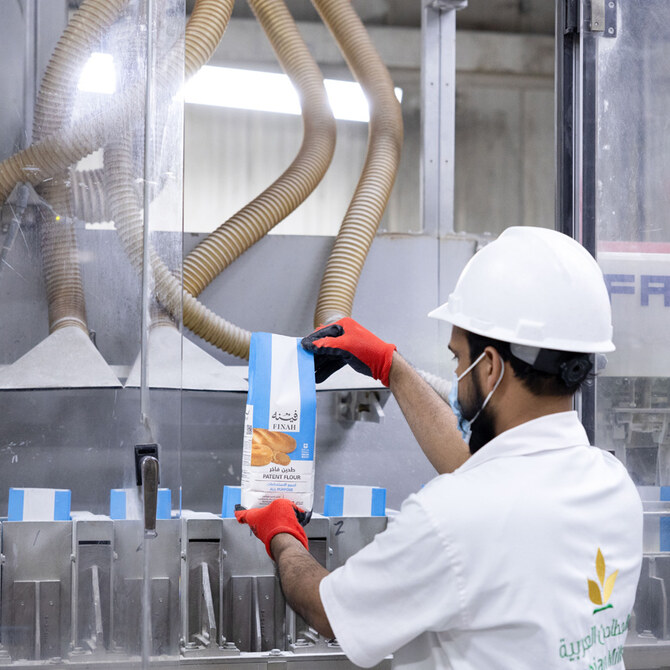

RIYADH: Saudi wheat flour producer Arabian Mills for Food Products Co. has set its final initial public offering price at SR66 ($17.59) per share on the Tadawul main market.
During the book-building process, the company received orders worth SR134.1 billion from local and international investment institutions for its IPO of approximately 30 percent of its shares on the Saudi Stock Exchange.
The offering comprises 15,394,502 offer shares.
The firm announced that the institutional offering was oversubscribed by about 132 times, leading to the offer price being set at the maximum of the range.
This indicates the company’s market capitalization upon listing would be SR3.387 billion.
As a result, the current stockholders will receive the net proceeds of the amount raised through the IPO, which is SR1.02 billion.
From this public offering, the shareholders selling their shares, including Abdulaziz Alajlan Sons for Commercial and Real Estate Investments, Sulaiman Abdulaziz Al-Rajhi International Co., and the National Agricultural Development Co., will collectively receive SR1.02 million.
Arabian Mills announced on Sept. 1 that the price range for the offering was set between SR62 and SR66 and appointed HSBC Saudi Arabia as the financial adviser, bookrunner, and lead manager for the institutional subscription, as well as the underwriter for the public offering.
“We feel that the demand, for the investors, this is the right time for any kind of an IPO. The macro-environment has been very favorable in general,” Rohit Chugh, CEO of Arabian Mills, told Arab News.
He added: “Secondly, as a company, we have seen about close to three years of privatization, which has given us an adequate amount of time to sort of reflect on our performance, which has been fantastic.”
This period has also allowed potential investors to review the company’s financial performance over the last two and a half years, giving them a complete view and boosting their confidence in the firm’s stability and prospects.
“Also, we have very good, strategic plans in place as far as future plans go, and now that we are very clear in terms of our vision, so if you take the past and the future, then it’s a very exciting time as far as we are concerned,” Chugh said.
He added: “In reality, the shareholders continue to remain invested. They’re very positive about the company, and that’s why they are just selling 30 percent of their shareholding to the new investors.”
Specifically, Alajlan Brothers will retain 35 percent, AlRajhi will keep about 25 percent, and NADEC will hold 10 percent, making up the 70 percent of shares that will remain with the existing investors.
“The 30 percent of the shareholding is what they have offered at a lucrative IPO price to the new investors because they feel that, with the growth plans, which we have in place for the future, they would like to invite new investors, to come and pitch in and be a part of this whole success story as we move,” the CEO said in the interview.
Expansion plans
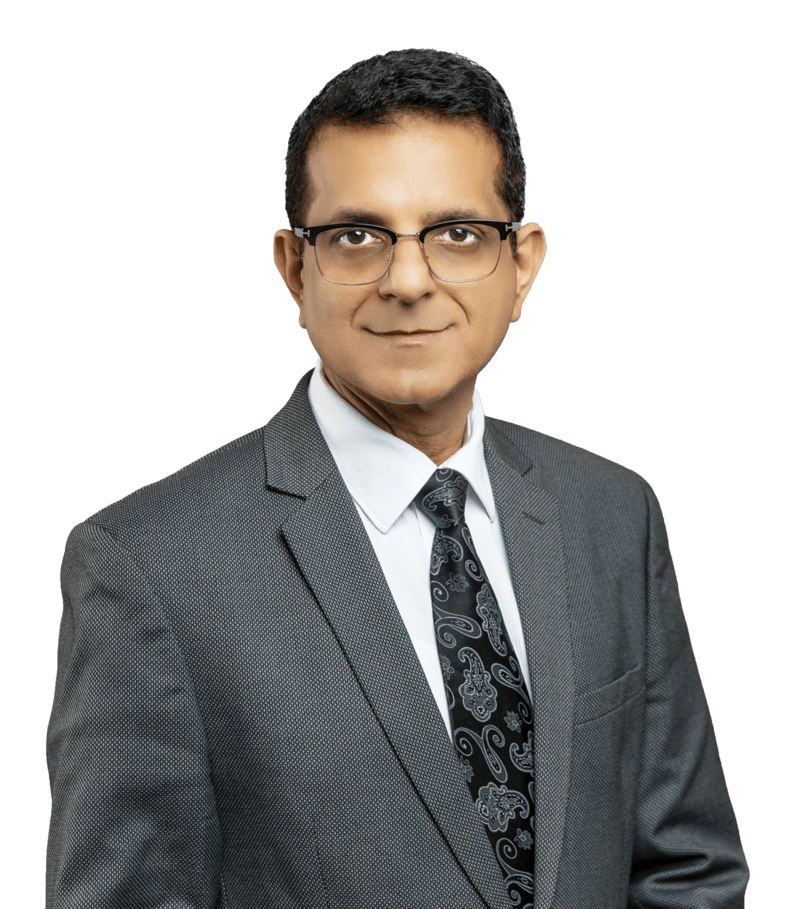
Rohit Chugh, CEO of Arabian Mills. Supplied
Chugh stated that the company is currently focused on expanding its presence in new regions within Saudi Arabia.
Although they are already well-established in the Kingdom’s central, northern, and southern parts, they recognize significant opportunities in other areas they haven’t yet explored.
“Therefore, we are planning to tap those growth opportunities in the western, eastern and the northern parts of the country by opening up distribution centers. West, for example, is where Makkah, Madinah is,” he said.
Chugh continued: “If you talk about the east, a lot of action is happening there as well. The Tabuk north side is where the NEOM projects will be coming up in the future, so we want to be a part of the growth journey, tapping all the right corners in Saudi Arabia.”
Currently, the company is not planning to expand into international markets because it is focused on selling wheat flour at subsidized prices through its arrangement with the General Food Security Authority. However, they are open to exploring export opportunities in the future.
Given their significant milling capacity and robust infrastructure in Saudi Arabia and the Gulf Cooperation Council, they are well-positioned to handle such opportunities if they arise.
For now, their focus remains on their existing operations, and any decision to expand internationally would depend on the conditions at that time.
IPO trajectory
The company’s CEO underlined that when setting the IPO price, the management aimed to ensure that investors would have the opportunity to make a profit.
When asked about his forecast or trajectory stock, Chugh said they could have set a higher price, but they chose a lower cost to attract new investors who would join them in the company’s growth journey.
The intention was to leave some potential for capital appreciation, as the management believes the firm’s true value is higher than the IPO price.
“That’s where we see that there should be a positive trajectory in the coming time. Obviously, this is subject to market conditions and global conditions,” he said.
Chugh added: “Nobody can predict that. But yes, we are optimistic as a company that we have priced it at the right pricing, like we got at SR66.”
He believes there are strong growth prospects in Saudi Arabia, driven by the country’s Vision 2030, which is set to have an impact well beyond its target year.
“Obviously, the next four, five years are critical for us, but we are even looking beyond that to the next 15, 20 years and seeing how we can take this organization to fulfill its maximum potential as part of the Vision 2030 and beyond,” Chugh said.


