

Pakistan confirms fifth case of mpox virus

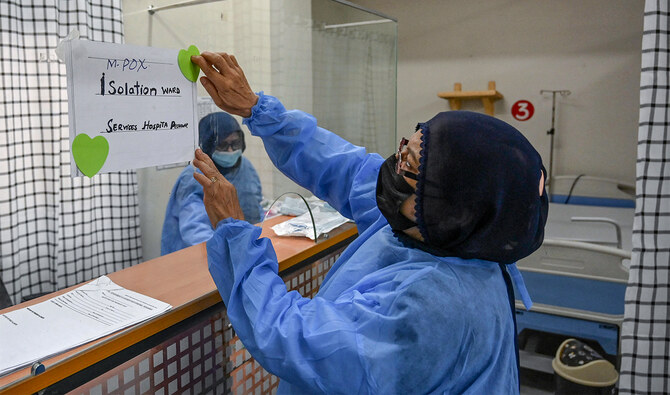
A health worker install a poster indicating an isolation ward prepared for mpox patients at the Police and Services hospital in Peshawar on August 20, 2024. (AFP/File)
Short Url
Updated 11 September 2024
Follow

Pakistan confirms fifth case of mpox virus

  • Patient hails from Lower Dir in northwest Pakistan and has history of traveling to Gulf countries
  • Health authorities had earlier declared Khyber Pakhtunkhwa province mpox free on September 8 

KARACHI: Pakistani health authorities confirmed a fifth case of the mpox virus in the country on Wednesday, identifying the patient as a resident of the northwestern district of Lower Dir who had been isolated at home after displaying symptoms of the disease and testing positively for it.

The World Health Organization has declared a global health emergency over the spread of a new mutated strain of mpox named clade I, which first emerged in the Democratic Republic of Congo and has since spread to several countries, leading to increased monitoring and preventive measures worldwide.

Since it confirmed its first mpox case last month, Pakistan has implemented stringent screening protocols at all airports and border entry points. 

“The fifth case of mpox reported in Pakistan,” the health ministry spokesperson in a statement said on Wednesday. “The citizen belongs to Lower Dir and has travel history from Gulf countries.”

The statement said the patient was referred for testing by the health department of the northwestern Khyber Pakhtunkhwa province based on symptoms he displayed during screening at the airport. He was now isolating at home, the ministry said. 

Dr. Mukhtar Bhart, the Prime Minister’s Coordinator for Health, said the federal ministry of health was working closely with provincial authorities to monitor new cases. 

Patients who contract mpox get flu-like symptoms and pus-filled lesions. Mpox is usually mild but can kill, and children, pregnant women and people with weakened immune systems are at higher risk of complications from the infection.

Earlier this week, health authorities had declared Pakistan’s KP province mpox-free after all four patients previously infected with the virus recovered.


Pakistan making diplomatic efforts to de-escalate Middle East tensions, FM says

Updated 4 sec ago
Follow

Pakistan making diplomatic efforts to de-escalate Middle East tensions, FM says

  • The statement came as Iran pressed on with a third day of strikes in the Gulf in response to US-Israeli air raids
  • Pakistan’s position is clear that all countries must abide by principles of UN Charter, international law, FM says

ISLAMABAD: Pakistan is making diplomatic efforts to de-escalate heightened tensions in the Middle East, Foreign Minister Ishaq Dar said on Monday, amid US-Israeli strikes on Iran and Tehran’s counterstrikes against US bases in Gulf countries.

Tensions escalated across the Middle East on Saturday after coordinated US-Israel strikes killed Supreme Leader Ali Khamenei among other senior Iranian officials. Tehran responded by targeting US military bases in the UAE, Bahrain, Qatar, Kuwait and Jordan. Saudi Arabia said Iran also launched attacks targeting Riyadh and the Eastern Province.

The Iranian missile and drone strikes continued on Monday in retaliation for the ongoing US-Israeli air raids, casting uncertainty over the future of the Islamic republic and heightening the risk of broader instability in the already volatile region.

Speaking at a press conference, FM Dar, who recently returned from Saudi Arabia where he attended an Organization of Islamic Cooperation OIC) meeting on Palestine, said Pakistan is very closely monitoring the evolving situation in Iran and the tensions which are building up in the region.

“These serious developments have taken place at a time when diplomatic efforts were underway to reach a peaceful and negotiated solution to [Iran nuclear program],” he said.

“We are making our full diplomatic efforts and, you know, requesting all parties to de-escalate and to refrain.”

Dar said Islamabad was concerned over a violation of the norms and international law, and the age-old tradition that the heads of state and the government should not be targeted.

“Post-World War II, we all know that these institutions were created to create some international, you know, law and order, and that’s why there was a UN Charter. There are certain conventions which we all are supposed to follow,” he said.

“But things are on ground moving very differently, which obviously is worrisome... The international law must prevail and the conventions must be respected.”

The statement came hours after the Ras Tanura oil refinery in Saudi Arabia sustained limited damage as a result of debris from the interception of two drones in its vicinity, the Saudi Press Agency reported, citing an official source at the Saudi Ministry of Energy.

Several American warplanes crashed in Kuwait on Monday morning but their crew survived, Kuwait’s defense ministry said, as Iran pressed on with a third day of strikes in the Gulf.

Dar said Pakistan’s position has been clear and persistent that all countries must abide by the principles of UN Charter and international law, including respect for the sovereignty and territorial integrity of other states as well as international humanitarian law.

“In my latest conversation with [Iranian] Foreign Minister Abbas Araqshi on 28th of February, I conveyed Pakistan’s condemnation of the attacks and called for restraint and diplomacy and dialogue, which he positively responded,” he shared.

“But on ground, we are seeing that things are not yet settling or easing out.”

Pakistan stands in full solidarity with all its brotherly countries and underscores the need to exercise maximum restraint, according to FM Dar.

“This is a message we have been giving to whosoever prime minister speaks, whosoever I speak, or whosoever Field Marshal Asim Munir speaks to, his counterparts on the defense side,” he said.