

Pakistan to launch Shariah-compliant certificates worth $178.6 million this month

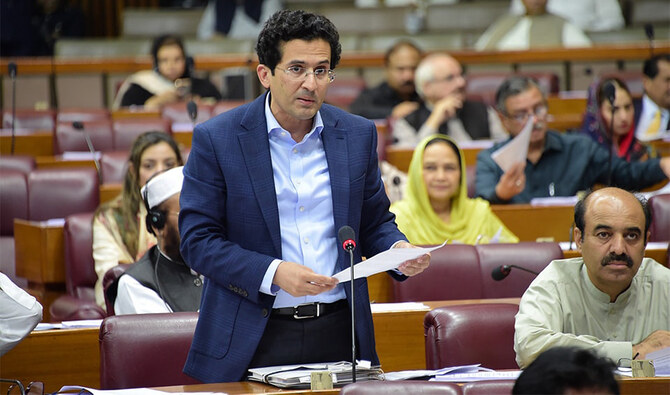
Pakistan’s State Minister for Finance Ali Pervaiz Malik speaks during a session of National Assembly in Islamabad, Pakistan on September 3, 2024. (Ali Pervaiz Malik/Facebook/File)
Short Url
Updated 11 September 2024
Follow

Pakistan to launch Shariah-compliant certificates worth $178.6 million this month

  • State minister highlights government’s commitment to promoting Islamic banking 
  • Central bank has set target to increase Pakistan’s Islamic banking share to 35% by 2025

ISLAMABAD: Pakistan’s State Minister for Finance Ali Pervaiz Malik said on Tuesday new Shariah-compliant certificates worth $178.6 million would be launched this month to facilitate lending activity under an interest-free system, state-run media reported.

A Shariah-compliant certificate is a document issued by the Federal Shariah Court verifying that a financial product or transaction conforms to Islamic principles and laws. Last year, the Securities and Exchange Commission of Pakistan (SECP) issued the first-ever Shariah-compliant certificate to two real estate investment trusts. In April, it also issued a license to the first Shariah-compliant brokerage house in Pakistan.

“In response to the Calling Attention Notice, Minister of State for Finance Ali Pervaiz Malik said new Shariah-compliant certificates worth $178.6 million will be launched this month,” Radio Pakistan said on Tuesday, as the minister briefed the National Assembly about the government’s “commitment to promoting Islamic banking” in the country. 

Earlier this week, Pak-Qatar Family Takaful Limited (PQFTL), a leading Pakistani Shariah-compliant family insurance provider, introduced an instant withdrawal facility for its customers, which would allow participants to withdraw partial funds in case of emergencies with ease and instant access through the company’s mobile app or its online portal. 

Last year, Pakistan’s central bank set a target to increase the share of Islamic banking in the country to 35% by 2025.

In 2021, the Federal Shariat Court, which determines whether Pakistani laws comply with Islamic law, directed the government to eliminate interest from the country’s banking system by 2027. 

At present, the share of Islamic banking in the overall commercial banking system in the country is 20%.

Pakistan has six full-fledged Islamic banks offering a wide range of products and the annual growth rate of Islamic banks’ assets and deposits has been 25% and 22% respectively over the last five years, according to central bank data.


At UNSC, Pakistan warns competition for critical minerals could fuel global conflict

Updated 54 min 58 sec ago
Follow

At UNSC, Pakistan warns competition for critical minerals could fuel global conflict

  • The demand for critical minerals has surged worldwide due to rapid expansion of electric vehicles, advanced electronics and clean energy technologies
  • Pakistan’s representative says all partnerships in critical minerals sector must be ‘cooperative and not exploitative’ and respect national ownership

ISLAMABAD: Ambassador Asim Iftikhar Ahmad, Pakistan’s permanent representative to the United Nations (UN), has warned that intensifying global competition over critical minerals could become a new driver of global conflict, urging stronger international cooperation and equitable access to resources vital for the world’s energy transition.

The warning comes as demand for critical minerals and rare earth elements surges worldwide due to the rapid expansion of electric vehicles, advanced electronics and clean energy technologies, with governments and companies increasingly competing to secure supply chains while raising concerns that this may lead to geopolitical rivalries in the coming years.

Speaking at a Security Council briefing on ‘Energy, Critical Minerals, and Security,’ Ahmad said experience showed that the risks of instability increased where mineral wealth intersected with weak governance, entrenched poverty and external interference.

“Access to affordable, reliable and sustainable energy is essential for development, stability and prosperity. The global transition toward renewable energy, electric mobility, battery storage and digital infrastructure has sharply increased the demand for critical minerals,” he said.

“This upsurge has generated new geopolitical and geo-economic pressures. If not managed responsibly, competition over natural resources can affect supply chains, aggravate tensions, undermine sovereignty and contribute to instability.”

In several conflict-affected settings, he noted, illicit extraction, trafficking networks and opaque financial flows have fueled armed conflict and violence, weakened state institutions and deprived populations of legitimate revenues.

“The scramble for natural resources and its linkage to conflict and instability is therefore not new,” Ahmad told UNSC members at the briefing. “Pakistan believes that natural resources must serve as instruments of economic development and shared prosperity, and not coercion or conflict.”

He urged the world to reaffirm the right of peoples to permanent sovereignty over their natural resources, saying all partnerships in the critical minerals sector must be cooperative and not exploitative, respect national ownership, ensure transparent contractual arrangements and align with host countries’ development strategies.

“In order to prevent the exploitation of mineral-producing countries and regions, particularly in fragile and conflict-affected settings, support their capacity-building for strengthening domestic regulatory institutions, combating illicit financial flows, ensuring environmental safeguards, and promoting equitable benefit-sharing with local communities,” he asked member states.

“Promote equitable participation in global value chains. Developing countries must be enabled to move beyond extraction toward processing, refining and downstream manufacturing. Technology transfer, skills development and responsible investment are essential to avoid perpetuating structural imbalances.”