

Pakistani police free leader of former premier Khan’s opposition party

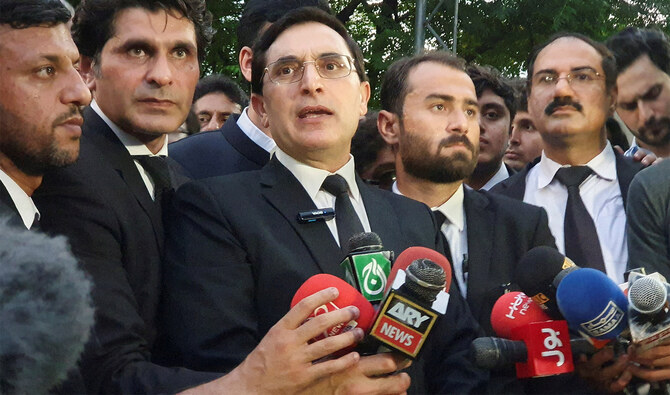
Gohar Khan, Chairman of jailed former Pakistani Prime Minister Imran Khan's party, the Pakistan Tehreek-e-Insaf (PTI), who along with other party leaders was detained by police, addresses the media outside the Anti Terrorism Court (ATC), following his release in Islamabad, Pakistan on September 10, 2024. (REUTERS)
Short Url
Updated 11 September 2024
Follow

Pakistani police free leader of former premier Khan’s opposition party

  • Gohar Khan was arrested along with several other PTI leaders on Monday night 
  • PTI spokesperson says 12 other leaders of the party remain in police custody 

ISLAMABAD: Pakistani police on Tuesday freed the chairman of the opposition party of former Prime Minister Imran Khan, a day after he was detained outside parliament on a charge of allegedly inciting violence, his party said.

Islamabad police in a statement confirmed the release of Gohar Khan, who is not related to the former premier. He was arrested along with several other leaders of the Pakistan Tehreek-e-Insaf party as they demanded Imran Khan’s release from prison.

After his release, Khan, who is also a lawmaker, called the arrests an attack on parliament. He asked the National Assembly speaker to investigate.

Party spokesperson Zulfi Bukhari said 12 others were still in police custody.

PTI’s top leadership denounced the arrests, vowing their campaign would continue until the former premier Khan’s release.

The former prime minister was imprisoned last year after his conviction in a graft case. He remains a popular figure despite his ouster in a no-confidence vote in 2022.


Pakistan, ADB ink $61.8 million agreements for three development projects

Updated 4 sec ago
Follow

Pakistan, ADB ink $61.8 million agreements for three development projects

  • Agreements pertain to the upgradation of ML-1 railway link, key bus project in Quetta and water sector development in Balochistan
  • Pakistani official says projects will “significantly contribute” to long-term, sustainable economic growth, address infrastructure needs

ISLAMABAD: Pakistan and the Asian Development Bank (ADB) on Friday signed agreements for three major development initiatives worth $61.8 million to boost connectivity, urban transport and water sector in various parts of the country, state-run media reported. 

The two side signed agreements relating to project readiness financing for the Karachi-Rohri Section of the Main Line-I, a critical link needed to transport copper and gold from the Reko Diq mine in southwestern Pakistan to export hubs, for $10 million. 

Another project readiness financing agreement was signed for a bus rapid transit project in the southwestern city of Quetta worth $3.8 million. The last agreement pertained to additional financing for the Balochistan Water Resources Development Sector Project, which amounts to $48 million. 

“The secretary, Ministry of Economic Affairs, expressed appreciation for ADB’s role as a trusted development partner, and its continued support to Pakistan to complement the development agenda of the country,” the state-run Associated Press of Pakistan (APP) said. 

He said the critical projects would “significantly contribute” to Pakistan’s long-term and sustainable economic growth, address urban infrastructure needs of the provincial capital of Quetta, and enhance agricultural productivity in Balochistan.

ADB’s Country Director for Pakistan Emma Fan appreciated Pakistan’s commitment toward development initiatives. 

“She also reaffirmed ADB’s continued commitment to working closely with the Ministry of Economic Affairs and other stakeholders to ensure its support remains aligned with Pakistan’s development priorities,” APP said. 

ADB has undertaken initiatives to support Pakistan’s economic recovery by strengthening its public finances, social protection systems and helping Islamabad with its post-flood reconstruction efforts. 

The bank says it has committed 764 public sector loans, grants, and technical assistance to the South Asian country totaling $43.4 billion to date.