Rapid advancement in AI requires comprehensive reevaluation, careful use, say panelists at GAIN Summit

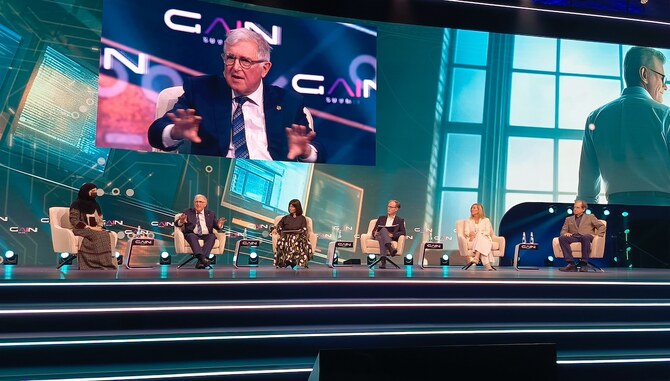
Panelists at GAIN Summit discuss the transformative impact of AI on education. (Supplied)
Short Url
Updated 10 September 2024
Follow

Rapid advancement in AI requires comprehensive reevaluation, careful use, say panelists at GAIN Summit

  • KAUST’s president speaks of ‘amazing young talents’ 

RIYADH: The rapid advancement in artificial intelligence requires a comprehensive reevaluation of traditional educational practices and methodologies and careful use of the technology, said panelists at the Global AI Summit, also known as GAIN, which opened in Riyadh on Tuesday.

During the session “Paper Overdue: Rethinking Schooling for Gen AI,” the panelists delved into the transformative impact of AI on education — from automated essay generation to personalized learning algorithms — and encouraged a rethink of the essence of teaching and learning, speaking of the necessity of an education system that seamlessly integrated with AI advancement.

Edward Byrne, president of King Abdullah University of Science and Technology, said the next decade would be interesting with advanced AI enterprises.

He added: “We now have a program to individualize assessment and, as a result, we have amazing young talents. AI will revolutionize the education system.”

Byrne, however, advised proceeding with caution, advocating the need for a “carefully designed AI system” while stressing the “careful use” of AI for “assessment.”

Alain Le Couedic, senior partner at venture firm Artificial Intelligence Quartermaster, echoed the sentiment, saying: “AI should be used carefully in learning and assessment. It’s good when fairly used to gain knowledge and skills.”

Whether at school or university, students were embracing AI, said David Yarowsky, professor of computer science at Johns Hopkins University.

He added: “So, careful use is important as it’s important to enhance skills and not just use AI to leave traditional methods and be less productive. It (AI) should ensure comprehensive evaluation and fair assessment.”

Manal Abdullah Alohali, dean of the College of Computer and Information Science at Princess Nourah bint Abdulrahman University, underlined that AI was a necessity and not a luxury. 

She said the university had recently introduced programs to leverage AI and was planning to launch a “massive AI program next year.”

She explained that the university encouraged its students to “use AI in an ethical way” and “critically examine themselves” while doing so.

In another session, titled “Elevating Spiritual Intelligence and Personal Well-being,” Deepak Chopra, founder of the Chopra Foundation and Chopra Global, explored how AI could revolutionize well-being and open new horizons for personal development.

He said AI had the potential to help create a more peaceful, just, sustainable, healthy, and joyful world as it could provide teachings from different schools of thought and stimulate ethical and moral values.

While AI could not duplicate human intelligence, it could vastly enhance personal and spiritual growth and intelligence through technologies such as augmented reality, virtual reality, and the metaverse, he added.

The GAIN Summit, which is organized by the Saudi Data and AI Authority, is taking place until Sept. 12 at the King Abdulaziz International Conference Center, under the patronage of Crown Prince Mohammed bin Salman.

The summit is focusing on one of today’s most pressing global issues — AI technology — and aims to find solutions that maximize the potential of these transformative technologies for the benefit of humanity.


Gems of Arabia magazine launched to spotlight talents shaping Saudi Arabia’s evolving cultural landscape

Updated 15 January 2026
Follow

Gems of Arabia magazine launched to spotlight talents shaping Saudi Arabia’s evolving cultural landscape

  • The publication features established and emerging talents elevating the region across design, fashion, art, tech, music, architecture and media
  • Saudi fashion designer Hatem Alakeel seeks to highlight the richness of the Kingdom, and wider modern Arab culture to global audiences

DUBAI: When Saudi fashion designer Hatem Alakeel interviewed Princess Reema bint Bandar Al-Saud before her appointment as Saudi ambassador to the US, the longtime advocate of women’s empowerment made a powerful prediction: “I look forward to the day that the Saudi woman is no longer the story but rather a phenomenal achievement.”

That moment would become the foundation for Gems of Arabia, an arts and culture audio-visual podcast that spotlights the creative talents shaping the landscape of Saudi Arabia and the broader region.

Over six years, Gems of Arabia has documented the sweeping transformation of the Kingdom’s art and culture scene, and is now evolving into a full-fledged magazine.

Hatem Alakeel is a Saudi fashion designer. (Supplied)

“It started off as a column I used to write, and from there, it turned into a podcast. Now it is growing into a magazine,” Dubai-based Alakeel, the magazine’s founder and editor-in-chief, told Arab News ahead of the launch of the digital publication on Thursday.

Besides spotlighting celebrated regional artists, Alakeel said Gems of Arabia is in search of the “hidden gems” elevating the region across design, fashion, art, tech, music, architecture and media.

The magazine serves as a platform for talented, authentic creatives and tech entrepreneurs unable to articulate their work “because they don’t have the public relations or capacity to promote themselves even through social media.”

Alakeel added: “Our job is to identify all these authentic people; you don’t have to be famous, you just have to be authentic, and have a great story to tell.”

The digital publication offers a dynamic blend of short-form podcasts, coverage of regional cultural events, in-depth features and editorials, long-form interviews and artist profiles — spotlighting both celebrated and emerging talents. This is complemented by social media vox pops and bite-sized coverage of art events across the region.

Alakeel, who also runs Authenticite, a consulting and creative production agency connecting creators and brands who want to understand Saudi culture, said the magazine content is “carefully curated” to feature topics and personalities that resonate in the region.

What differentiates Gems of Arabia, he said, is its story of continuity and substance amassed over the years that has captured the evolution of the wider regional landscape.

“The website represents an archive of nearly 150 articles compiled through years of podcasts and long-form conversations that show continuity and depth changes,” he said.

“So, it’s an evolution and it’s another home for all our content and our community.”

Growing up in France, Alakeel said his mission started early on when he felt the need to represent his Saudi culture “in a way where it can hold its own internationally.”

Through his first brand, Toby, he sought to bring the traditional thobe into modern designs and introduce it to the luxury fashion world. This mission was accomplished when his thobe designs were placed alongside global labels such as Harvey Nichols, Dolce & Gabbana and Prada.

What began as a personal design mission would soon expand into a broader platform to champion Saudi talent. 

“I was articulating my culture through fashion and it just felt natural to do that through the incredible people that the region has,” Alakeel said, adding that the magazine aims to highlight the richness of the Kingdom, and wider modern Arab culture to global audiences.

“Art is such a great way of learning about a culture and a country,” he said. 

On the ground in Saudi Arabia, the publication hosts GEMS Forum, a series of live cultural gatherings that bring together prominent artistic figures for in-depth conversations later transformed into podcast episodes recorded with a live audience.

Alakeel said the print edition of Gems of Arabia will debut in March, designed as a collectible coffee-table quarterly distributed across the Gulf.

He envisions the platform growing into a long-term cultural record.

“It's a Saudi-centric magazine, but the idea is to make it inclusive to the region and everyone authentic has a seat at the table,” said Alakeel.