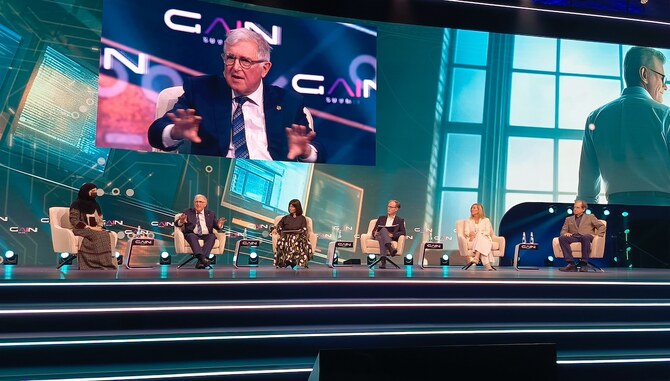

RIYADH: The rapid advancement in artificial intelligence requires a comprehensive reevaluation of traditional educational practices and methodologies and careful use of the technology, said panelists at the Global AI Summit, also known as GAIN, which opened in Riyadh on Tuesday.
During the session “Paper Overdue: Rethinking Schooling for Gen AI,” the panelists delved into the transformative impact of AI on education — from automated essay generation to personalized learning algorithms — and encouraged a rethink of the essence of teaching and learning, speaking of the necessity of an education system that seamlessly integrated with AI advancement.
Edward Byrne, president of King Abdullah University of Science and Technology, said the next decade would be interesting with advanced AI enterprises.
He added: “We now have a program to individualize assessment and, as a result, we have amazing young talents. AI will revolutionize the education system.”
Byrne, however, advised proceeding with caution, advocating the need for a “carefully designed AI system” while stressing the “careful use” of AI for “assessment.”
Alain Le Couedic, senior partner at venture firm Artificial Intelligence Quartermaster, echoed the sentiment, saying: “AI should be used carefully in learning and assessment. It’s good when fairly used to gain knowledge and skills.”
Whether at school or university, students were embracing AI, said David Yarowsky, professor of computer science at Johns Hopkins University.
He added: “So, careful use is important as it’s important to enhance skills and not just use AI to leave traditional methods and be less productive. It (AI) should ensure comprehensive evaluation and fair assessment.”
Manal Abdullah Alohali, dean of the College of Computer and Information Science at Princess Nourah bint Abdulrahman University, underlined that AI was a necessity and not a luxury.
She said the university had recently introduced programs to leverage AI and was planning to launch a “massive AI program next year.”
She explained that the university encouraged its students to “use AI in an ethical way” and “critically examine themselves” while doing so.
In another session, titled “Elevating Spiritual Intelligence and Personal Well-being,” Deepak Chopra, founder of the Chopra Foundation and Chopra Global, explored how AI could revolutionize well-being and open new horizons for personal development.
He said AI had the potential to help create a more peaceful, just, sustainable, healthy, and joyful world as it could provide teachings from different schools of thought and stimulate ethical and moral values.
While AI could not duplicate human intelligence, it could vastly enhance personal and spiritual growth and intelligence through technologies such as augmented reality, virtual reality, and the metaverse, he added.
The GAIN Summit, which is organized by the Saudi Data and AI Authority, is taking place until Sept. 12 at the King Abdulaziz International Conference Center, under the patronage of Crown Prince Mohammed bin Salman.
The summit is focusing on one of today’s most pressing global issues — AI technology — and aims to find solutions that maximize the potential of these transformative technologies for the benefit of humanity.