Third edition of Global AI Summit launches in Riyadh 

1 / 4
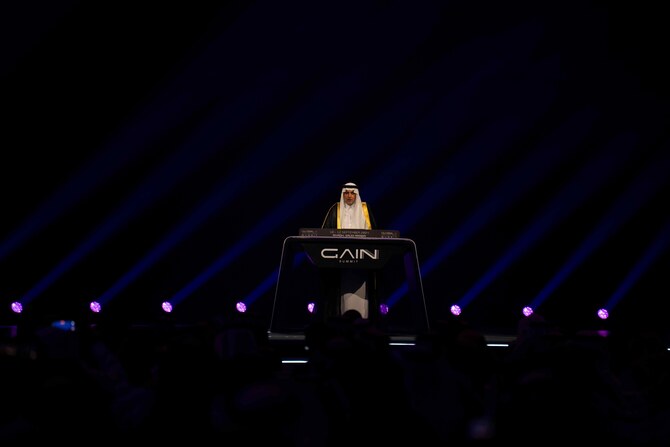
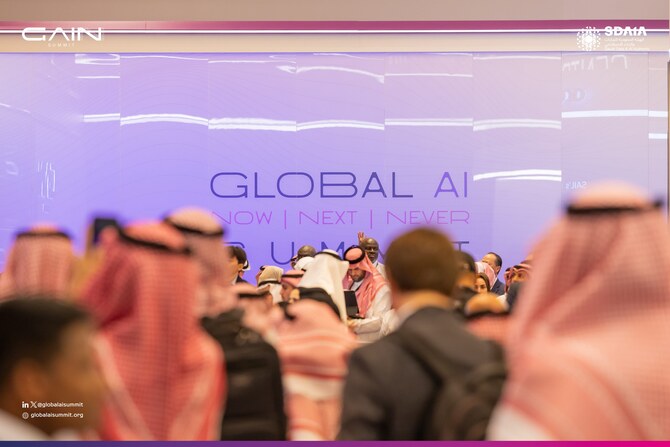
After an opening ceremony featuring silver-clad dancers twirling neon lights, SDAIA President Abdullah bin Sharaf Al-Ghamdi delivered the opening speech. (AN/File)
2 / 4
After an opening ceremony featuring silver-clad dancers twirling neon lights, SDAIA President Abdullah bin Sharaf Al-Ghamdi delivered the opening speech. (AN/File)
3 / 4
After an opening ceremony featuring silver-clad dancers twirling neon lights, SDAIA President Abdullah bin Sharaf Al-Ghamdi delivered the opening speech. (AN/File)
4 / 4
After an opening ceremony featuring silver-clad dancers twirling neon lights, SDAIA President Abdullah bin Sharaf Al-Ghamdi delivered the opening speech. (GAIN/File)
Short Url
Updated 10 September 2024
Follow

Third edition of Global AI Summit launches in Riyadh 

  • Summit runs until Sept. 12 at the King Abdulaziz Convention Center
  • Event is expected to host more than 400 speakers in 150 sessions, with more than 20,000 people set to attend in person and an estimated 25 million participating online

RIYADH: The third edition of the Global AI Summit, also known as GAIN, brought together business leaders, high-ranking officials, and top academics from more than 100 countries on its opening day on Tuesday.

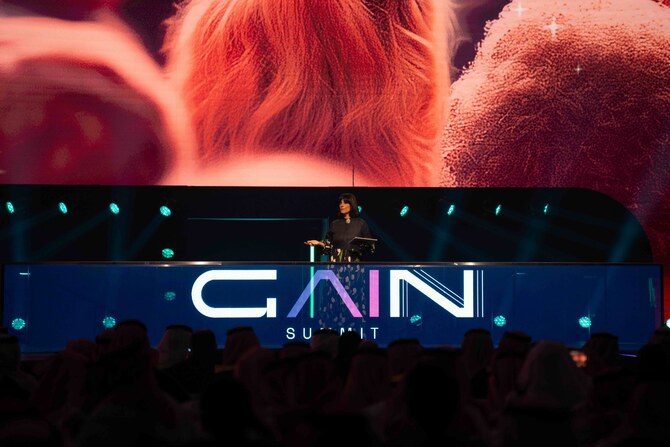
After an opening ceremony featuring silver-clad dancers twirling neon lights, and a rendition of John Lennon’s “Imagine,” the Saudi Data and Artificial Intelligence Authority’s President Abdullah bin Sharaf Al-Ghamdi delivered the opening speech.

“Let’s think about human-centered artificial intelligence … Despite the challenges, I remain optimistic. The solution is unity. We can navigate the AI-driven world through collaboration,” he said. 

“Today, we celebrate ALLaM, a pioneering Arabic large language model proudly developed here in the Kingdom of Saudi Arabia.”

The SDAIA’s president also highlighted the progress of the SauTech Arabic speech-to-text tool that was unveiled at the previous edition of the summit in 2022.  

Since then, SauTech has been utilized by the Saudi Ministry of Justice to transcribe thousands of hours of virtual court hearings.  

Minister of Communications and Information Technology Abdullah Al-Swaha chaired the first panel of the conference entitled “Empowering Society Through AI-Driven Technology.”

He highlighted partnerships between Aramco, Qualcomm, and Alat Technologies to develop new AI solutions in the Kingdom.  

Other major announcements from the first day included the SDAIA’s partnership with UNESCO to launch the International Center for AI Research and Ethics.

The ICAIRE intends to boost awareness of ethics in AI, support research and development, and provide recommendations on AI policies.

Aramco announced the deployment of an AI supercomputer designed to accelerate complex tasks like analyzing drilling plans and geological data in order to recommend the most efficient oil well placement options.

The oil company also signed further memorandums of understanding with Cerebras Systems, SambaNova Systems, and FuriosaAI to explore collaboration in supercomputing, neural processing, and innovation in Saudi Arabia.

The SDAIA also announced a new smart gate system at NEOM Bay Airport, in partnership with the Ministry of Interior and the General Directorate of Passports.  

The system aims to use AI technology to improve the efficiency of immigration services at the airport.

Saudi Arabia’s Ministry of Tourism signed an agreement with the SDAIA to establish a center of excellence for AI in tourism, and to promote the development of AI technologies in the sector.  

Another memorandum of understanding was signed with Qassim University to train national cadres in data and AI.  

The General Presidency of the Commission for Promotion of Virtue and Prevention of Vice signed an agreement with the SDAIA to collaborate over IT and data management.

This year’s edition of GAIN runs until Sept. 12 at the King Abdulaziz Convention Center. 

The three-day summit is expected to host more than 400 speakers in 150 sessions, with more than 20,000 people set to attend in person and an estimated 25 million participating online.

Israel arrests 2 Turkish CNN journalists over live broadcast outside IDF HQ

Updated 03 March 2026
Follow

Israel arrests 2 Turkish CNN journalists over live broadcast outside IDF HQ

  • Police said reporter Emrah Cakmak and cameraman Halil Kahraman were detained on suspicion of filming a sensitive security facility
  • Since the Gaza war began, restrictions have expanded significantly, including tighter limits on filming soldiers on duty and sensitive or strategic sites

LONDON: Israeli police have arrested two Turkish CNN journalists who were broadcasting live outside the Israel Defense Forces’ headquarters in Tel Aviv.

Police said the pair were detained on suspicion of filming a sensitive security facility, according to the Israel Police Spokesperson’s Unit.

Reporter Emrah Cakmak and cameraman Halil Kahraman, from the network’s Turkish-language channel, had been reporting near the IDF’s Kirya military headquarters on Tuesday after Iran launched another missile barrage at Tel Aviv and other parts of central Israel.

During the live broadcast, two men believed to be soldiers approached the crew and seized the reporter’s phone, according to initial reports and a video circulating online that could not be independently verified.

Police said officers were dispatched after receiving reports of two people carrying cameras and allegedly broadcasting in real time for a foreign outlet.

Israel’s long-standing military censorship system, overseen by the IDF Military Censor, has long barred journalists and civilians from publishing material deemed harmful to national security.

Since the Gaza war began, restrictions have expanded significantly, including tighter limits on filming soldiers on duty and sensitive or strategic sites.

After a series of similar incidents involving foreign media — most of them Palestinian citizens of Israel working for Arab-language and international media, along with foreign journalists — during the 12-Day War, Israeli police halted live international broadcasts from missile impact sites, citing concerns that exact locations were being revealed.

The Government Press Office later imposed a blanket ban on live coverage from crash and impact areas.

Communications Minister Shlomo Karhi and National Security Minister Itamar Ben-Gvir subsequently ordered that all foreign journalists obtain prior written approval from the military censor before broadcasting — live or recorded — from combat zones or missile strike locations.

Police said that when officers asked the CNN Turk crew to identify themselves, they presented expired press cards and were taken in for questioning.

Burhanettin Duran, head of Turkiye’s Directorate of Communications, condemned the arrests as an attack on the press and said Ankara is working to secure the journalists’ release.