

Iran condemns Western sanctions over missiles transfer to Russia

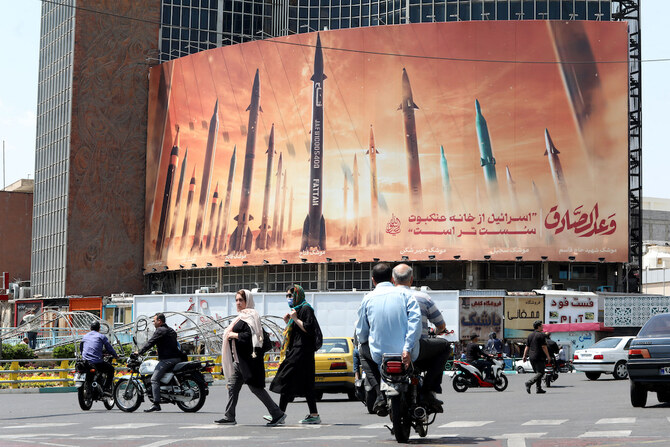
Above, motorists drive their vehicles past a billboard depicting Iranian missiles in Tehran on April 20, 2024. Tehran has condemned additional sanctions for supposed Iran’s recent transfer of missiles to Russia. (AFP file photo)
Short Url
Updated 11 September 2024
Follow

Iran condemns Western sanctions over missiles transfer to Russia

  • “Taking immediate steps to cancel bilateral air services agreements with Iran,” UK, France, Germany said
  • London, Paris and Berlin: “We now have confirmation Iran made these transfers”

DUBAI: Iran's foreign ministry condemned on Tuesday the decision to cancel bilateral air services agreements by France, Germany, and the United Kingdom meant to sanction Tehran for what they said was its recent transfer of missiles to Russia.

Germany, France and Britain on Tuesday condemned what they said was Iran’s delivery of ballistic missiles to Russia for use in the Ukraine war and declared new sanctions targeting air transport.

“We will be taking immediate steps to cancel bilateral air services agreements with Iran,” they said in a joint statement, adding that they would also “work toward imposing sanctions on Iran Air.”

US Secretary of State Antony Blinken had said earlier, on a visit to London, that Russia had received shipments of the ballistic missiles and “will likely use them within weeks in Ukraine.”

London, Paris and Berlin said that “we now have confirmation that Iran has made these transfers.”

“This is a further escalation of Iran’s military support to Russia’s war of aggression against Ukraine and will see Iranian missiles reaching European soil, increasing the suffering of the Ukrainian people,” they said.

“This act is an escalation by both Iran and Russia, and is a direct threat to European security.”


Germany, France and Britain on Tuesday condemned what they said was Iran's delivery of ballistic missiles to Russia for use in the Ukraine war and declared new sanctions targeting air transport. (AP/File)

The three countries said they “will be taking immediate steps to cancel bilateral air services agreements with Iran.”

“In addition, we will pursue the designations of significant entities and individuals involved with Iran’s ballistic missile program and the transfer of ballistic missiles and other weapons to Russia.

“We will also work toward imposing sanctions on Iran Air,” they said, echoing a step also taken by Washington.

Blinken said Washington had privately warned Iran that providing ballistic missiles to Russia would be “a dramatic escalation” and said new sanctions would be imposed later on Tuesday.

The US later identified nine Russian-flagged vessels it said were involved in the delivery of weapons from Iran to Russia, designating them as “blocked property” under Washington’s sanctions regime, according to the Treasury Department’s website.

It also imposed additional measures on previously sanctioned airline Iran Air, the department said in a statement.

Blinken said Iran has trained dozens of Russian military personnel to use its Fath-360 close-range ballistic missile system, which has a maximum range of 75 miles (121 km).

The UK also said on Tuesday it had started terminating “all direct air services between the UK and Iran” as part of the new sanctions.

London said it was acting alongside international partners to “cancel its bilateral air services arrangements with Iran,” which would “restrict Iran Air’s ability to fly in to the UK.”

Iran Air operates direct flights between London and Tehran three days a week, according to the schedule listed on its website.

* with AFP and Reuters


Colombia’s ELN guerrillas place communities in lockdown citing Trump ‘intervention’ threats

Updated 2 sec ago
Follow

Colombia’s ELN guerrillas place communities in lockdown citing Trump ‘intervention’ threats

BOGOTA: Colombia’s National Liberation Army (ELN) guerrilla group ordered civilians in areas under its control on Friday to stay home for three days as it carries out military exercises in response to “intervention” threats from US President Donald Trump.
The ELN, the oldest surviving guerrilla group in the Americas, controls key drug-producing regions of Colombia and vowed Friday to fight for the country’s “defense” in the face of Trump’s “threats of imperialist intervention.”
Amid a major US pressure campaign against Venezuela, which many view as an attempt to push out strongman Nicolas Maduro, Trump on Wednesday warned that Colombia’s leftist President Gustavo Petro could “be next” over his country’s mass cocaine production.
“He’s going to have himself some big problems if he doesn’t wise up. Colombia is producing a lot of drugs,” Trump told reporters, when asked if he expected to speak with frequent foe Petro.
“He better wise up, or he’ll be next...I hope he’s listening.”
The ELN urged civilians in areas it controls to stay indoors for 72 hours starting at 6:00 am on Sunday, avoiding main roads and rivers.
“It is necessary for civilians not to mix with fighters to avoid accidents,” the group said in a statement.
Petro criticized the move on social media, saying one “doesn’t protest against anyone by killing peasants and taking away their freedom.”
“You, gentlemen of the ELN, are declaring an armed strike not against Trump, but in favor of the drug traffickers who control you,” he wrote on X.
Colombian Defense Minister Pedro Sanchez dismissed the ELN move as “nothing more than criminal coercion” and vowed the military “will be everywhere — in every mountain, every jungle, every river” to counter its threat.
With a force of about 5,800 combatants, the ELN is present in over a fifth of Colombia’s 1,100-plus municipalities, according to the Insight Crime research center.
The ELN has also taken part in failed peace negotiations with Colombia’s last five governments.
While claiming to be driven by leftist, nationalist ideology, the ELN is deeply rooted in the drug trade and has become one of the region’s most powerful organized crime groups.
It vies for territory and control of lucrative coca plantations and trafficking routes with dissident fighters that refused to lay down arms when the FARC guerrilla army disarmed under a 2016 peace deal.
One ELN stronghold is the Catatumbo region near the Venezuelan border — one of the areas with the most coca crops in the world.
Colombia is the world’s top cocaine producer, according to the UN.

- Souring ties -

Historically strong relations between Bogota and Washington have deeply soured since Trump’s return to office.
Petro, who came to power in 2022 as Colombia’s first-ever leftist president, has openly clashed with Trump calling him “rude and ignorant” and comparing him to Adolf Hitler.
The Colombian leader denounced the Trump administration’s treatment of migrants and what he has termed the “extrajudicial executions” of nearly 90 people in strikes on boats in the Caribbean and Pacific the US claims, without providing evidence, were ferrying drugs.
Petro has also criticized Washington’s military deployment within striking distance of Venezuela, where Maduro fears he is the target of a regime-change plot under the guise of an anti-drug operation.
Washington, in turn, has accused Petro of drug trafficking and imposed sanctions.
Trump removed Bogota from a list of allies in the fight against narco trafficking, but the country has so far escaped harsher punishment.