

Mubadala Abu Dhabi Open set for third edition in early 2025

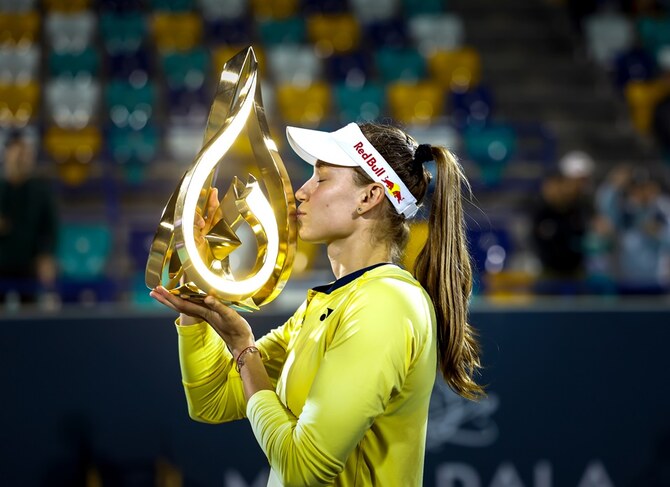
Elena Rybakina was the winner of the 2024 Mubadala Abu Dhabi Open, the second edition of the tournament. (Supplied)
Short Url
Updated 10 September 2024
Follow

Mubadala Abu Dhabi Open set for third edition in early 2025

  • 28 singles players and 16 doubles pairs will come together for 8 days of tennis action in the UAE capital

ABU DHABI: The Mubadala Abu Dhabi Open is set to return for the third time in 2025 after its successful second edition earlier this year.

The Women’s Tennis Association and International Management Group have announced that the tournament will take center stage at the International Tennis Centre, Zayed Sports City, from Feb. 1-8.

Secretary-General of Abu Dhabi Sports Council, Aref Hamad Al Awani, said: “We continue to steadily build on the success of this prestigious championship, following the excellence demonstrated in the past two editions.

“The championship highlights our commitment to hosting world-class events in Abu Dhabi, the global sports capital, backed by the confidence of official sports federations and organizations, as well as the exceptional infrastructure that positions Abu Dhabi as a premier global destination, attracting top sports stars from around the world.”

The Mubadala Abu Dhabi Open has quickly established itself as one of the highest-profile tournaments in women’s tennis, with strong line-ups competing for valuable ranking points.

With 28 singles players and 16 top doubles teams, the third edition aims to build on the success of this year’s event, where former Grand Slam champion and World No. 4 Elena Rybakina clinched the singles title and Bethanie Mattek-Sands and Sofia Kenin triumphed in the doubles.

Homaid Al-Shimmari, deputy group CEO and chief corporate and human capital officer for Mubadala Investment Company, said: “The third edition of the Mubadala Abu Dhabi Open promises to be the best yet, offering an unparalleled experience that celebrates world-class tennis. Our commitment to this event highlights our dedication to supporting women’s professional tennis, enhancing Abu Dhabi’s global presence, and fostering engagement through world-class sporting experiences.”

Women’s Tennis Association CEO Portia Archer added: “We’re excited to welcome the Mubadala Abu Dhabi Open back for the 2025 season after an impressive second edition featuring eight of the world’s top 20 players. The tournament’s exceptional organization and passionate fan base make it a favorite among WTA players.”


Most women’s national team players earn less than $20,000, FIFPRO study shows

Updated 9 sec ago
Follow

Most women’s national team players earn less than $20,000, FIFPRO study shows

  • Some 66 percent of players earn below $20,000 annually from football
  • Nearly one-third of respondents reported earning between $0 and $4,999 from football

MANCHESTER: Two-thirds of women’s national team players earn less than $20,000 annually, according to a new FIFPRO survey that highlights persistent financial insecurity and structural gaps in the women’s game.
The global players union and affiliated national players unions surveyed 407 footballers from 41 nations who participated in the UEFA Women’s Euros, Copa America Femenina, the Women’s Africa Cup of Nations and the OFC Women’s Nations Cup.
Some 66 percent of players earn below $20,000 annually from football and nearly one-third of respondents reported earning between $0 and $4,999 from football, while only a small minority reached higher income brackets.
Professional clubs remain the main source of income, followed by national team payments, yet one in four players still rely on jobs outside football to make ends meet.
“Financial stability is a cornerstone of any career,” said FIFPRO’s Director of Women’s Football Alex Culvin. “The data is very clear: most players are earning insufficient income to ensure secure careers within the game.
“It is a risk to the sustainability of the sport because players will be inclined to leave football early to make ends meet.”
The survey, conducted between August and October, also revealed short-term contracts remain common: 33 percent of players were signed for one year or less, and 22 percent had no contract at all.
International competition schedules continue to strain players, with 58 percent saying pre-match rest was inadequate and 57 percent reporting insufficient recovery after games.
Travel conditions are also an issue, with three-quarters of players flying economy class during tournaments, with only 11 percent in premium economy or business.
While FIFPRO noted improvements since their 2022 survey – including increased prize money and a player-dedicated share at the Women’s Euros – similar reforms have not been replicated across other confederations.
Culvin said stakeholders must “continue to raise standards to support the increased professionalization of the women’s game.”