



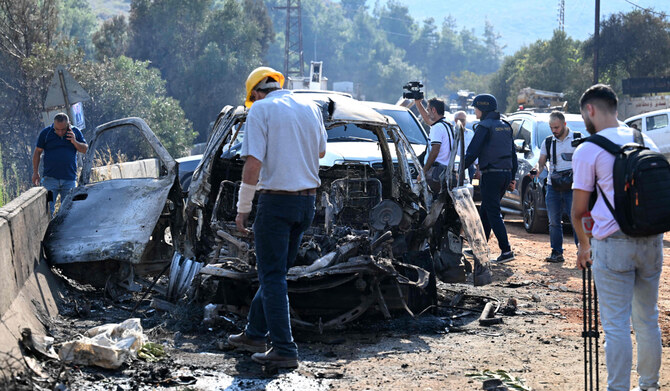
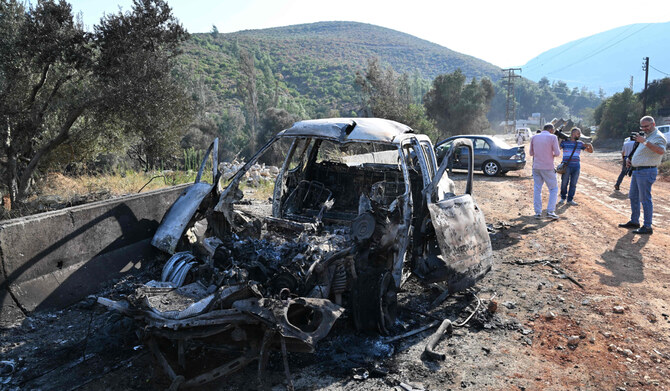

MASYAF, Syria: Near the usually quiet Syrian town of Masyaf smoke was still billowing from trees while burnt-out cars stood nearby, a day after authorities reported deadly Israeli strikes on military sites.
Syrian health minister Hassan Al-Ghabash told AFP the overnight “Israeli aggression” killed 18 people and wounded 37 others, during a media tour organized by the authorities.
At the entrance to the mountainous town, about 220 kilometers (135 miles) north of the capital Damascus, a partially burned sign read “Masyaf.”
Fire-damaged cars were visible on both sides of the road, with nearby trees still burning and electric cables damaged and tangled, reported an AFP correspondent at the scene.
The raids also blew five large craters in the main road to Masyaf, the correspondent said.
Ambulances were still moving around the area, where one car had been burnt down to its metal frame and a yellow bulldozer was flipped upside down.
Mohammed Akkari, 47, who lives near the site of the strikes with his wife and two children, said they were gripped by fear when their house shook near midnight.
“We had never heard such a sound, a terrifying explosion, my children were terrified,” he told AFP.
At the Masyaf hospital, firefighter Mohammed Shmeil, 36, was being treated for his injured leg and foot.
“What we saw during that incident was something else,” he said, wincing in pain.
The Syrian Observatory for Human Rights war monitor said 26 people were killed in what its chief Rami Abdel Rahman said was “one of the most violent Israeli attacks” in years.
The Britain-based Observatory, which relies on a network of sources inside Syria, said the strikes targeted sites “where pro-Iran groups and weapons development experts are stationed.”
The “Israeli strikes... targeted the area of the scientific research center in Masyaf” in Hama province and other sites, destroying “buildings and military centers,” the group said.
He said Iranian experts “developing arms including precision missiles and drones” worked in the government scientific research center that was hit.
Israeli strikes on Syria since 2011 have mainly targeted army positions and Iran-backed fighters including from Lebanon’s Hezbollah group.
Israeli authorities rarely comment on individual strikes in Syria, but have repeatedly said they will not allow arch-enemy Iran, a Damascus ally, to expand its presence in the country.
Israeli raids on Syria surged after Hamas’s October 7 attack on Israel sparked war in Gaza, then eased somewhat after an April 1 strike blamed on Israel hit the Iranian consular building in Damascus.
In late August, several pro-Iranian fighters were killed in Syria’s central Homs region in strikes attributed to Israel, the Observatory had said.
Days later, the Israeli military said it killed an unspecified number of fighters belonging to Hamas ally Islamic Jihad in a strike in Syria near the Lebanese border.


