Flooding kills more than 20 people in Morocco and Algeria

1 / 4
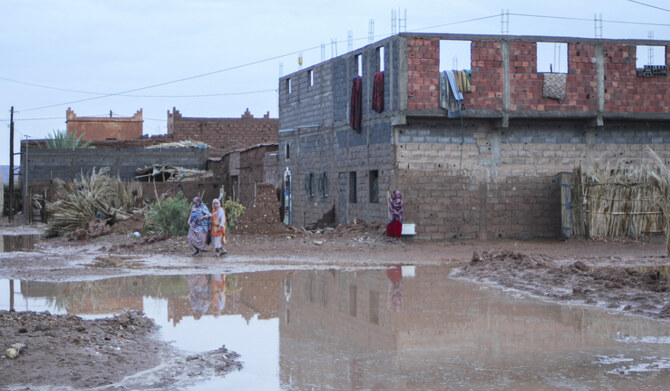
Women walk past floods caused by heavy rainfall in Tagounite, Zagora, southern Morocco, Saturday, Sept. 7, 2024. (AP)
2 / 4
A desert oasis town is flooded due to heavy rainfall in Tazarine, Zagora, southern Morocco, Sunday, Sept. 8, 2024. (AP)
3 / 4
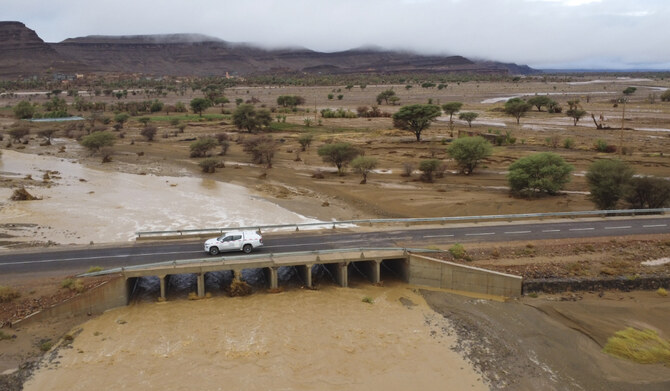
Flood water caused by heavy rainfall streams under a bridge, in Tazarine, Zagora, southern Morocco, Sunday, Sept. 8, 2024. (AP)
4 / 4
A car drives through a bridge as flood water caused by heavy rainfall streams, in Tazarine, Zagora, southern Morocco, Sunday, Sept. 8, 2024. (AP)
Short Url
Updated 10 September 2024
Follow

Flooding kills more than 20 people in Morocco and Algeria

  • Meteorologists had predicted that a rare deluge could strike North Africa’s Sahara Desert, where many areas receive less than an inch of rain a year

RABAT, Morocco: Torrential downpours hit North Africa’s normally arid mountains and deserts over the weekend, causing flooding that killed nearly two dozen people in Morocco and Algeria and destroyed homes and critical infrastructure.
In Morocco, officials said the two days of storms surpassed historic averages, in some cases exceeding the annual average rainfall. The downpours affected some of the regions that experienced a deadly earthquake one year ago.
Meteorologists had predicted that a rare deluge could strike North Africa’s Sahara Desert, where many areas receive less than an inch of rain a year.
Officials in Morocco said 18 people were killed in rural areas where infrastructure has historically been lacking, and 56 homes collapsed. Nine people were missing. Drinking water and electrical infrastructure were damaged, along with major roads.
Among the dead in the region, where many tourists go to enjoy desert landscapes, were foreigners from Canada and Peru.
Rachid El Khalfi, Morocco’s Interior Ministry spokesperson, said in a statement on Monday that the government was working to restore communication and access to flooded regions in the “exceptional situation” and urged people to use caution.
In neighboring Algeria, which held a presidential election over the weekend, authorities said at least five died in the country’s desert provinces. Interior Minister Brahim Merad called the situation “catastrophic” on state-owned television.
Algeria’s state-run news service APS said the government had sent thousands of civil protection and military officers to help with emergency response efforts and rescue families stuck in their homes. The floods also damaged bridges and trains.


Lebanon PM Nawaf Salam says he will not allow anyone to drag the country into new conflicts

Updated 6 sec ago
Follow

Lebanon PM Nawaf Salam says he will not allow anyone to drag the country into new conflicts

  • Salam said Hezbollah can threaten to become further involved between Iran, Israel and the US, but the Lebanese government has full control

DUBAI: Lebanon’s Prime Minister Nawaf Salam said that Lebanon has had enough ventures in the past and that he would not allow anyone to drag the country into new conflicts.

Speaking at the World Governments Summit on Tuesday, Salam said Lebanon has been involved in the war on Gaza over the last couple of years, and the damage it has cost them has been massive.

Salam said Hezbollah can threaten to become further involved between Iran, Israel and the US, but the Lebanese government has full control over the southern region and will not allow further involvement. 

“For the first time since 1996, the Lebanese government through the Lebanese Armed Forces … has full control over the south of the country,” he said.

“No one is ready to involve the country in further adventures which could cost us more and will not engage in further ventures and conflicts,” he added.

“We are aware that we are in one of the most tense regions in the world. We need to fortify ourselves by working on restoring the decision on peace and war in Lebanon,” he added.

Salam said Lebanon’s goal was to reform its sovereignty and attract global investment.

“People only focus on reforms in financial institutions, but reforms are much wider than that for my government, which of course means financial reform, but administrative reforms are also important and needed,” he added.

Salam said that attracting investment requires achieving a sense of security in the country, not only for the Lebanese people but for the world.

“Reform and sovereignty go hand in hand. We need to restore the Lebanese state and the confidence in our people,” he explained.

Salam emphasized his country’s position in achieving judicial, security and financial reforms and said he will not allow anyone to do their work for them. 

“All we want from our brothers here is to support our journey, but not take our place or play our role,” he said, referring to countries of the Gulf Cooperation Council.

The minister said there would be a conference soon to support the Lebanese Armed Forces, and he invited all Arab leaders to participate in this event, adding that it was a way to enhance Lebanon’s security.