SAO PAULO: Supporters of former Brazilian President Jair Bolsonaro began flooding Sao Paulo’s main boulevard for an Independence Day rally Saturday, buoyed by the government’s blocking of tech billionaire Elon Musk’s X platform, a ban they say is proof of their political persecution.
A few thousand demonstrators, clad in the yellow-and-green colors of Brazil’s flag, poured onto Av. Paulista. References to the ban on X and images of Musk abounded.
“Thank you for defending our freedom,” read one banner praising the tech entrepreneur.
Saturday’s march is a test of Bolsonaro’s capacity to mobilize turnout ahead of the October municipal elections, even though Brazil’s electoral court has barred him from running for office until 2030. It’s also something of a referendum on X, whose suspension has raised eyebrows even among some of Bolsonaro’s opponents all the while stoking the flames of Brazil’s deep-seated political polarization.
“A country without liberty can’t celebrate anything this day,” Bolsonaro wrote on his Instagram account Sept 4., urging Brazilians to stay away from official independence day parades and instead join him in Sao Paulo.
Supreme Court Justice Alexandre de Moraes ordered X’s nationwide ban on Aug. 30 after months of feuding with Musk over the limits of free speech. The powerful judge has spearheaded efforts to ban far-right users from spreading misinformation on social media, and he ramped up his clampdown after die-hard Bolsonaro supporters ransacked Congress and the presidential palace on Jan. 8, 2023, in an attempt to overturn Bolsonaro’s defeat in the presidential election.
The ban is red meat to Bolsonaro’s allies, who have accused the judiciary and President Luiz Inácio Lula da Silva’s government of colluding to silence their movement.
“Elon Musk has been a warrior for freedom of speech,” staunch Bolsonaro ally and lawmaker Bia Kicis said in an interview. “The right is being oppressed, massacred, because the left doesn’t want the right to exist.”
“Our liberties are in danger, we need to make our voices heard. De Moraes is a tyrant, he should be impeached, and people on the streets is the only thing that will convince politicians to do it,” added retiree Amaro Santos as he walked down the thoroughfare Saturday,
Musk, a self-proclaimed “free speech absolutist,” has also urged Brazilians to turn out in droves for the rally, resharing someone else’s post claiming that X’s ban had awakened people “to the fact that freedom isn’t free and needs to be fought for.” He’s also created an X account, named for the controversial jurist, to publish sealed court orders directing X to shut down accounts deemed unlawful.
But De Moraes’ decision to ban X was far from arbitrary, having been upheld by fellow Supreme Court justices. And while expression, online and elsewhere, is more easily censored under Brazil’s laws than it is in the US, Musk has emerged as both a cause célèbre and a mouthpiece for unrestricted free speech.
Since 2019, X has shut down 226 accounts of far-right activities accused of undermining Brazil’s democracy, including those of lawmakers affiliated with Bolsonaro’s party, according to court records.
But when it refused to take action on some accounts, de Moraes warned last month that its legal representative could be arrested, prompting X to disband its local office. The US-based company refused to name a new representative — as required in order to receive court notices — and de Moraes ordered its nationwide suspension until it did so.
A Supreme Court panel unanimously upheld de Moraes’ decision to block X days later, undermining Musk’s efforts to cast him as an authoritarian bent on censoring political speech.
The more controversial component of his ruling was the levy of a whopping $9,000 daily fine for regular Brazilians using virtual private networks (VPNs) to access X.
“Some of these measures that have been adopted by the Supreme Court appear to be quite onerous and abusive,” said Andrei Roman, CEO of Brazil-based pollster Atlas Intel.
In the lead-up to Saturday’s protest, some right-wing politicians defied de Moraes’ ban and brazenly used a VPN to publish posts on X, calling for people to partake in the protests.
The march in Sao Paulo is organized in parallel to official events to celebrate Brazil’s anniversary of independence from Portugal. Commemorations have been fraught with tension in recent years, as Bolsonaro used them while in office to rally supporters and show political strength.
Three years ago, he threatened to plunge the country into a constitutional crisis when he declared he would no longer abide de Moraes’ rulings. He has since toned down the attacks — a reflection of his own delicate legal situation.
Bolsonaro has been indicted twice since his term ended in 2022, most recently for alleged money laundering in connection with undeclared diamonds from Saudi Arabia. De Moraes is overseeing an investigation into the Jan. 8 riot, including whether Bolsonaro had a role in inciting it.


Brazil’s X ban drives outraged Bolsonaro supporters to rally for ‘free speech’

https://arab.news/8rmrd
Brazil’s X ban drives outraged Bolsonaro supporters to rally for ‘free speech’

- The former president has urged his loyalists to stay away from official independence day parades and instead join him in Sao Paulo
- X platform owner Elon Musk has also urged Brazilians to turn out in droves for the rally as he hit back against a judicial order banning X
- Judge Alexandre de Moraes ordered X banned in the country for refusing to block accounts that were being used to undermine Brazilian democracy


To infinity and beyond: Grendizer’s 50 years of inspiring Arabs
- 50 years after its creation, the Grendizer anime series continues to capture Arab imagination
- Arab News Japan speaks to creator Go Nagai, Middle Eastern fans and retells the story behind the UFO Robot tasked with protecting our planet
LONDON: Few cultural imports have crossed borders as unexpectedly, or as powerfully, as Grendizer, the Japanese giant robot that half a century ago became a childhood hero across the Arab world, nowhere more so than in Saudi Arabia.
Created in Japan in the mid-1970s by manga artist Go Nagai, Grendizer was part of the “mecha” tradition of giant robots. The genre was shaped by Japan’s experience during the Second World War, and explored themes of invasion, resistance and loss through the medium of science fiction.
But while the series enjoyed moderate success in Japan, its true legacy was established thousands of kilometers away in the Middle East.
The anime “UFO Robot Grendizer” arrived on television in the region in 1979, dubbed into Arabic and initially broadcast in Lebanon during the Lebanese civil war. The story it told of the heroic Duke Fleed, a displaced prince whose planet had been destroyed by alien invaders, struck a chord with children growing up amid regional conflict and occupation by Israel.

Its themes of defending one’s homeland, standing up to aggression and protecting the innocent were painfully relevant in the region, transforming the series from mere entertainment into a kind of emotional refuge.
Much of the show’s impact came from its successful Arabization. The powerful Arabic dubbing and emotionally charged voice-acting, especially by Lebanese actor Jihad El-Atrash as Duke Fleed, lent the show a moral gravity unmatched by other cartoons of the era.
The theme song for the series, performed by Sami Clark, became an anthem that the Lebanese singer continued to perform at concerts and festivals right up until his death in 2022.
By the early 1980s, “Grendizer” had spread across the Middle East, inspiring fandoms in Saudi Arabia, Kuwait, Iraq and beyond. For many, it was not only their first exposure to anime, it also delivered lessons on values such as justice and honor.
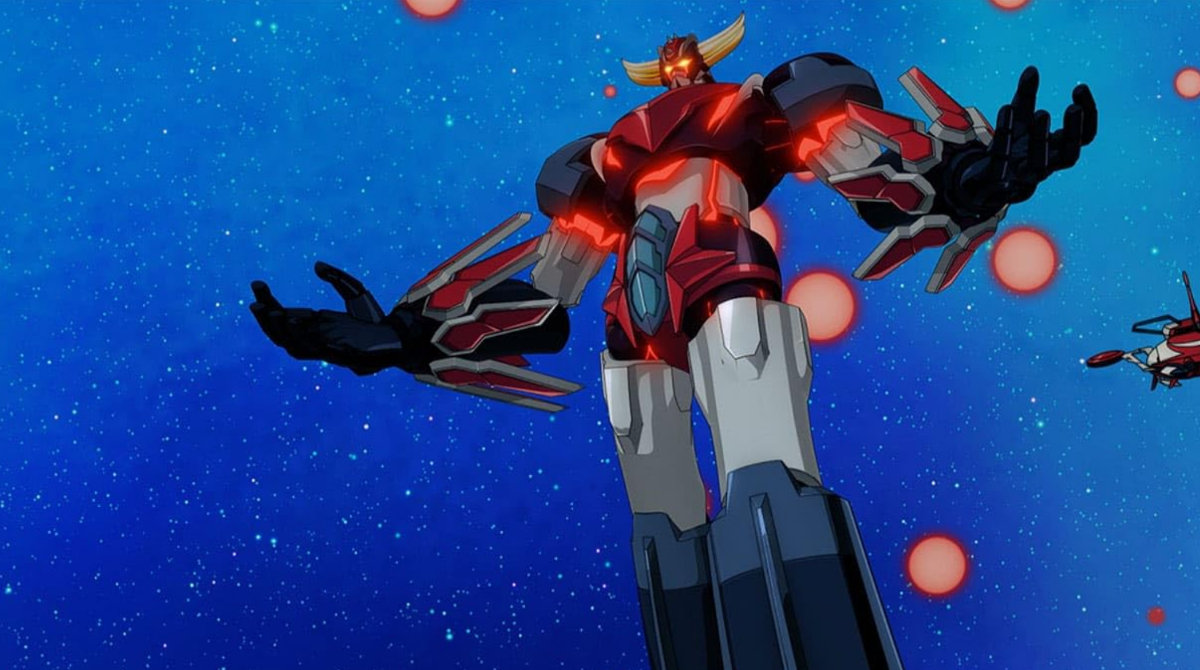
Grendizer was so influential in the region that it became the subject of scholarly research, which in addition to recognizing the ways in which the plight of the show’s characters resonated with the audience in the Middle East, also linked the show’s popularity to generational memories of displacement, particularly the Palestinian Nakba.
Half a century later, “Grendizer” remains culturally alive and relevant in the region. In Saudi Arabia, which embraced the original version of the show wholeheartedly, Manga Productions is now introducing a new generation of fans to a modernized version of the character, through a video game, The Feast of The Wolves, which is available in Arabic and eight other languages on platforms including PlayStation, Xbox and Nintendo Switch, and a new Arabic-language anime series, “Grendizer U,” which was broadcast last year.
Fifty years after the debut of the show, “Grendizer” is back — although to a generation of fans of the original series, their shelves still full of merchandise and memorabilia, it never really went away.


