KHAN YOUNIS, Gaza Strip: This week, when they would normally be going back to school, the Qudeh family’s children stumbled with armfuls of rubble they collected from a destroyed building to sell for use in building graves in the cemetery that is now their home in southern Gaza.
“Anyone our age in other countries is studying and learning,” said 14-year-old Ezz El-Din Qudeh, after he and his three siblings — the youngest a 4-year-old — hauled a load of concrete chunks. “We’re not. We’re working at something beyond our capacities. We are forced to in order to get a living.”
As Gaza enters its second school year without schooling, most of its children are caught up helping their families in the daily struggle to survive amid Israel’s devastating campaign.
Children trod barefoot on the dirt roads to carry water in plastic jerricans from distribution points to their families living in tent cities teeming with Palestinians driven from their homes. Others wait at charity kitchens with containers to bring back food.
Humanitarian workers say the extended deprivation of education threatens long-term damage to Gaza’s children. Younger children suffer in their cognitive, social and emotional development, and older children are at greater risk of being pulled into work or early marriage, said Tess Ingram, regional spokesperson for UNICEF, the United Nations agency for children.
“The longer a child is out of school, the more they are at risk of dropping out permanently and not returning,” she said.
Gaza’s 625,000 school-age children already missed out on almost an entire year of education. Schools shut down after Israel launched its assault on the territory in retaliation for Hamas’ Oct. 7 attack on southern Israel. With languishing negotiations to halt fighting in the Israel-Hamas war, it’s not known when they can return to classes.
More than 90 percent of Gaza’s school buildings have been damaged by Israeli bombardment, many of them run by UNWRA, the UN agency for Palestinians, according to the Global Education Cluster, a grouping of aid organizations led by UNICEF and Save the Children. About 85 percent are so wrecked they need major reconstruction — meaning it could take years before they are usable again. Gaza’s universities are also in ruins. Israel contends that Hamas militants operate out of schools.
Some 1.9 million of Gaza’s 2.3 million people have been driven from their homes. They have crowded into the sprawling tent camps that lack water or sanitation systems, or UN and government schools now serving as shelters.
Kids have little choice but to help families
Mo’men Qudeh said that before the war, his kids enjoyed school. “They were outstanding students. We raised them well,” he said.
Now he, his four sons and his daughter live in a tent in a cemetery in Khan Younis after they had to flee their home in the eastern neighborhoods of the city. The kids get scared sleeping next to the graves of the dead, he said, but they have no alternative.
The continual flow of victims from airstrikes and shelling into the cemetery and the plentiful supply of destroyed buildings are their source for a tiny income.
Every day at 7 a.m., Qudeh and his children start picking through rubble. On a recent day of work, the young kids stumbled off the pile of wreckage with what they found. Qudeh’s 4-year-old son balanced a chunk of concrete under his arm, his blonde curly hair covered in dust. Outside their tent, they crouched on the ground and pounded the concrete into powder.
On a good day, after hours of work, they make about 15 shekels ($4) selling the powder for use in constructing new graves.
Qudeh, who was injured in Israel’s 2014 war with Hamas, said he can’t do the heavy work alone.
“I cry for them when I see them with torn hands,” he said. At night, the exhausted children can’t sleep because of their aches and pain, he said. “They lie on their mattress like dead people,” he said.
Children are eager for a lost education
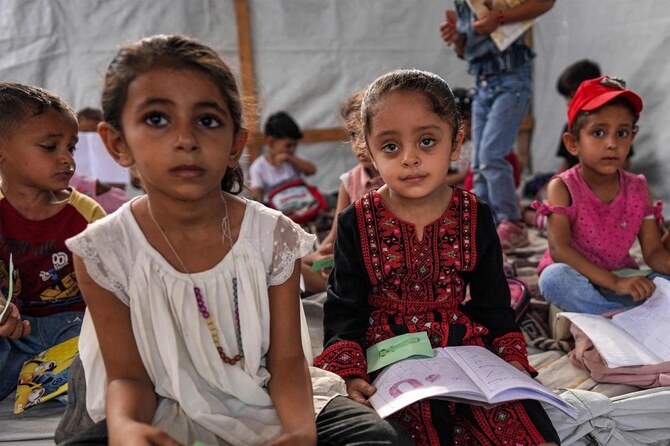
Aid groups have worked to set up educational alternatives — though the results have been limited as they wrestle with the flood of other needs.
UNICEF and other aid agencies are running 175 temporary learning centers, most set up since late May, that have served some 30,000 students, with about 1,200 volunteer teachers, Ingram said. They provide classes in literacy and numeracy as well as mental health and emotional development activities.
But she said they struggle to get supplies like pens, paper and books because they are not considered lifesaving priorities as aid groups struggle to get enough food and medicine into Gaza.
In August, UNRWA began a “back to learning” program in 45 of its schools-turned-shelters that provide children activities like games, drama, arts, music and sports. The aim is to “give them some respite, a chance to reconnect with their friends and to simply be children,” spokesperson Juliette Touma said.
Education has long been a high priority among Palestinians. Before the war, Gaza had a high literacy rate — nearly 98 percent.
When she last visited Gaza in April, Ingram said children often told her they miss school, their friends and their teachers. While describing how much he wanted to go back to class, one boy abruptly stopped in panic and asked her, “I can go back, can’t I?”
“That was just heartbreaking to me,” she said.
Parents told her they had seen the emotional changes in their children without the daily stability provided by school and with compounding traumas from displacement, bombardment and deaths or injuries in the family. Some become sullen and withdrawn, others become easily agitated or frustrated.
Gaza’s schools are packed with homeless families instead of students
The 11-month Israeli campaign has destroyed large swaths of Gaza and brought a humanitarian crisis, with widespread malnutrition and diseases spreading. More than 40,000 Palestinians have been killed, according to Gaza health officials. Children are among the most severely affected. Ingram said nearly all of Gaza’s 1.1 million children are believed to need psychosocial help.
Israel says its campaign aims to eliminate Hamas to ensure it cannot repeat its Oct. 7 attack, in which militants killed some 1,200 people in southern Israel and abducted 250 others.
The conflict has also set back education for Palestinian children in the West Bank, where Israel has intensified movement restrictions and carried out heavy raids.
“On any given day since October, between 8 percent and 20 percent of schools in the West Bank have been closed,” Ingram said. When schools are open, attendance is lowered because of difficulties in movement or because children are afraid, she said.
Parents in Gaza say they struggle to give their children even informal teaching with the chaos around them.
At a school in the central town of Deir Al-Balah, classrooms were packed with families, their laundry draped over the stairwells outside. Made of bedsheets and tarps propped on sticks, ramshackle tents stretched across the yard.
“The children’s future is lost,” said Umm Ahmed Abu Awja, surrounded by nine of her young grandchildren. “What they studied last year is completely forgotten. If they return to school, they have to start from the beginning.”


![]()

Gaza enters its second school year without schooling. The cost could be heavy for kids’ futures
Short Url
https://arab.news/5sfc3
Gaza enters its second school year without schooling. The cost could be heavy for kids’ futures
- Most of Gaza’s children are caught up helping their families in the daily struggle to survive amid Israel’s devastating campaign
- Humanitarian workers say the extended deprivation of education threatens long-term damage to Gaza’s children

Latest updates


Recommended


© 2026 SAUDI RESEARCH & PUBLISHING COMPANY, All Rights Reserved And subject to Terms of Use Agreement.