

Thailand’s king swears in new government after turmoil

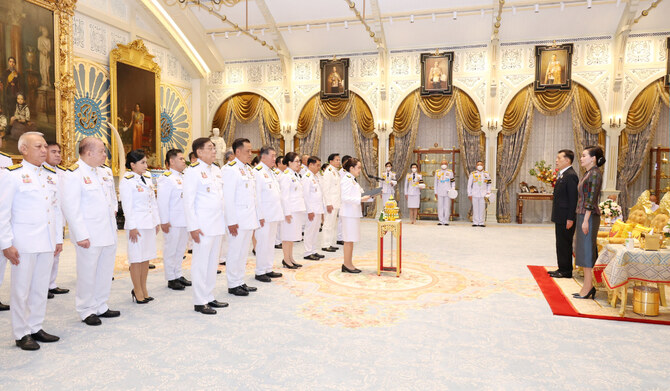
Thailand's Prime Minister Paetongtarn Shinawatra stands with her cabinet members in front of Thailand's King Maha Vajiralongkorn during a royal oath-taking at the Palace in Bangkok, Thailand, September 6, 2024. (REUTERS)
Short Url
Updated 06 September 2024
Follow

Thailand’s king swears in new government after turmoil

  • Dressed in official uniform, Paetongtarn and her Cabinet ministers swore their allegiance in front of King Vajiralongkorn and Queen Suthida in a ceremony at Bangkok’s Dusit Palace

BANGKOK: Thailand’s King Maha Vajiralongkorn swore in Prime Minister Paetongtarn Shinawatra and 35 Cabinet ministers in Bangkok on Friday, ushering in a new government in Southeast Asia’s second largest economy after a period of political turmoil.
Paetongtarn, 38, leader of the ruling Pheu Thai party, was elected by parliament last month to become Thailand’s youngest prime minister after her predecessor Srettha Thavisin was dismissed by a court order over an ethics violation.
The Cabinet, which was formally endorsed by the king on Wednesday, comprises 17 members from Pheu Thai, including the premier, and another 19 positions divided among coalition partners.
Dressed in official uniform, Paetongtarn and her Cabinet ministers swore their allegiance in front of King Vajiralongkorn and Queen Suthida in a ceremony at Bangkok’s Dusit Palace.
“I want to wish, with gladness, that the Cabinet will have the encouragement and determination to perform your duties as you have sworn for the benefit of the country and people,” the king said after the Cabinet’s oath of allegiance.
Paetongtarn and the Cabinet ministers bowed after the king’s remark.
The youngest daughter of the divisive former premier Thaksin Shinawatra, Paetongtarn has not served in government previously and will face challenges on multiple fronts, including a floundering economy.
She is also the second woman and fourth member of the Shinawatra clan to hold Thailand’s top elected position, with three previous premiers removed by coups or court decisions.
Paetongtarn’s government will deliver its policy statement to parliament next Thursday and Friday, marking the formal start of her administration.


China says Philippines distorted facts about incident near disputed atoll

Updated 2 sec ago
Follow

China says Philippines distorted facts about incident near disputed atoll

BEIJING: China’s defense ministry accused the Philippines on Wednesday of distorting the facts about an incident involving the Chinese coast guard and Filipino fishermen near a South China Sea shoal, a charge Manila strongly rejected.
The Philippine coast guard said over the weekend that three Filipino fishermen were injured and two fishing vessels damaged when Chinese coast guard ships cut their anchor lines and fired water cannon near the Sabina Shoal on Friday, actions the Philippine defense secretary denounced as “dangerous” and “inhumane.”
The Chinese ministry defended its coast guard’s actions as “reasonable, lawful, professional and restrained,” and vowed to “take strong and effective measures” in response to “all acts of infringement and provocation,” according to a statement released on its social media account.
“The Philippine side amassed a large number of ships in an organized and premeditated manner to illegally intrude” into the atoll’s lagoon, the ministry said. “Philippine personnel even threatened Chinese coast guard on site with a knife,” it added.
Philippine defense ministry spokesperson Arsenio Andolong maintained that Manila has evidence to counter China’s assertions.
“The facts are not distorted. They are documented, timestamped, and corroborated by video recordings, vessel logs, and on-site reporting by the Philippine Coast Guard,” Andolong said in a statement.
“The Philippines is not hyping the issue, the facts speak for themselves. These are aggressive and excessive actions of an encroaching state,” he added.
Sabina Shoal, which China refers to as Xianbin Reef and the Philippines as the Escoda Shoal, lies in the Philippines’ exclusive economic zone 150 km (95 miles) west of Palawan province.
China claims almost the entire South China Sea, a waterway supporting more than $3 trillion of annual commerce. The areas Beijing claims cut into the exclusive economic zones of Brunei, Indonesia, Malaysia, the Philippines and Vietnam.
An international arbitral tribunal ruled in 2016 that Beijing’s sweeping claims had no basis under international law, a decision China rejects.