‘Class is permanent, form temporary’: Bangladeshi cricket commentator says Babar Azam will bounce back

Pakistan’s Babar Azam avoids a ball during the second day of second and last cricket Test match between Pakistan and Bangladesh, at the Rawalpindi Cricket Stadium in Rawalpindi on August 31, 2024. (AFP)
Short Url
Updated 06 September 2024
Follow

‘Class is permanent, form temporary’: Bangladeshi cricket commentator says Babar Azam will bounce back

  • Athar Ali Khan represented Bangladesh in 19 ODIs from 1988 to 1998, was in Pakistan to commentate on two-Test series against Bangladesh
  • “They played better cricket and were a better side,” Khan said about Bangladesh completing 2-0 series sweep against Pakistan this month

KARACHI: Former Bangladeshi cricketer and current commentator Athar Ali Khan came to the defense of Pakistani batting sensation Babar Azam this week, saying he was going through a “bad patch” in his career but could bounce back with just one good innings as “class is permanent and form is temporary.”
Khan, who represented Bangladesh in 19 One-Day Internationals from 1988 to 1998, was in Pakistan to commentate on a two-Test series that started last month and which Bangladesh swept 2-0. He launched his commentary career around the time his nation gained Test status in 2000.
Out-of-form Babar Azam this week dropped out of the top 10 of the International Cricket Council’s ranking for Test batsmen after nearly five years and is now number 12 in the ranking. In the four innings across two Tests against Bangladesh, he scored 64 runs, leading to widespread criticism.
“Every player in their career goes up and down,” Khan told Arab News in an interview, referring to Azam’s recent performance against Bangladesh. “I mean, there are lean patches, purple patches when you’re scoring runs right, left and center. But there is a phase where there is a lean patch.
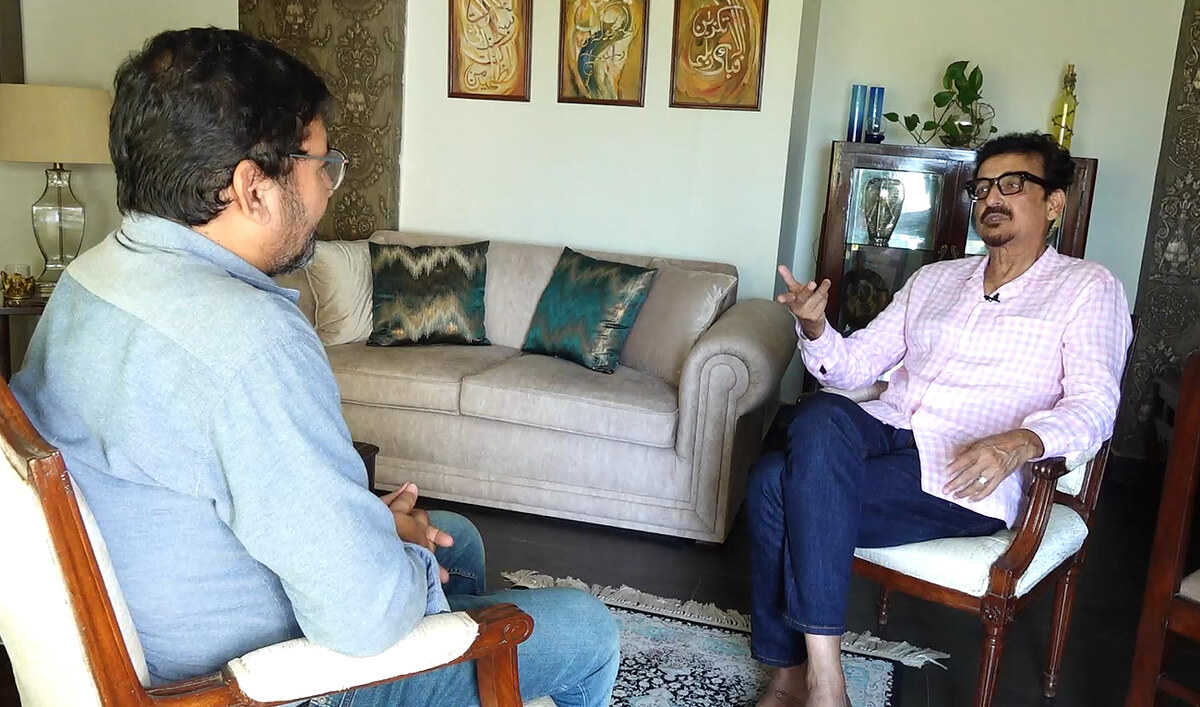


Bangladeshi commentator and former cricketer Athar Ali Khan (R) speaks during an interview with Arab News’ correspondent Naimat Khan in Karachi on September 4, 2024. (AN Photo)

“He’s a class act. It’s just one innings, which will give him enough confidence, but he’s too good a player to miss out for such a long time. [But] I always feel that class is permanent, form is temporary.”
Bangladesh swept the series with dominant performances in both matches. In the first Test, Mushfiqur Rahim’s superb 191 from 341 deliveries and Mehidy Hasan Miraz’s 4 wickets for 21 runs powered Bangladesh to a 10-wicket win.
The second Test saw another impressive display from the visiting team as Litton Das scored a brilliant 138 from 228 balls, while Miraz and Hasan Mahmud each claimed five wickets to secure a convincing 6-wicket victory, leading Bangladesh to a series win against Pakistan.

Khan said his team’s victory had opened a “glorious chapter” in Bangladeshi cricket history.
“It was the finest moment of Test cricket for Bangladesh,” he said. “In my opinion, it’s a Banglawash. It’s a word that I phrased a long time back when we went and won all the matches.”
Asked if Bangladesh’s historic victory was a result of Pakistan’s poor performance, which many attributed to lack of unity and poor selection, he said credit must be given to his national team.
“They played better cricket and were a better side,” he replied, adding that Pakistan had not expected Bangladesh to play such good cricket.
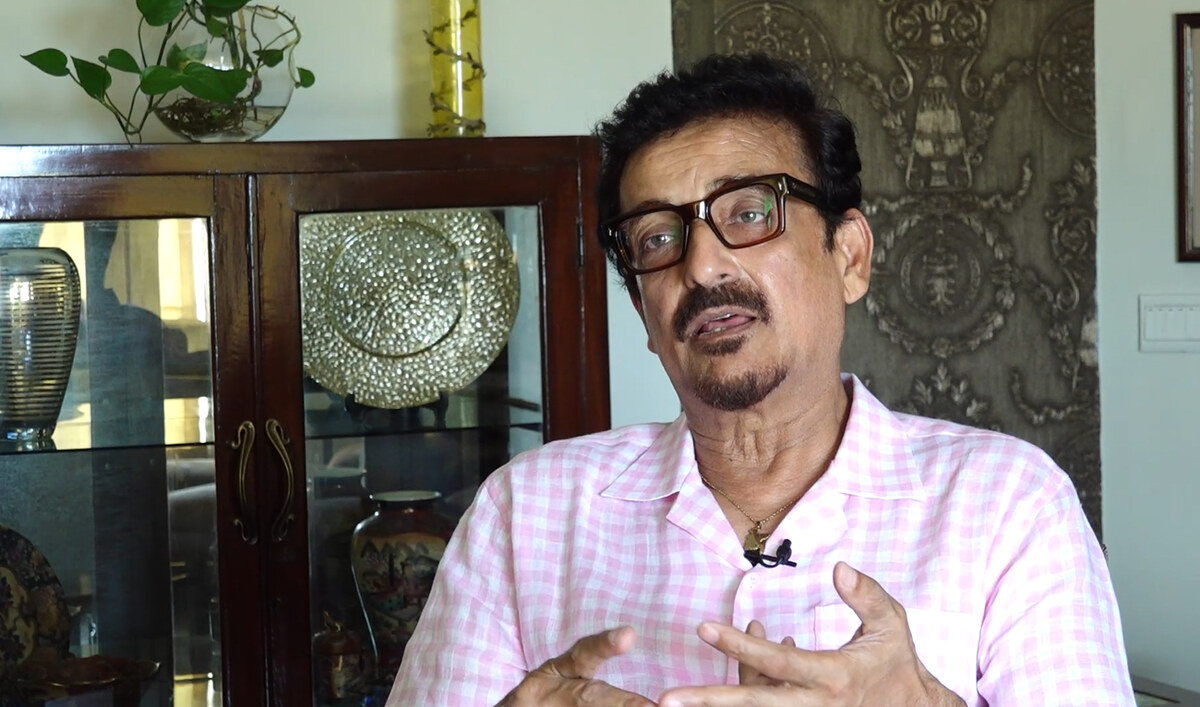


Bangladeshi commentator and former cricketer Athar Ali Khan speaks during an interview with Arab News in Karachi on September 4, 2024. (AN Photo)

“Pakistan did not do what they should have done, but they scored 448 in the first innings of the first Test match,” Khan pointed out. “They had Bangladesh 26 for 6 in the second Test match. They should have gone and won the match but then there was resistance, there was recovery. So, you have got to give more praise to Bangladesh, saying that you are a better team. You have got to accept the fact.”
The Bangladeshi cricketer-turned-commentator also questioned Pakistan’s decision to omit Mir Hamza from the first Test, despite his impressive record in first-class cricket.
“The surprising part for me to note was when Mir Hamza was picked in the second Test match, how come he was not picked up in the first and because he has 451 wickets in first-class cricket,” he said.
“INDIA WILL TAKE NOTE”
Bangladesh are now set to face a tough challenge as they are scheduled to tour India in September and October for two Test and three Twenty20 International matches.
“I think they [Bangladesh] are looking good, and they are looking threatening, and India will take note,” Khan said.

Acknowledging India to be among the finest sides in the cricketing world, he said Bangladesh’s opening batters should strive for better performance.
“I think one thing I would like to see from Bangladesh when they go to India is the top order because the top order has not really fired up for Bangladesh,” he said, adding that his team’s current advantage was the seam bowling attack.
“For the very first time, Bangladesh bowlers have taken all 10 wickets in a Test inning.” Khan said, “and also Hassan Mahmud picked up five for the very first time in Test cricket against Pakistan.”


Islamabad dismisses claims about paying up to 8 percent interest on foreign loans as ‘misleading’

Updated 22 February 2026
Follow

Islamabad dismisses claims about paying up to 8 percent interest on foreign loans as ‘misleading’

  • Pakistan has long relied on external loans to help bridge persistent gaps in public finances and foreign exchange reserves
  • Pakistan’s total external debt, liabilities stand at $138 billion at an overall average cost of around 4 percent, ministry says

KARACHI: Pakistan’s finance ministry on Sunday dismissed as “misleading” claims that the country is paying up to 8 percent interest on external loans, saying the overall average cost of external public debt is approximately 4 percent.

Pakistan has long relied on external loans to help bridge persistent gaps in public finances and foreign exchange reserves, driven largely by a narrow tax base, chronic trade deficits, rising debt-servicing costs and repeated balance-of-payments pressures.

Over the decades, successive governments have turned to multilateral and bilateral lenders, including the International Monetary Fund, the World Bank and the Asian Development Bank, to support budgetary needs and shore up foreign exchange reserves.

The finance ministry on Sunday issued a clarification in response to a “recent press commentary” regarding the country’s external debt position and associated interest payments, and said the figures required contextual explanation to ensure accurate understanding of Pakistan’s external debt profile.

“Pakistan’s total external debt and liabilities currently stand at $138 billion. This figure, however, encompasses a broad range of obligations, including public and publicly guaranteed debt, debt of Public Sector Enterprises (both guaranteed and non-guaranteed), bank borrowings, private-sector external debt, and intercompany liabilities to direct investors. It is therefore important to distinguish this aggregate figure from External Public (Government) Debt, which amounts to approximately $92 billion,” it said.

“Of the total External Public Debt, nearly 75 percent comprises concessional and long-term financing obtained from multilateral institutions (excluding the IMF) and bilateral development partners. Only about 7 percent of this debt consists of commercial loans, while another 7 percent relates to long-term Eurobonds. In light of this composition, the claim that Pakistan is paying interest on external loans ‘up to 8 percent’ is misleading.

The overall average cost of External Public Debt is approximately 4 percent, reflecting the predominantly concessional nature of the borrowing portfolio.”

With respect to interest payments, public external debt interest outflows increased from $1.99 billion in Fiscal Year (FY) 2022 to $3.59 billion in FY2025, representing an increase of 80.4 percent, not 84 percent as reported. In absolute terms, interest payments rose by $1.60 billion over this period, not $1.67 billion, it said.

According to the State Bank of Pakistan’s records, Pakistan’s total debt servicing payments to specific creditors during the period under reference were as follows: the IMF received $1.50 billion, of which $580 million constituted interest; Naya Pakistan Certificates payments totaled $1.56 billion, including $94 million in interest; the Asian Development Bank received $1.54 billion, including $615 million in interest; the World Bank received $1.25 billion, including $419 million in interest; and external commercial loans amounted to nearly $3 billion, of which $327 million represented interest payments.

“While interest payments have increased in absolute terms, this rise cannot be attributed solely to an expansion in the debt stock,” the ministry said. “Although the overall debt stock has increased slightly since FY2022, the additional inflows have primarily originated from concessional multilateral sources and the IMF’s Extended Fund Facility (EFF) under the ongoing IMF-supported program.”

Pakistan secured a $7 billion IMF bailout in Sept. 2024 as part of Prime Minister Shehbaz Sharif’s efforts to stabilize the South Asian economy that narrowly averted a default in 2023. The government has since been making efforts to boost trade and bring in foreign investment to consolidate recovery.

“It is also important to note that the increase in interest payments reflects prevailing global interest rate dynamics. In response to the inflation surge of 2021–22, the US Federal Reserve raised the federal funds rate from 0.75-1.00 percent in May 2022 to 5.25–5.50 percent by July 2023. Although rates have since moderated to around 3.75 percent, they remain significantly higher than 2022 levels,” the finance ministry said.

“The government remains committed to prudent debt management, transparency, and the continued strengthening of Pakistan’s macroeconomic stability,” it added.