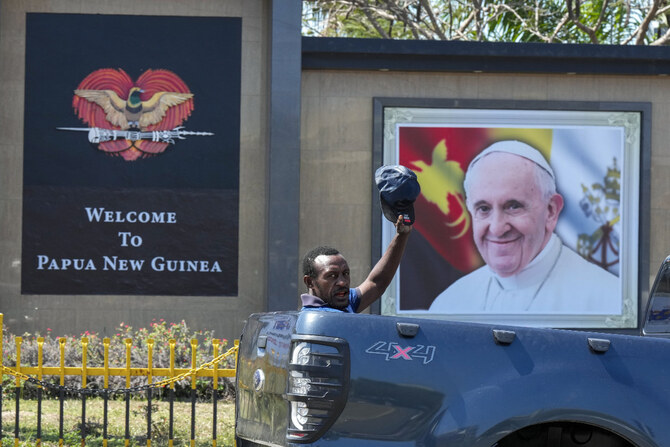

PORT MORESBY, Papua New Guinea: Pope Francis arrived in Papua New Guinea on Friday for the second leg of his four-nation trip through Southeast Asia and Oceania, becoming the second pope to visit the poor, strategically important South Pacific nation.
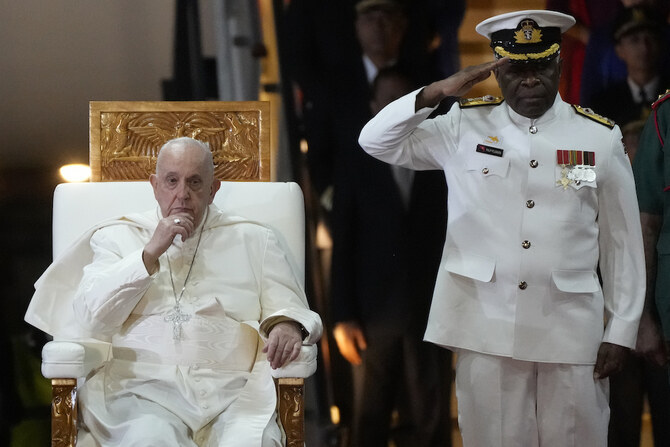
A cannon salute and marching band greeted the 87-year-old pope on the tarmac of the Port Moresby airport as he arrived after a six-hour flight from Jakarta, Indonesia. During the brief welcome ceremony the pope momentarily lost his balance while maneuvering from his wheelchair to a chair, but his security guards steadied him.
The packed three-day Indonesia visit culminated with a jubilant Mass on Thursday afternoon before a crowd that filled two sports stadiums and overflowed into a parking lot.
“Don’t tire of dreaming and of building a civilization of peace,” Francis urged them in an ad-libbed homily. “Be builders of hope. Be builders of peace.”
The Vatican had originally expected the Mass would draw some 60,000 people, and Indonesian authorities had predicted 80,000. But the Vatican spokesman quoted local organizers as saying more than 100,000 attended.

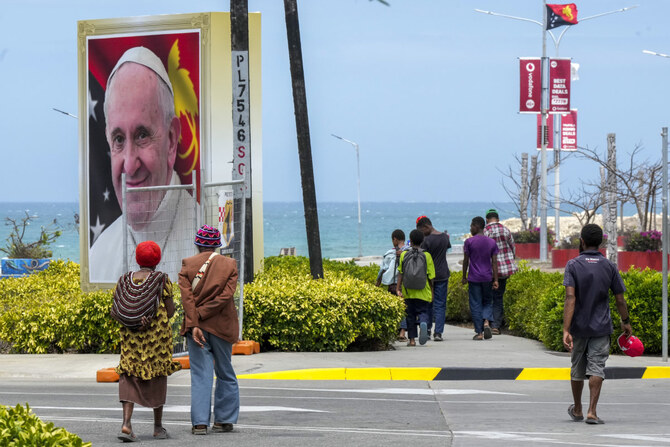
A woman wears a shirt with a photo of Pope Francis at a market ahead of his visit to Port Moresby, Papua New Guinea, on Sept. 6, 2024. (AP)
“I feel very lucky compared to other people who can’t come here or even had the intention to come here,” said Vienna Frances Florensius Basol, who came with her husband and a group of 40 people from Sabah, Malaysia, but couldn’t get into the stadium.
“Even though we are outside with other Indonesians, seeing the screen, I think I am lucky enough,” she said from a parking lot where a giant TV screen was erected for anyone who didn’t have tickets for the service.
While in Indonesia, Francis sought to encourage the country’s 8.9 million Catholics, who make up just 3 percent of the population of 275 million, while also seeking to boost interfaith ties with the country boasting the world’s largest Muslim population.
In the highlight of the visit, Francis and the grand imam of Jakarta’s Istiqlal Mosque, Southeast Asia’s largest, signed a joint declaration pledging to work to end religiously inspired violence and protect the environment.
In Papua New Guinea, Francis’ agenda is aligned with more of his social justice priorities. The poor, strategically important South Pacific nation is home to more than 10 million people, most of whom are subsistence farmers.
John Lavu, the choir conductor at St. Charles Luwanga parish in the capital, Port Moresby, said the visit would help him grow stronger in his Catholic faith.
“I have lived this faith all my life, but the coming of the Holy Father, the head of the church, to Papua New Guinea and to be a witness of his coming to us is going to be very important for me in my life as a Catholic,” he said on the eve of Francis’ arrival.
Francis will be traveling to remote Vanimo to check in on some Catholic missionaries from his native Argentina who are trying to spread the Catholic faith to a largely tribal people who also practice pagan and Indigenous traditions.
The country, the South Pacific’s most populous after Australia, has more than 800 Indigenous languages and has been riven by tribal conflicts over land for centuries, with conflicts becoming more and more lethal in recent decades.
History’s first Latin American pope will likely refer to the need to find harmony among tribal groups while visiting, the Vatican said. Another possible theme is the country’s fragile ecosystem, its rich natural resources at risk of exploitation and the threat posed by climate change.
The Papua New Guinean government has blamed extraordinary rainfall for a massive landslide in May that buried a village in Enga province. The government said more than 2,000 people were killed, while the United Nations estimated the death toll at 670.
Francis becomes only the second pope to visit Papua New Guinea, after St. John Paul II touched down in 1984 during one of his lengthy, globetrotting voyages. Then, John Paul paid tribute to the Catholic missionaries who had already been trying for a century to bring the faith to the country.
Papua New Guinea, a Commonwealth nation that was a colony of nearby Australia until independence in 1975, is the second leg of Francis’ four-nation trip. In the longest and farthest voyage of his papacy, Francis will also visit East Timor and Singapore before returning to the Vatican on Sept. 13.