

Trump says US colleges could lose accreditation over ‘antisemitic propaganda’ if he’s elected

1 / 2
Republican presidential nominee Donald Trump appears via a live satellite video feed during the Republican Jewish Coalition annual leadership summit in Las Vegas on Sept. 5, 2024. (Las Vegas Sun via AP)
2 / 2
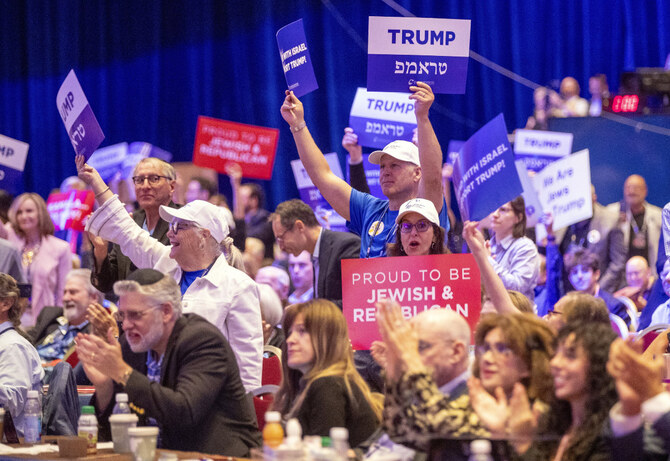
Attendees react after a live satellite video speech by Republican presidential candidate former President Donald Trump during the Republican Jewish Coalition annual leadership summit in Las Vegas on Sept. 5, 2024. (Las Vegas Sun via AP)
Short Url
Updated 06 September 2024
Follow

Trump says US colleges could lose accreditation over ‘antisemitic propaganda’ if he’s elected

  • Speaking remotely to a crowd of Jewish donors in Las Vegas, Trump also warned that his rival Kamala Harris would abandon Israel if she becomes president
  • “You’re not going to have an Israel if she (Harris) becomes president,” the Republican presidential nominee said without providing evidence for such a claim

LAS VEGAS: Republican presidential candidate Donald Trump told Jewish donors on Thursday that US universities would lose accreditation and federal support over what he described as “antisemitic propaganda” if he is elected to the White House.
“Colleges will and must end the antisemitic propaganda or they will lose their accreditation and federal support,” Trump said, speaking remotely to a crowd of more than 1,000 Republican Jewish Coalition donors in Las Vegas.
Protests roiled college campuses in spring, with students opposing Israel’s military offensive in Gaza and demanding institutions stop doing business with companies backing Israel.
Republicans have said the protests show some Democrats are antisemites who support chaos. Protest groups say authorities have unfairly labeled their criticism of Israel’s policies as antisemitic.
The Association of American Universities, which says it represents some 69 leading US universities, did not immediately respond to a request for comment.
In the United States, the federal government does not directly accredit universities but has a role in overseeing the mostly private organizations that give colleges accreditation.
In his speech, Trump also said he would ban refugee resettlement from “terror infested” areas like Gaza and arrest “pro-Hamas thugs” who engage in vandalism, an apparent reference to the college student protesters.
Under both Trump and Biden, similar numbers of Palestinians were admitted to the US as refugees. From fiscal year 2017-2020, the US accepted 114 Palestinian refugees, according to US State Department data, compared with 124 Palestinian refugees from fiscal year 2021 to July 31 of this year.
While Trump sketched out few concrete Middle Eastern policy proposals for a second term, he painted a potential Harris presidency in cataclysmic terms for Israel.
“You’re going to be abandoned if she becomes president. And I think you need to explain that to your people... You’re not going to have an Israel if she becomes president,” Trump said without providing evidence for such a claim.
The Harris campaign did not immediately respond to a request for comment about Trump’s speech.
Harris has hewed closely to President Joe Biden’s strong support of Israel and rejected calls from some in the Democratic Party that Washington should rethink sending weapons to Israel because of the heavy Palestinian death toll in Gaza.
She has, however, called for a ceasefire in Gaza, calling the situation there “devastating.”
Health authorities in Gaza say more than 40,000 Palestinians have been killed in the Israeli assault on the enclave since the Oct. 7, 2023 attacks led by Palestinian Islamist group Hamas.
Some 1,200 Israelis were killed in the surprise attack and about 250 were taken hostage, according to Israeli tallies.
The subsequent assault on Gaza has displaced nearly its entire 2.3 million population, caused a hunger crisis and led to genocide allegations at the World Court that Israel denies.

Wish list for Trump
The Republican Jewish Coalition Victory Fund says it is spending some $15 million to support Trump by helping bring out Jewish voters in battleground states.
The network has been financially supported by Sheldon Adelson, the late American casino mogul, and his Israeli-born widow Miriam Adelson. RJC members gathered this week for their annual conference at The Venetian Resort, which was developed by Sheldon Adelson’s company, the Las Vegas Sands Corp. Miriam Adelson is also the lead financier of a super PAC spending group that has said it is looking to raise over $100 million to support Trump.
In a half-dozen Reuters interviews at the conference, attendees broadly voiced three priorities for a potential second Trump term: Expanding the Abraham Accords, pursuing a tougher line on Iran, and either reforming or defunding the United Nations.
The Trump administration in 2020 helped broker the Abraham Accords, a series of normalization agreements between Israel and Arab nations.
But US-backed plans to normalize ties between Saudi Arabia and Israel were put on ice last year as war escalated between Israel and Hamas.
RJC chairman Norm Coleman, who is also a lobbyist for Saudi Arabia in Washington, told Reuters he was still hopeful the Abraham Accords could be expanded under Biden. “But if it’s not done, I would hope that President Trump would do what he did before and play a role in bringing the region together,” Coleman said.


Brown University shooting leaves students, community frustrated with official response

Updated 5 sec ago
Follow

Brown University shooting leaves students, community frustrated with official response

  • On Sunday, officials released a person of interest without charges, leaving investigators scrambling for new leads
  • The FBI and Providence police have released footage but have not identified the suspect. Students and community members are frustrated by security gaps
PROVIDENCE: The ongoing effort to find a man who walked onto Brown University ‘s campus during a busy exam season and shot nearly a dozen students in a crowded lecture hall has raised questions about the school’s security systems and the urgency of the investigation itself.
A day after Saturday’s mass shooting, officials said a person of interest taken into custody would be released without charges, leaving investigators with little actionable insight from the limited security video they had recovered and scrambling to develop new leads.
Law enforcement officials were still doing the most basic investigative work two days after the shooting that killed two students and wounded nine, canvassing local residences and businesses for security camera footage and looking for physical evidence. That’s left students and some Providence residents frustrated at gaps in the university’s security and camera systems that helped allow the shooter to disappear.
“The fact that we’re in such a surveillance state but that wasn’t used correctly at all is just so deeply frustrating,” said Li Ding, a student at the nearby Rhode Island School of Design who dances on a Brown University team.
A petition for increased security
Ding is among hundreds of students who have signed a petition to increase security at school buildings, saying that officials need to do a better job keeping the campus secure against threats like active shooters.
“I think honestly, the students are doing a more effective job at taking care of each other than the police,” Ding said.
Kristy dosReis, chief public information officer for the Providence Police Department, said that at no point did the investigation stand down even after officials appeared to have a breakthrough in the case, detaining a Wisconsin man who they now believe was not involved.
“The investigation continued as the scenes were still active. Nothing was cleared,” said dosReis.
Police and the FBI on Monday released new video and photographs of a man they believe carried out the attack. The man wore a mask in the footage captured before and after the attack.
Investigation is ‘painstaking work’
FBI Boston Special Agent in Charge Ted Docks said a $50,000 reward was being offered for information that would lead to the identification, arrest and conviction of the shooter.
Docks described the investigation, including documenting the trajectory of bullets at the shooting scene, as “painstaking work.”
“We are asking the public to be patient as we continue to run down every lead so we can give victims, survivors, their families and all of you the answers you deserve,” Docks told reporters.
A lack of campus security footage
While Brown University is dotted with cameras, there were few in the Barus and Holley building, home of the engineering school that was targeted.
“Reality is, it’s an old building attached to a new one,” Rhode Island Attorney General Peter Neronha told reporters about the lack of cameras nearby.
The lack of campus footage left police seeking tips from the public.
Katherine Baima said US marshals came to her door on Monday, seeking footage from a security camera pointing toward the street.
“This is the first time any of us in my building, as far as I know, had heard from anyone,” Baima said.
Students said the school’s emergency alert system kept them relatively well-informed about the presence of an active shooter. But they were uncertain what to do during a prolonged campus lockdown.
Chiang-Heng Chien, a 32-year-old doctoral student in engineering, hid under desks and turned off the lights after receiving an alert about the shooting at 4:22 p.m. Saturday in a campus lab.
“While I was hiding in the lab, I heard the police yelling outside but my friends and I were debating whether we should open the door, since at that moment the shooter was believed to be (nearby),” he said in a text.
Experts say colleges can be at disadvantage when it comes to security
Law enforcement experts say colleges are often at a disadvantage when responding to threats like an active shooter. Their security officers are typically less trained and paid less than in other law enforcement departments. They also don’t always have close partnerships with better-resourced agencies.
Often, funding for campus police departments is not a top priority, even for schools with ample resources, said Terrance Gainer, a former Illinois law enforcement official who later served as the US Senate’s sergeant-at-arms.
“They just aren’t as flush in law enforcement as you would think. They don’t like a lot of uniformed presence, they don’t like a lot of guns around,” said Gainer, who is now a consultant. “Whether it’s Brown or someone else, a key question is, what type of relationship do they have with the local police department?”
At Utah Valley University, where conservative leader Charlie Kirk was assassinated by a shooter on a school building roof last summer, the undersized campus police department never asked neighboring agencies to assist with security at the outdoor Kirk event that attracted thousands, an Associated Press review found.
Changes in Providence’s alert system
Providence has an emergency alert system, but it switched from a mobile app to a web-based system in March. The new system requires someone to register online to receive alerts — something not all residents knew.
Emely Vallee, 35, lives about a mile (1.6 kilometers) from Brown with her two young children. She said she received “absolutely nothing” in alerts. She relied instead on texts from friends and the news.
Vallee had expected to be notified through the city’s 311 app, but hadn’t realized that Mayor Brett Smiley phased out the app in March. Smiley said his administration sent out multiple alerts the day of the shooting using the new 311 system and has continued to send them.
Hailey Souza, 23, finished her shift at a smoothie shop just off-campus minutes before the shooting. Everything seemed normal and quiet, Souza said.
But driving home, she saw a boy bleeding on the sidewalk. “Then everyone started running and screaming,” she said. Souza said she saw a bystander rip off his T-shirt to help.
The shop Souza manages, In The Pink, is a block from the engineering building. One of the shooting victims, Ella Cook, was a regular at the store, Souza said. Cook had come in a few days earlier and said her last final was Saturday.
Souza later learned that police came by the store to tell her co-workers about an active shooter. But Souza never received an emergency alert. “Nothing,” she said.