Trump says US colleges could lose accreditation over ‘antisemitic propaganda’ if he’s elected

1 / 2
Republican presidential nominee Donald Trump appears via a live satellite video feed during the Republican Jewish Coalition annual leadership summit in Las Vegas on Sept. 5, 2024. (Las Vegas Sun via AP)
2 / 2
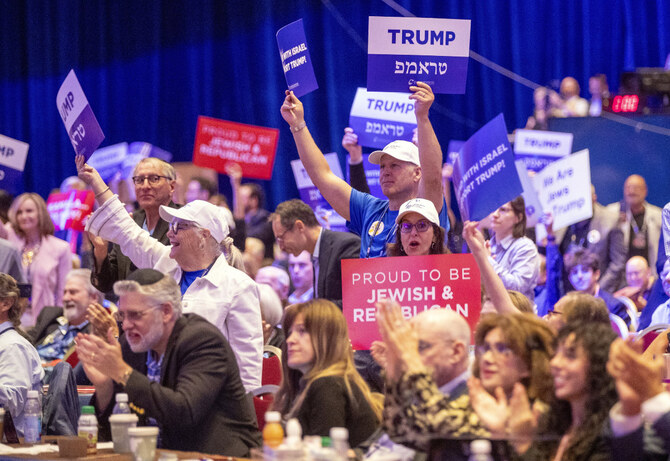
Attendees react after a live satellite video speech by Republican presidential candidate former President Donald Trump during the Republican Jewish Coalition annual leadership summit in Las Vegas on Sept. 5, 2024. (Las Vegas Sun via AP)
Short Url
Updated 06 September 2024
Follow

Trump says US colleges could lose accreditation over ‘antisemitic propaganda’ if he’s elected

  • Speaking remotely to a crowd of Jewish donors in Las Vegas, Trump also warned that his rival Kamala Harris would abandon Israel if she becomes president
  • “You’re not going to have an Israel if she (Harris) becomes president,” the Republican presidential nominee said without providing evidence for such a claim

LAS VEGAS: Republican presidential candidate Donald Trump told Jewish donors on Thursday that US universities would lose accreditation and federal support over what he described as “antisemitic propaganda” if he is elected to the White House.
“Colleges will and must end the antisemitic propaganda or they will lose their accreditation and federal support,” Trump said, speaking remotely to a crowd of more than 1,000 Republican Jewish Coalition donors in Las Vegas.
Protests roiled college campuses in spring, with students opposing Israel’s military offensive in Gaza and demanding institutions stop doing business with companies backing Israel.
Republicans have said the protests show some Democrats are antisemites who support chaos. Protest groups say authorities have unfairly labeled their criticism of Israel’s policies as antisemitic.
The Association of American Universities, which says it represents some 69 leading US universities, did not immediately respond to a request for comment.
In the United States, the federal government does not directly accredit universities but has a role in overseeing the mostly private organizations that give colleges accreditation.
In his speech, Trump also said he would ban refugee resettlement from “terror infested” areas like Gaza and arrest “pro-Hamas thugs” who engage in vandalism, an apparent reference to the college student protesters.
Under both Trump and Biden, similar numbers of Palestinians were admitted to the US as refugees. From fiscal year 2017-2020, the US accepted 114 Palestinian refugees, according to US State Department data, compared with 124 Palestinian refugees from fiscal year 2021 to July 31 of this year.
While Trump sketched out few concrete Middle Eastern policy proposals for a second term, he painted a potential Harris presidency in cataclysmic terms for Israel.
“You’re going to be abandoned if she becomes president. And I think you need to explain that to your people... You’re not going to have an Israel if she becomes president,” Trump said without providing evidence for such a claim.
The Harris campaign did not immediately respond to a request for comment about Trump’s speech.
Harris has hewed closely to President Joe Biden’s strong support of Israel and rejected calls from some in the Democratic Party that Washington should rethink sending weapons to Israel because of the heavy Palestinian death toll in Gaza.
She has, however, called for a ceasefire in Gaza, calling the situation there “devastating.”
Health authorities in Gaza say more than 40,000 Palestinians have been killed in the Israeli assault on the enclave since the Oct. 7, 2023 attacks led by Palestinian Islamist group Hamas.
Some 1,200 Israelis were killed in the surprise attack and about 250 were taken hostage, according to Israeli tallies.
The subsequent assault on Gaza has displaced nearly its entire 2.3 million population, caused a hunger crisis and led to genocide allegations at the World Court that Israel denies.

Wish list for Trump
The Republican Jewish Coalition Victory Fund says it is spending some $15 million to support Trump by helping bring out Jewish voters in battleground states.
The network has been financially supported by Sheldon Adelson, the late American casino mogul, and his Israeli-born widow Miriam Adelson. RJC members gathered this week for their annual conference at The Venetian Resort, which was developed by Sheldon Adelson’s company, the Las Vegas Sands Corp. Miriam Adelson is also the lead financier of a super PAC spending group that has said it is looking to raise over $100 million to support Trump.
In a half-dozen Reuters interviews at the conference, attendees broadly voiced three priorities for a potential second Trump term: Expanding the Abraham Accords, pursuing a tougher line on Iran, and either reforming or defunding the United Nations.
The Trump administration in 2020 helped broker the Abraham Accords, a series of normalization agreements between Israel and Arab nations.
But US-backed plans to normalize ties between Saudi Arabia and Israel were put on ice last year as war escalated between Israel and Hamas.
RJC chairman Norm Coleman, who is also a lobbyist for Saudi Arabia in Washington, told Reuters he was still hopeful the Abraham Accords could be expanded under Biden. “But if it’s not done, I would hope that President Trump would do what he did before and play a role in bringing the region together,” Coleman said.


Trump vows Iran war will ‘end very soon’

US President Donald Trump speaks during a press conference at Trump National Doral in Miami, Florida, on March 9, 2026. (AFP)
Updated 7 sec ago
Follow

Trump vows Iran war will ‘end very soon’

  • Iranian state media carried images of tens of thousands of people celebrating Mojtaba Khamenei’s selection in central Tehran, many carrying his picture
  • Global shipping giant MSC announced it was formally halting some export shipments from the Gulf, meaning goods sitting on ships would be unloaded
  • President Vladimir Putin on Monday promised “unwavering support”

TEHRAN: President Donald Trump said Monday that US military operations in Iran would be ending soon, reassuring markets that have been thrust into chaos by a war that is still reverberating across the Middle East.
The war had sent stock markets slumping and oil prices soaring again on Monday as Tehran, under new leader Mojtaba Khamenei, fired a fresh barrage of missiles at its Gulf neighbors and signaled that the strategic Strait of Hormuz would likely remain closed.
But Wall Street then climbed into positive territory with Trump’s repeated signals of a short-term conflict, despite the lack of details and amid threats that the United States could step up a war campaign that has hit more than 5,000 targets so far, according to the US military.
“It’s going to be ended soon, and if it starts up again they’ll be hit even harder,” Trump told a news conference in Florida, after telling an audience of lawmakers that the campaign would be a “short-term excursion.”
Trump’s remarks came on the first day in power for the 56-year-old son of slain leader Ali Khamenei, with Iranian forces launching a fresh wave of missile and drone attacks on Saudi Arabia, Bahrain, Qatar, the UAE and Israel.
Another missile was also fired at NATO member Turkiye — the second such incident in five days — with the alliance’s air defenses intercepting it before it could reach its target.
With the Strait of Hormuz blocked to nearly all oil tankers, the price of benchmark crude oil contracts rocketed past $100 a barrel on Monday — their highest levels since Russia’s invasion of Ukraine in 2022 — before pulling back.
French President Emmanuel Macron said his country and its allies were working on a “purely defensive” mission to reopen the strait, through which nearly 20 percent of the world’s crude oil usually transits.
The mission would aim to escort ships “after the end of the hottest phase of the conflict,” but experts say it would mean putting naval vessels at risk of fire from the nearby Iranian coast.
Kamal Kharazi, a foreign policy adviser to Iran’s supreme leader, told CNN that Tehran was calculating that economic pressure would eventually prompt other countries to intervene and end the war.
Benchmark oil prices are up 40-50 percent since the US and Israel launched their attack on Iran on February 28, while stock markets worldwide are down, hitting pension funds and savings.
But those trends began to ease with oil prices dropping nearly eight percent at open of trade on Tuesday, though stock futures on Wall Street remained volatile amid Washington’s mixed messaging.

- Rallies -

Iran faced a fresh blitz of US and Israeli strikes after its Assembly of Experts, the top clerical body, appointed its first new supreme leader in 37 years.
Iranian state media carried images of tens of thousands of people celebrating Mojtaba Khamenei’s selection in central Tehran, many carrying his picture.
Iran’s rebel Houthi allies in Yemen and the Hezbollah armed group in Lebanon pledged allegiance, while Russian President Vladimir Putin on Monday promised “unwavering support.”
Trump told reporters he was “disappointed” about Khamenei’s appointment, but remained open to a replacement from inside the Islamic republic, citing the recent transition of power in Venezuela as “a formula that has been very good so far.”
Ali Ansari, a professor of Iranian history at the University of St. Andrews in Scotland, told AFP the new supreme leader was a hard-liner who had “been involved in all the most violent repressions that have taken place over the last 15-16 years.”
Ali Vaez, of the International Crisis Group think tank, said the appointment was intended to send a defiant message that Trump’s war “has only replaced one Khamenei with another.”

- Oil risks -

Oil traders, policymakers and central bankers are all watching the Middle East for news about Gulf energy infrastructure, which is crucial for the world economy.
About 10 vessels in or near the Strait of Hormuz have come under attack since Iran blocked the waterway in retaliation for the US-Israeli strikes, shipping experts say.
Global shipping giant MSC announced it was formally halting some export shipments from the Gulf, meaning goods sitting on ships would be unloaded.
Following strikes on Bahrain’s Al Ma’ameer oil facility that ignited a fire, the country’s state-owned energy company Bapco joined its counterparts in Qatar and Kuwait in declaring “force majeure” — a warning that events beyond its control may lead it to miss export targets.
The Saudi defense ministry said Monday it had thwarted a drone attack targeting an oil field in the kingdom’s east, near the Emirati border.

- ‘Resistance’ -

In Bahrain, the interior ministry said early Tuesday an Iranian attack on a residential area in the capital Manama killed one person and injured others.
In Israel earlier, around 10 explosions were audible in Tel Aviv after the military announced it had detected missiles inbound from Iran.
At least one Israeli was killed when he was hit by shrapnel, emergency services said.
The multi-front war also intensified in Lebanon, where Israeli and Hezbollah exchanges of fire since March 2 have killed at least 486 people and wounded more than 1,300.
Lebanese President Joseph Aoun accused Hezbollah of working to “collapse” the state, while the head of the group’s parliamentary bloc said it had “no other option... than the option of resistance.”