

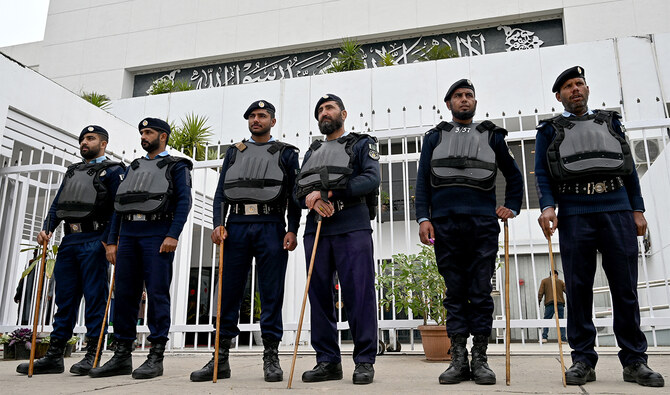

ISLAMABAD: The Pakistani senate on Thursday approved with majority a controversial bill seeking to “regulate” public gatherings in the federal capital, Islamabad, with rights activists and a major opposition party saying the legislation was against the constitution and an attempt to curtail freedom of movement and expression.
The stated aim of the “Peaceful Assembly and Public Order Bill 2024” is to streamline the process for obtaining permission to hold public gatherings in Islamabad and designating specific areas for such activity. It has proposed three-year jail terms for participants of ‘illegal’ assemblies, with ten-year imprisonment for repeat offenders.
“To maintain and preserve public peace and public order, it is necessary to regulate holding of peaceful assembly in order to protect the fundamental rights of other citizens and to preserve public and private property and to ensure that daily lives of the citizens are not hindered and public functionaries are able to perform their duties smoothly,” a copy of the bill seen by Arab News says.
The law defines assembly as any public or political gathering, rally or sit-in of more than 15 people on a public road, public place or any premises wholly or partly open air.
The bill has triggered strong opposition by jailed former prime minister Imran Khan’s Pakistan Tehreek-e-Insaf (PTI) party, which says the bill is meant to target the party, calling it in violation of the “democratic and fundamental rights” of the public.
The bill was moved in the Senate by Irfan Siddiqui of the ruling Pakistan Muslim League-Nawaz (PML-N) party, who said on the floor of the house the law was not aimed at blocking the PTI from holding a planned rally in Islamabad on Sept. 8.
“It has nothing to do with any jalsa [rally],” Siddiqui said. “We are not imposing any restrictions on anyone.”
He said protesters and participants of public gatherings in Islamabad had in the past held the capital city of over 2.5 million people hostage and the legislation was aimed at protecting the fundamental rights of citizens.
“We are regulating it [peaceful assembly], we are not banning any peaceful assembly,” Siddiqui said. “They [PTI] should do their jalsa wherever they get the permission.”
“AGAINST SPIRIT OF THE CONSTITUTION”
Last month, the chief commissioner of Islamabad disallowed the PTI from holding a planned rally on Aug. 22 due to what he cited as security threats and a lack of resources available with security agencies. The rally was initially planned for July to build pressure for Khan’s release from prison following his arrest over a year ago, but the party rescheduled it for Aug. 22.
On Thursday, the PTI announced it had received permission from the administration in the federal capital to hold the rally on Sept. 8.
PTI’s Shibli Faraz, who is the leader of the opposition in the senate, said the government was “misusing” its majority in the house to get the controversial bill passed.
“These laws will be used against you one day,” he warned the treasury benches, adding that it was a “fundamental and democratic” right of the people to hold peaceful public gatherings.
“Our party got written permissions [for public gatherings], but they were canceled one day before the event when the people and all other resources had been mobilized,” he said.
The proposed legislation will now be tabled for a vote in the National Assembly where the ruling coalition of PM Shehbaz Sharif enjoys a simple majority. It will become law after it is passed by both houses.
Ammar Ali Jan, a Pakistani historian, academic and political organizer, who is a founder and general secretary of the left-wing Haqooq-e-Khalq Party, said the proposed legislation was aimed at “stifling protests and gatherings” that were deemed to be in opposition to the governments and other state authorities.
“After this controversial legislation, bureaucrats will be responsible to grant permission for protests and gatherings against the very government they are serving,” he told Arab News. “So, it will be practically impossible for them to do so.
“Only the groups and parties of the sitting government’s choice will be getting the permissions,” Jan added.
“This legislation is against the very spirit of the constitution and fundamental rights of the citizens to hold peaceful gatherings to register their protest.”
The Human Rights Commission of Pakistan (HRCP), one of the oldest rights bodies in Pakistan, also “strongly opposed” the proposed legislation.
“The right to peaceful assembly is directly linked to the right of freedom of expression and right to movement,” HRCP’s director Farah Zia told Arab News. “So by curbing peaceful assembly you are actually infringing on other rights of the citizens as well.”


