

Saudi Arabia eyes high-tech auto partnerships with China

Minister of Industry and Mineral Resources Bandar Alkhorayef is leading a delegation to China and Singapore from Sept. 1 to 8. SPA
Short Url
Updated 05 September 2024
Follow

Saudi Arabia eyes high-tech auto partnerships with China

  • Saudi delegation visit seeks to strengthen bilateral relations, attract investments to the Kingdom, and explore joint venture opportunities in the industrial sector
  • Saudi automotive market is a significant player in the region, representing 40% of total sales in the MENA region

RIYADH: Saudi Arabia’s automotive industry is set to benefit from advanced technology and strategic deals signed with Chinese companies during a ministerial visit.

Minister of Industry and Mineral Resources Bandar Alkhorayef is leading a delegation to China and Singapore from Sept. 1 to 8. The visit seeks to strengthen bilateral relations, attract investments to Saudi Arabia, and explore joint venture opportunities in the industrial sector, according to the Saudi Press Agency.

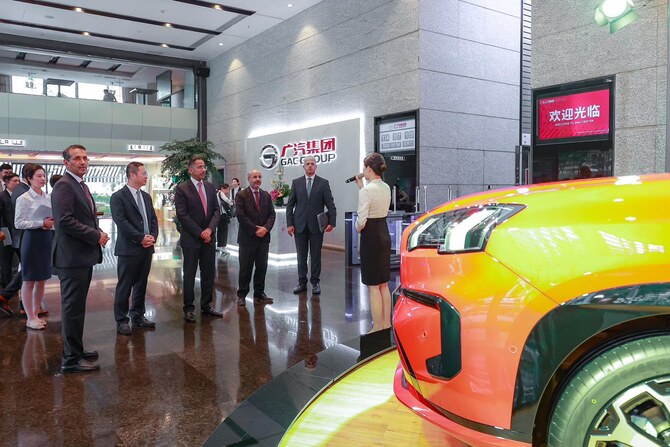
During the trip, Alkhorayef visited the Guangzhou Economic and Technological Development District and toured Guangzhou MINO Equipment Co. He engaged in discussions with the company’s vice president about potential collaborations in manufacturing high-tech vehicles.

This initiative supports Saudi Arabia’s goal to become a major automotive hub and a leader in innovative, eco-friendly vehicle solutions.

The Saudi automotive market is a significant player in the region, representing 40 percent of total sales in the Middle East and North Africa.

In a post on X, Alkhorayef wrote: “My official visit to China started with a tour of the Guangzhou Economic and Technological Development Zone, where I learned about their experience in setting up industrial cities.”

“I also visited GAC and met with FOTON to discuss opportunities to enhance industrial cooperation and exchange expertise and knowledge, especially in the manufacture of high-tech cars,” the minister added.

During his visit, Alkhorayef met with the president of Guangzhou Industrial Investment Holding Group to discuss enhancing cooperation in the industrial sector and advancing smart equipment production.

He also toured the Guangzhou Economic and Technological Development District, established in 1984, which ranks second among 219 similar zones for comprehensive capability and leads in scientific and technological innovation.

Recognized as one of the top 10 high-tech parks globally, GETDD showcased its offerings in knowledge exchange, capacity building, and foreign investment opportunities in its Science Square.

The minister was briefed on Guangzhou's incentives and its expertise in scientific and technological innovations within the industrial sector.

He reviewed the National Industrial Strategy’s sub-sectors, including automotive, and discussed Saudi Arabia’s incentives for attracting foreign investment. He explored opportunities to leverage China's advanced high-tech automotive manufacturing expertise.

The visit underscores the importance of the industrial sector in Saudi Arabia’s national strategy, which focuses on innovative technology and market expansion.

In 2023, Saudi non-oil exports to China surpassed SR28 billion ($7.45 billion), while imports from China reached SR160 billion. Key Saudi exports included chemicals, plastics, metals, and machinery, while major imports from China comprised machinery, electrical equipment, and steel.


Gold slips over 1 percent on strong dollar, easing rate-cut bets

Updated 12 March 2026
Follow

Gold slips over 1 percent on strong dollar, easing rate-cut bets

  • Chile central bank issues first gold purchase in decades
  • BMI expects silver to average $93/oz in 2026

Gold prices fell more than 1 percent on Thursday, pressured by a stronger dollar and diminishing hopes for a reduction in borrowing costs as the ongoing Iran war stoked inflation concerns.
Spot gold dipped 1.1 percent at $5,118.16 per ounce by 1:31 p.m. ET (1731 GMT). US gold futures for April delivery settled 1 percent lower at $5,125.80.
The dollar gained for a third consecutive session. The greenback is a competitive ‌safe-haven asset, and ‌a stronger US currency makes gold more ​expensive ‌for ⁠holders ​of other currencies.
“The ⁠higher dollar index, rising treasury yields and lack of interest-rate cuts are the negative factors, but the conflict in the Middle East has been generating some safe-haven flows,” said Phillip Streible, chief market strategist at Blue Line Futures.
Two tankers were ablaze in Iraqi waters in an apparent escalation in Iranian attacks that have cut off ⁠Middle East energy supplies. In reaction, oil prices ‌rose sharply for the day.
Iran will avenge ‌the blood of its martyrs, keep ​the Strait of Hormuz closed and ‌attack US bases, new Supreme Leader Ayatollah Mojtaba Khamenei said.
Higher crude ‌prices feed into inflation by raising transportation and production costs. Gold is considered an inflation hedge, but high interest rates weigh on it by making yield-bearing assets more attractive.
“If they can prevent oil prices from climbing ‌further, gold should be in a good place... On the bullish side for gold, the main argument is ⁠that central ⁠bank buying and steady exchange-traded fund inflows, which have remained positive all year,” Streible added.
Chile’s central bank issued its first major gold purchase since at least 2000. In February, the bank boosted its gold reserves to $1.108 billion, up from $42 million in January, equivalent to 2.2 percent of total reserves.
Elsewhere, spot silver eased 1 percent to $84.90. Prices gained more than 146 percent last year.
Analysts at BMI wrote in a note they expect silver to average $93 per ounce in 2026, with strong investment demand consolidating the gains witnessed in 2025, and offsetting price-induced ​demand destruction in solar ​panels and jewelry.
Spot platinum lost 1.1 percent to $2,145.75, and palladium fell 1 percent to $1,620.86.