Bangladesh election chief quits, denies poll interference for Sheikh Hasina’s fourth term

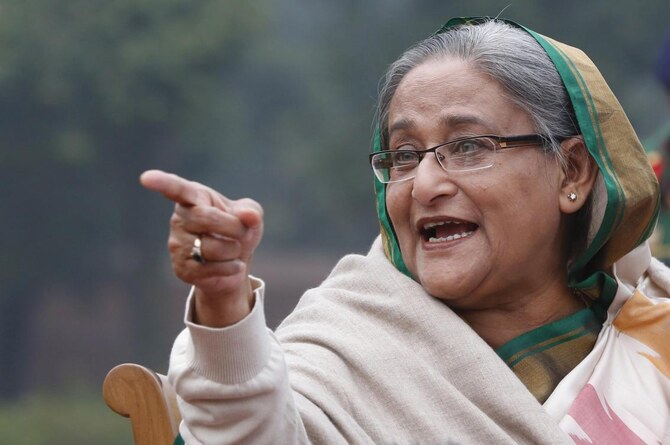
The five commissioners presided over a January election that guaranteed Sheikh Hasina a fourth consecutive term and her Awami League party and its allies a near-monopoly on seats. (AP)
Short Url
Updated 05 September 2024
Follow

Bangladesh election chief quits, denies poll interference for Sheikh Hasina’s fourth term

  • Kazi Habibul Awal and the country’s four other election commissioners all tendered their resignation
  • They are the latest of several Sheikh Hasina-appointed public officials to quit their posts since her departure

DHAKA: Bangladesh’s elections chief quit Thursday after denying political interference in January polls that re-elected autocratic leader Sheikh Hasina, who has since fled the country after a student-led revolution.
Kazi Habibul Awal and the country’s four other election commissioners all tendered their resignation, citing the ex-premier’s ouster as the reason for doing so.
They are the latest of several Hasina-appointed public officials to quit their posts since her departure, including the central bank boss and supreme court judges.
“I and the other commissioners intended to resign given the changed scenario of the country,” Awal told reporters.
The five commissioners presided over a January election that guaranteed Hasina a fourth consecutive term and her Awami League party and its allies a near-monopoly on seats.
The vote was marred by low turnout and was boycotted by the main opposition Bangladesh Nationalist Party (BNP) after thousands of members were arrested in a pre-emptive crackdown.
Rights groups and Western governments criticized the vote as unfree and unfair.
But Awal said the lack of genuine political opposition to Hasina meant that the vote itself was conducted with integrity.
“The main opposition party BNP and like-minded parties didn’t participate,” he said.
“As it was a one-party election, there was no necessity to influence the election.”
Hasina’s 15-year rule saw widespread human rights abuses, including the mass detention and extrajudicial killings of her political opponents.
She fled to India by helicopter last month, where she remains, and was replaced by Nobel Peace Prize laureate Muhammad Yunus, who is heading an interim government.
Yunus faces the monumental task of charting democratic reforms after years of repression but his caretaker cabinet has yet to give an indication of when fresh elections will be held.
Senior bureaucrats who quit their posts last month had been given ultimatums to do so by leaders of the student protests which toppled Hasina.


Italian general challenges Meloni from the right

Updated 6 sec ago
Follow

Italian general challenges Meloni from the right

  • A career soldier with experience in the Afghanistan and Iraq wars, Vannacci shot to fame in 2023 with the publication of a controversial book, “The World Upside Down”
  • Meloni’s party remains the most popular, polling at more than 29 percent support — more than it won in 2022 elections

ROME: A retired general who criticizes the EU, wants to send home illegal migrants and says Ukraine should accept a peace deal with Russia is challenging Italy’s hard-right government on its own turf.
Roberto Vannacci, 57, last month defected from the far-right League party, a partner in Prime Minister Giorgia Meloni’s coalition government, and set up a new party he said is “proud of being right-wing.”
Opinion polls put the new “National Future” at around three percent support, most of it taken from the League, led by Deputy Prime Minister Matteo Salvini, but also Meloni’s far-right Brothers of Italy.
Meloni’s party remains the most popular, polling at more than 29 percent support — more than it won in 2022 elections.
But the general offers “the first movement emerging on the right that isn’t aligned with the three main parties,” Lorenzo Castellani, professor of politics at Rome’s Luiss University, said.
A career soldier with experience in the Afghanistan and Iraq wars, Vannacci shot to fame in 2023 with the publication of a controversial book, “The World Upside Down.”
In it, he complained about a “dictatorship of minorities,” while saying Italian star volleyball player Paola Egonu, who is black, had features that “do not represent Italian-ness.”
He was suspended from his army job, with Defense Minister Guido Crosetto — a member of Meloni’s party — saying that his “personal ramblings ... discredit the army, the Defense Ministry and the constitution.”
But in the end, he was allowed to retire, and the controversy made him a celebrity on the far right.
Salvini, whose anti-immigration League has been losing ground to Meloni’s in recent years, invited him into his party and Vannacci was elected to the European Parliament in 2024.
But last month the ex-general struck out on his own, taking with him two League MPs and another who was independent but formerly in Meloni’s party.
He is targeting voters disenchanted with Salvini and also Meloni, who has radical far-right roots but in office has taken a more pragmatic approach.
National Future is “a party of the true right, pure, sincere, proud, unashamed of being right-wing,” and “not hesitant, not fearful,” Vannacci told the foreign press association Thursday.
Once a firebrand euroskeptic, Meloni has worked closely with the EU in office, while her flagship promise to cut illegal immigration has been tempered by a major boost in visas for legal migrants.

Vannacci has “a more extremist approach to issues like immigration, like security, where he explicitly talks about remigration,” Castellani said.
The ex-general highlights Italy’s Roman-Christian roots and has called for migrants to be returned to their countries of origin if they arrived illegally or committed a crime.
While Meloni has distanced herself from Italy’s Fascist past, Vannacci was accused of revisionism last year after a social media post defending the democratic credentials of dictator Benito Mussolini.
National sovereignty, meanwhile, is a priority, with Vannacci lambasting the EU as both overreaching member states’ rights and globally ineffective — not least in the current wars in the Middle East and Ukraine.