

Ousted Bangladeshi leader becomes diplomatic headache for India

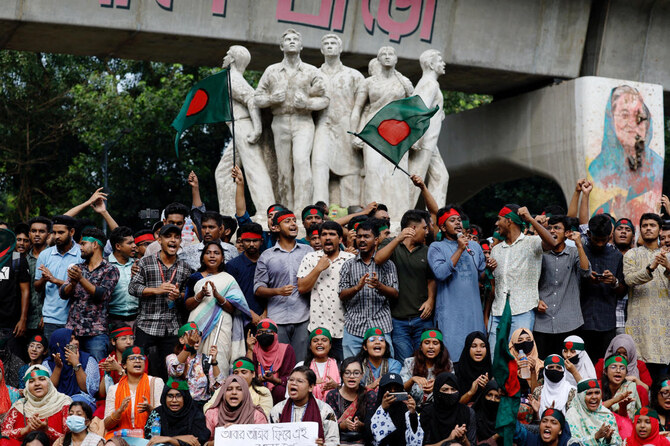
Activists of the Anti-Discriminatory Student Movement gather at the University of Dhaka's Teacher Student Center (TSC), demanding capital punishment for Bangladeshi former Prime Minister Sheikh Hasina for the deaths of students during anti-quota protests, in Dhaka, Bangladesh, August 13, 2024. (Reuters)
Short Url
Updated 02 September 2024
Follow

Ousted Bangladeshi leader becomes diplomatic headache for India

NEW DELHI: Four weeks after ex-premier Sheikh Hasina fled Bangladesh by helicopter during a student-led revolution, analysts say she has become a diplomatic headache for her hosts in India.
Hasina’s iron-fisted tenure came to an end last month as protesters marched on her palace in Dhaka after 15 years characterised by rights abuses and opposition crackdowns.
Bangladeshi students who led the uprising are demanding she return from India, her biggest benefactor before her ouster, to be tried for the killing of protesters during the revolt.
But sending the 76-year-old back risks undermining India’s standing with its other neighbors in South Asia, where it is waging a fierce battle for influence with China.
“India is clearly not going to want to extradite her back to Bangladesh,” said Thomas Kean of the conflict resolution think-tank International Crisis Group.
“The message that would send to other leaders in the region who are close to New Delhi would not be a very positive one... that ultimately, India will not protect you,” he told AFP.
New Delhi last year saw its preferred presidential candidate in the Maldives lose to a rival that immediately tilted the strategically placed luxury tourism destination toward Beijing.
Hasina’s toppling lost India its closest ally in the region.
Those who suffered under Hasina in Bangladesh are openly hostile to India for the abuses committed by her government.
That hostility has smoldered through megaphone diplomacy waged by Hindu-nationalist Indian Prime Minister Narendra Modi and directed toward Bangladesh’s caretaker administration.
Modi has pledged support for the government that replaced Hasina, led by 84-year-old Nobel Peace Prize laureate Muhummad Yunus.
But Modi, who has made championing the Hindu faith a key plank of his tenure, has also repeatedly urged Yunus’s administration to protect Bangladesh’s Hindu religious minority.
Hasina’s Awami League was considered to be more protective of Bangladesh’s Hindu minority than the Bangladesh Nationalist Party (BNP).
Modi used his annual Independence Day address from atop the 17th century Red Fort to suggest Bangladeshi Hindus were in danger, and later raised the matter with US President Joe Biden.
Some Bangladeshi Hindus and Hindu temples were targeted in the chaos that followed Hasina’s departure in attacks that were condemned by student leaders and the interim government.
But wildly exaggerated accounts of the violence were later reported by pro-government Indian news channels and sparked protests by Hindu activist groups loosely affiliated with Modi’s party.
Fakhrul Islam Alamgir, a top leader of the BNP, said India had put “all its fruit in one basket” by backing Hasina, and did not know how to reverse course.
“The people of Bangladesh want a good relationship with India, but not at the cost of their interests,” Alamgir, one of thousands of BNP members arrested during Hasina’s tenure, told AFP.
“The attitude of India unfortunately is not conducive to creating confidence.”

Diplomatic issue
Such is the atmosphere of distrust, when deadly floods washed through both countries in August some Bangladeshis blamed India for the deaths that resulted.
Bangladesh’s interim government has not publicly raised the issue of Hasina taking refuge in India with New Delhi — her last official whereabouts is a military air base near the capital — but Dhaka has revoked her diplomatic passport, preventing her from traveling onwards.
The countries have a bilateral extradition treaty first signed in 2013 which would permit her return to face criminal trial.
A clause in the treaty, however, says extradition might be refused if the offense is of a “political character.”
India’s former ambassador to Bangladesh, Pinak Ranjan Chakravarty, said that the bilateral relationship is too important for Dhaka to sour it by pressing for Hasina’s return.
“Any mature government will realize that making an issue out of Hasina staying in India is not going to give them any benefits,” he told AFP.


Hong Kong firm begins arbitration proceedings over ruling against its Panama Canal port contract

Updated 6 sec ago
Follow

Hong Kong firm begins arbitration proceedings over ruling against its Panama Canal port contract

  • The Hutchison subsidiary has operated ports at both ends of the Panama Canal since 1997
  • US Secretary of State Marco Rubio views the operation of the ports as a national security issue
HONG KONG: Hong Kong’s CK Hutchison Holdings said Wednesday its subsidiary started arbitration proceedings against Panama after that country’s Supreme Court ruled a concession for the subsidiary to operate Panama Canal ports was unconstitutional.
Hutchison said it strongly disagreed with last week’s ruling, and China warned Panama would pay “a heavy price” if it persisted. Panama’s president has moved to assure the public that the ports would operate without interruption after the ruling, which advanced a US aim to block any influence by China over the canal linking the Atlantic and Pacific oceans.
Hutchison’s subsidiary, Panama Ports Company, began arbitration proceedings Tuesday under the rules of the Paris-based International Chamber of Commerce, the company said in a statement.
The rules are overseen by the chamber’s International Court of Arbitration, an independent body, and it’s unclear what the impact of the proceedings would be. The Panamanian president’s office and commerce ministry did not immediately respond to requests for comment late Tuesday local time.
The ruling draws ire from China
The court ruling has drawn backlash from China, and the tensions may complicate Hutchison’s plan to sell its port assets in dozens of countries to a group that includes the US investment firm BlackRock Inc.
The planned sale has already been caught up in tensions between Beijing and Washington. US President Donald Trump, who has alleged that China interferes with the canal, initially welcomed that plan. However, it apparently angered Beijing and drew a review by Chinese anti-monopoly authorities.
On Tuesday night, Beijing’s office overseeing Hong Kong affairs criticized the Panama court ruling as legally groundless and ridiculous, saying the ruling reflected that Panamanian authorities were bowing down to hegemonic powers. It did not specify the countries but pointed to politicians from some countries who had said they were “encouraged” by the ruling, in an apparent veiled reference to US Secretary of State Marco Rubio.
In a statement shared on social media platform WeChat, the office said that China will never bow to hegemonism and has sufficient means and tools, as well as capability, to uphold justice in the international economic and trade order.
“Panama’s authorities should recognize the situation and correct their course,” it said. “If they persist in their own way and refuse to see reason, they will pay a heavy price both politically and economically!”
A company caught in US-China tensions
The Hutchison subsidiary has operated ports at both ends of the Panama Canal since 1997. The awkward position Hutchison found itself in highlights the challenges Hong Kong business elites face in navigating Beijing’s expectations of national loyalty, especially during U.S-China tension. CK Hutchison is owned by the family of Hong Kong’s richest man, Li Ka-shing.
The company said last July that it was considering seeking a Chinese investor to join as a significant member of the consortium under its sale plan, a move that some interpreted as way to please Beijing, but CK Hutchison hasn’t said more since.
The consortium also includes BlackRock subsidiary Global Infrastructure Partners and Terminal Investment Limited, which is chaired by Italian shipping scion Diego Aponte, whose family reportedly has a longstanding relationship with Li’s.
Last May, Hutchinson co-managing director, Dominic Lai told shareholders that Terminal Investment was the main investor.
Panama’s government has maintained it has full control over the canal and that the operation of the ports by Hutchison does not mean Chinese control of it. But Rubio made clear that the US viewed the operation of the ports as a national security issue.