PARIS: Amnesty International Thursday urged a war crimes probe into Israel razing homes and farms in eastern Gaza to expand a so-called buffer zone between it and the Palestinian territory.
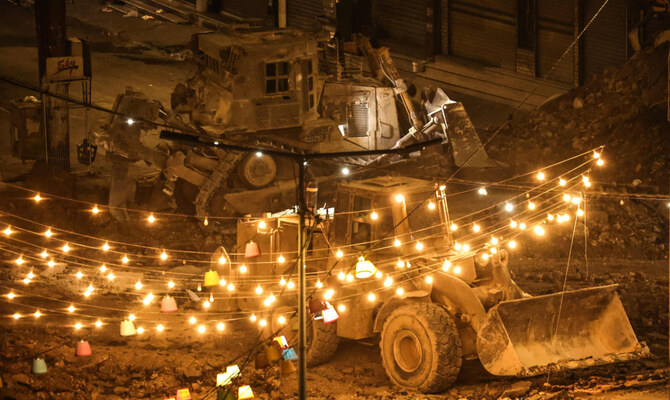
“Using bulldozers and manually laid explosives, the Israeli military has unlawfully destroyed agricultural land and civilian buildings, razing entire neighborhoods, including homes, schools and mosques,” it said.
The London-based rights group said the levelling since the start of the war on October 7 “should be investigated as war crimes of wanton destruction and of collective punishment.”
Israel has in several cases said it was destroying “terror” infrastructure to protect Israeli communities living on the other side of the fence. It did not reply to a request from Amnesty for comment.
An Amnesty investigation, which examined satellite imagery and videos posted by Israeli soldiers between October and May, showed “newly cleared land along Gaza’s eastern boundary, ranging from approximately 1 to 1.8 km (0.6 to 1.1 miles) wide,” the group said.
The expanded buffer zone covers around 58 square kilometers (22 square miles), or about 16 percent of the Gaza Strip, it said.
More than 90 percent of buildings within that zone appeared to have been destroyed or severely damaged, it said.
More than half of the agricultural land in the area showed “a decline in health and intensity of crops due to the ongoing conflict,” it added.
“Our analysis reveals a pattern along the eastern perimeter of Gaza that is consistent with the systematic destruction of the entire area,” said Amnesty’s Erika Guevara-Rosas.
“The homes were not destroyed as the result of intense fighting. Rather, the Israeli military deliberately razed the land after they had taken control of the area,” she added.
“Israeli measures to protect Israelis from attacks from Gaza must be carried out in conformity with its obligations under international law including the prohibition of wanton destruction and of collective punishment.”
Palestinian armed group Hamas attacked Israel on October 7, resulting in the deaths of 1,205 people, mostly civilians and including hostages killed in captivity, according to an AFP tally based on Israeli official figures.
Of 251 hostages seized by Palestinian militants during the attack, 97 remain in Gaza including 33 the Israeli military says are dead.
Israel’s retaliatory campaign against Hamas has killed more than 40,800 people in Gaza, according to the Hamas-run territory’s health ministry. The UN rights office says most of the dead are women and children.

Amnesty urges war crimes probe over Israel levelling east Gaza
https://arab.news/nuabf
Amnesty urges war crimes probe over Israel levelling east Gaza
- The London-based rights group said the levelling since the start of the war on October 7 “should be investigated as war crimes of wanton destruction and of collective punishment”
Syria nears anniversary of Assad’s fall amid renewed ‘deeply troubling’ abuses, UN warns
- Early steps by interim leadership ‘encouraging but only the beginning’ of long process of accountability, human rights chief says
- Concern that rising hate speech, both online and on the streets, has intensified violence against Alawite, Druze, Christian, Bedouin communities
NEW YORK: Syria is days away from marking the first anniversary of the fall of President Bashar Assad’s regime, but the country’s interim authorities face mounting criticism over continuing abuses and a fragile security environment, the UN human rights chief said.
In a statement on Friday, UN High Commissioner for Human Rights Volker Turk said early steps by the interim leadership, including the creation of national commissions for transitional justice and missing persons, and investigative bodies examining violence in coastal areas and in Suweida, were “encouraging but only the beginning” of a long process of accountability.
Trials for suspects linked to last year’s coastal violence have begun, and a draft law on transitional justice has been announced. But Turk said the human rights situation remains deeply troubling.
According to the UN, hundreds of people have been killed over the past year in summary executions, arbitrary killings, and abductions. Victims include members of minority communities and individuals accused of ties to the former government. Deaths were attributed to gunfire, stabbings, blunt-force attacks, shelling, hand grenades and explosive remnants of war.
The UN said perpetrators include security forces under the interim authorities, armed groups aligned with them, remnants of the former government’s forces, local militias, and unidentified armed actors.
Investigators also documented reports of sexual violence, arbitrary detention, looting, destruction of homes, forced evictions, and property confiscations, along with restrictions on free expression and peaceful assembly.
Turk warned that rising hate speech, both online and on the streets, had intensified violence against Alawite, Druze, Christian, and Bedouin communities.
The past year has also seen repeated Israeli military operations inside Syrian territory, including incursions and the occupation of additional areas. The UN said it had received reports of civilian casualties in a recent Israeli strike near Damascus, along with arrests and home searches carried out during military actions.
Turk expressed concern that former armed groups have been integrated into new security forces without adequate human rights checks, raising the risk of repeat violations.
“Proper vetting and comprehensive security sector reform are essential to prevent individuals responsible for serious abuses from entering the security forces,” he said.
He urged Syria’s interim authorities to ensure independent and transparent investigations into all violations, past and present, and to hold those responsible to account.
“Accountability, justice, peace, and the security of all Syrians are absolute prerequisites for a successful transition,” Turk said, adding that victims must have access to remedies and reparation.
The UN Human Rights Office said its Damascus program is supporting efforts to advance inclusive transitional justice and strengthen the rule of law as Syria navigates a post-Assad transition.


