BEIRUT: Israeli forces resumed shelling in southern Lebanon on Wednesday following a period of uneasy, relative calm, targeting border towns, valleys and forests.
Two people were injured in an airstrike on the town of Khiam and taken to Marjayoun Hospital. Aircraft also hit Wadi Hujeir and carried out strikes on the outskirts of the town of Qabrikha, on the area between the towns of Aainata and Kounine, and on the outskirts of the town of Bani Haiyyan.
The Israeli army said “warplanes shelled rocket-launch platforms in the areas of Kounine and Qabrikha in southern Lebanon.” Israeli artillery also targeted the outskirts of the villages of Beit Lif and Ramyah.
In Israel, sirens sounded in the settlements of Zar’it, Shtula, Netu’a, Dishon and Al-Malikiyah, and in Ramot Naftali in western Galilee.
The Israeli army said that “60 rockets were launched from Lebanon toward the northern region, causing fires in several settlements in Upper Galilee, which firefighting teams worked to extinguish.”
Hezbollah said it shelled “the headquarters of the Sahel Battalion in the Beit Hillel barracks, and enemy artillery positions in Dishon with volleys of Katyusha rockets,” and launched attacks “targeting Israeli soldiers in the Zar’it barracks (the headquarters of the battalion affiliated with the Western Brigade) with artillery shells, hitting them directly.”
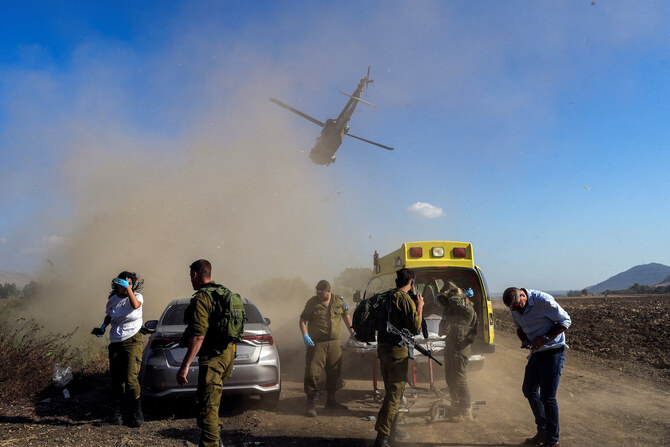
Israeli media reported “two injuries in the Dishon area in Galilee, where several rockets fell after being launched from Lebanon.” There were also reports that “a rocket fell in the Kfar Blum area in Upper Galilee,” “a fire broke out in the Kiryat Shmona settlement due to rockets launched from Lebanon,” and additional rockets struck between Kiryat Shmona and Beit Hillel.
Israeli army media advised settlers in Kiryat Shmona “to remain near shelters and avoid moving around the city until further notice.” Upper Galilee Regional Council similarly urged citizens in several towns to “stay close to shelters, avoid gatherings and decrease movement.”
In its latest report, the Alma Research and Education Center in Israel said 281 attacks on the country originated from Lebanon in August, compared with 259 in July.
“Most of these attacks were carried out by Hezbollah, along with other organizations,” it said. “The average number of daily attacks reached nine in August, compared with 8.3 attacks in July, with Hezbollah confirming its responsibility for the vast majority of them.”
The Hezbollah attacks resulted in “the deaths of three Israelis and injuries to 30 others” last month, it added.
“The middle of the month saw an escalation in Hezbollah’s assaults, which continued until Aug. 25, when Israeli forces conducted a preemptive strike to thwart Hezbollah’s response to the assassination of (its military leader) Fuad Shukr,” the research center said.
The report noted a subsequent “decline in attacks,” suggesting that “the intensity of these attacks coincided with the Israeli military’s targeting of Hezbollah operatives” and were “potentially aimed at exhausting Israeli defense systems in preparation for a planned retaliatory strike on Aug. 25.”
It added: “Kiryat Shmona was an important target for Hezbollah attacks, which resulted in the death of one civilian and injuries to 28 others, in addition to heavy losses to industrial facilities, educational institutions, residential properties, cemeteries and commercial complexes.”
The report also stated: “During August, Hezbollah used the term ‘appropriate weapons’ to refer to various types of armaments. Previously, this term in their statements was specifically associated with anti-tank missiles. In August, however, it became evident that the term encompassed artillery fire, anti-tank missiles and drones.”
Last month, it added, there was “an increase in (Hezbollah’s) utilization of long-range missiles, with 176 missiles launched compared with 137 in July. Additionally, the number of drone attacks rose to 62 in August, up from 56 in July. Throughout August, Hezbollah employed surface-to-air missiles and sniper fire.”


![]()

Cross-border attacks by Israeli forces and Hezbollah resume after period of uneasy calm
Short Url
https://arab.news/rf67a
Cross-border attacks by Israeli forces and Hezbollah resume after period of uneasy calm
- Research center in Israel says 281 attacks on the country originated from Lebanon in August, compared with 259 in July
- In Israel, sirens sounded in the settlements of Zar’it, Shtula, Netu’a, Dishon and Al-Malikiyah, and in Ramot Naftali in western Galilee


Latest updates


© 2026 SAUDI RESEARCH & PUBLISHING COMPANY, All Rights Reserved And subject to Terms of Use Agreement.