

Pakistani finance minister says economic reforms meant to boost foreign investment

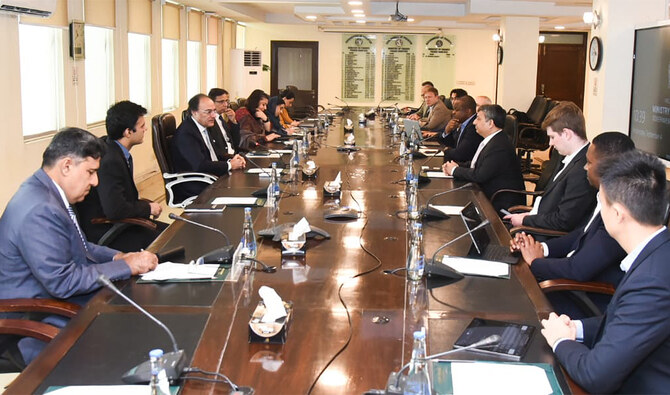
Pakistan's Federal Minister for Finance and Revenue Muhammad Aurangzeb (third in left row) meets a delegation of international investors led by the top JP Morgan official in Pakistan in Islamabad, Pakistan, on September 4, 2024. (@Financegovpk/X)
Short Url
Updated 04 September 2024
Follow

Pakistani finance minister says economic reforms meant to boost foreign investment

  • Muhammad Aurangzeb meet a delegation of foreign investors, highlights macroeconomic gains
  • The delegation says Pakistan can be a gateway to regional markets investors seek to explore

ISLAMABAD: Federal Minister for Finance and Revenue Muhammad Aurangzeb said on Wednesday Pakistan was undertaking structural and financial reforms to create a conducive environment for foreign investment and stabilize the national economy while meeting with a delegation of international investors led by the top JP Morgan official in Pakistan.

Last year, Pakistan set up the Special Investment Facilitation Council, a hybrid civil-military body, to encourage international businesses to explore opportunities in the country by streamlining investment procedures amid prolonged economic challenges.

The finance minister briefed the visiting delegation about Pakistan’s improving macroeconomic indicators, including a 14 percent rise in exports, a decline in inflation to 9.6 percent and an overall decrease in the current account deficit.

He also pointed out the improvement in Pakistan’s sovereign credit ratings, saying they reflected a stable and promising economic outlook.

“The country’s economic growth is underpinned by robust fiscal discipline, inflation management, and a favorable balance of payments,” he told the delegation, according to an official statement.

He informed the government was also trying to broaden the tax base, cut down the public sector size and proceed with the privatization drive.

“These reforms are designed to create a more conducive environment for foreign investment and to ensure the long-term stability of the economy,” he added.

The visiting delegation discussed a range of potential investment areas, including renewable energy, information technology, infrastructure development and the financial sector.

They maintained that Pakistani market had immense potential, adding the strategic location of the country made it a gateway to regional markets where foreign investors were eager to explore opportunities.

The foreign minister welcomed the delegation’s interest in investing in Pakistan and assured its members of the government full support.


Pakistan minister orders measures to ease port congestion, speed up sugar and cement handling

Updated 7 sec ago
Follow

Pakistan minister orders measures to ease port congestion, speed up sugar and cement handling

  • Meeting in Islamabad reviewed congestion at Port Qasim and its impact on export shipments
  • Ports directed to enforce first-come, first-served berthing and penalize unnecessary delays

KARACHI: Pakistan’s Maritime Affairs Minister Junaid Anwar Chaudhry on Saturday directed authorities to streamline sugar and cement operations at Port Qasim after reports of severe congestion caused by the slow unloading of sugar consignments disrupted export activities.

The government has been working to ease port bottlenecks that have delayed shipments and raised logistics costs for exporters, particularly in the cement and clinker sectors. The initiative is part of a broader effort to improve operational efficiency and align port management with national trade and logistics priorities.

“Improving operational efficiency is vital to prevent port congestion, which can cause delays, raise costs, and disrupt the supply chain,” Chaudhry told a high-level meeting attended by senior officials from the maritime and commerce ministries, port authorities and the Trading Corporation of Pakistan.

The meeting was informed that sugar was being unloaded at a rate below Port Qasim’s potential capacity. The minister instructed the Port Qasim Authority to optimize discharge operations in line with its daily capacity of about 4,000 to 4,500 tons.

Participants also reviewed directives from the Prime Minister’s Office calling for up to 60 percent of sugar imports to be redirected to Gwadar Port to ease the load on Karachi terminals.

Officials said all vessels at Port Qasim and Karachi Port would now be berthed on a first-come, first-served basis, with penalties to be applied for unnecessary delays.

The TCP was told to improve operational planning and coordinate vessel arrivals more closely with port authorities.

Chaudhry commended the engagement of all participants and said consistent adherence to performance standards was essential to sustaining port efficiency and preventing a recurrence of logistical disruptions.