Lebanese already haunted by past traumas fear more catastrophes to come

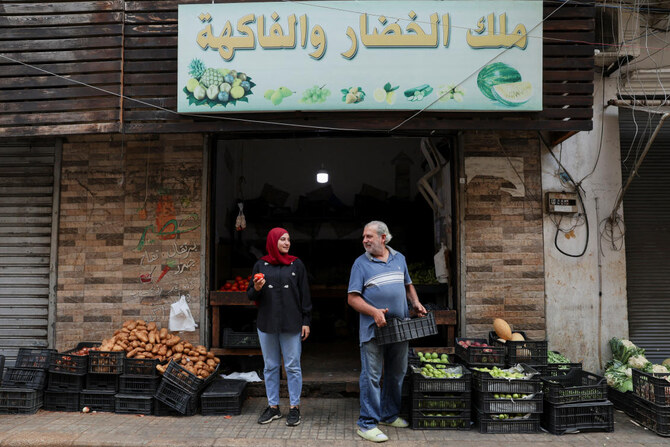
Fruits and vegetable shop owner, Hussein Fakih, and his daughter, Alaa, in front of their shop in Bourj Hammoud, Lebanon. (Reuters)
Short Url
Updated 04 September 2024
Follow

Lebanese already haunted by past traumas fear more catastrophes to come

  • People are now most anxious about the prospect of another full blown conflict between Hezbollah and Israel
  • Lebanon took years to rebuild from a 2006 war between the arch-foes which killed 1,200 people in Lebanon

BEIRUT: Shopkeeper Alaa Fakih lies awake at night scared that another catastrophe could strike Lebanon. Like many she is traumatized by the past — from the 1975-1990 civil war to a devastating Beirut port blast in 2020 and an enduring economic collapse — and fearful of the future.
“I shouldn’t be thinking about all these things — I’m thinking how to continue my daughter’s education and if, for example, I was walking and God forbids, an explosion happens,” said Fakih, 33, whose heart beats rapidly at night as she shivers.
“How to walk and not have an explosion. All these have a negative effect on my psychological well-being.” People are now most anxious about the prospect of another full blown conflict between Lebanon’s armed group Hezbollah and Israel, who have been engaged in border warfare since the Gaza war erupted in October. Lebanon took years to rebuild from a 2006 war between the arch-foes which killed 1,200 people in Lebanon, mostly civilians, and 158 Israelis, most of them soldiers.
Decades of corruption and mismanagement by ruling politicians led the financial system to collapse in 2019, wiping out savings, demolishing the currency and fueling poverty.
The following year, Beirut was shattered by a huge chemicals explosion at the port that killed at least 220 people and was so powerful it was felt 250 km (155 miles) away in Cyprus and sent a mushroom cloud over the Lebanese capital. Political pressure has derailed an investigation that sought to prosecute powerful people over the explosion.
“One can cry from the slightest things, your tears come down,” said Fakih.
COPING MECHANISMS
Psychoanalyst Alyne Husseini Assaf said Lebanese have struggled to process the many layers of suffering. Some hide away their feelings. Others live in denial.
“There’s a defense mechanism of escaping, mostly with alcohol or drugs. There’s also a defense mechanism where the person escapes in psychological and physical symptoms, sits in bed and does not want to do anything anymore,” she said.
Once called the Switzerland of the Middle East, Lebanon descended into a brutal multi-sided civil war in 1975.
Reminders of the war are not hard to find, including bullet-riddled buildings in an area once known as the Green Line that split Beirut into Christian East and mainly Muslim West.
Sectarian tensions and memories of war linger on.
“There is a psychological legacy passed on from a generation to the next and it stays alive if the person does not work on themselves on a psychological level,” said Assaf.
All it takes is a sonic boom over Beirut to trigger panic attacks.
Manal Syriani, the mother of Eidan, 4, is typical. Her trauma is triggered by memories of the port explosion.
“There’s no follow up, there’s no justice, no one is telling you what’s going on,” said Syriani, who is in the hospitality business.
“There is now a person relying on me so how will I make this person feel safe? I mean, anything could happen. He could be playing outside and a shell falls, that’s it.”
She has sought relief from her thoughts at a church.
“It’s this calmness, this is what I seek, this is what makes me... that gives you fuel to keep going, to repeat the same cycles, to go through the same cycles again.”


Deal with Iran ‘Unimaginable,’ Pompeo tells WGS in Dubai

Updated 4 sec ago
Follow

Deal with Iran ‘Unimaginable,’ Pompeo tells WGS in Dubai

  • UAE’s Gargash says he would like to see direct US negotiations with Tehran

DUBAI: Former US secretary of State, Mike Pompeo, told the World Government Summit in Dubai on Monday that he believed a deal between Iran and the United States was “unimaginable” under the current Ayatollah regime believing US strikes on the nation were still a possibility despite the apparent deescalation of the last few days.

“It's unimaginable that there could be a deal. To me, we've had a deal with Iranians multiple times,” he told a panel in Dubai on Tuesday.

“They have cheated and lied and avoided compliance with every deal they've signed.”

Pompeo was central to the US decision to leave the Joint Comprehensive Plan of Action (JCPOA) nuclear deal when he served as secretary during Donald Trumps first term. According to the US department of Justice, the Islamic Republic subsequently placed a $1 million bounty on his head.

Trump has in previous days said the US was seeking to srike a deal with Iran whilst simultanously ordering a large scale militray build up in the region. Pompeo said that he believed the US president could use military strikes – or at least the threat of them – to increase leverage on the regime to give up its enrichment and missiles fully, although he remained cynical of anything being achieved without regime change. 

“To think that there's a long-term solution that actually provides stability and peace to this region while the Ayatollah was still in power, is something I pray for, but find unimaginable,” Pompeo said.

On Syria, Pompeo expressed cautious optimism that the interim president Ahmed Hussein al-Sharaa will succeed in rebuilding his country with a lasting peace.

Al-Sharaa has previously said he was focused on consolidating power, rebuilding state institutions, integrating military factions, and restoring Syria's international relations, including with the United States, Russia, and regional powers.

Pompeo said he maintained a level of mistrust in the Syrian president – most notably due to his involvement with Al-Qaeda - but added that he hoped Al-Sharaa would do well.

 “I have known of Mr. Sharaa for a long time, when I was a CIA director… we had a $10m bounty on his head. He was an Al Qaeda terrorist,” he said.

“It is important for the region to get stability in Syria and so I am rooting for him…. I hope we all do our part to help him be more successful at bringing a very fractured nation back together so that.”

He said he hoped the up to seven million people who had fled the country as refugees could one day return to their homes.

“But it is a very difficult task for anyone and someone with the history that he has, I think it makes it even more complicated for him to be successful. But he’s the leader today and we all should hope that he is able to pull off what It is he has stated his intentions are.”

Pompeo was joined on stage by former UAE Minister of State for Foreign Affairs, Anwar Gargash, who was more hopeful of a diplomatic solution to the Iranian crisis; saying the region stood firm against escalation and further prolonged military conflict.

Gargash believed that it was in the best interest of Iran to strike a deal with the US that would open the pathway to it resolving its multitude of crises.

“I think that the region has gone through various various calamitous confrontations. I don't think we need another one,” he told the summit.

“I would like to see direct Iranian American negotiations leading to understandings so that we don't have these issues every other day.”

Speaking more broadly on regional security, Gargash said resolving the Palestinian issue was still of utmost importance if the middle east was to secure a prosperous future. He said that the UAE was commiitted to seeing through the Trumps plan but ruled out rumours that the emirates was poised to take over governance of the territory.

“We have to work with the Palestinians. We have to work with the Egyptians, the Israelis, the Jordanians, and of course, American leadership is key, really, for achieving a sort of, I won't say, sustainable solution at this time, but moving on with with the part two of President Trump's plan,” he said.

On the international stage, Gargash said he bvelived the health of the China-US relationship was the biggest hinderence to peace – warning that if not managed properly it would likely lead to increasing comflict around the world. He said it was paramount that the two countries maintained a mature relationship based on competition.