Oil Updates – crude extends drop on easing Libyan dispute, demand concerns

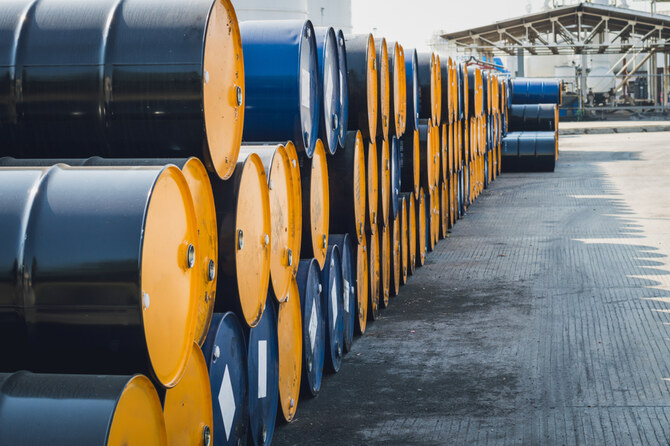
Brent crude futures for November fell 43 cents, or 0.6 percent, to $73.32 by 9:45 Saudi time. Shutterstock
Short Url
Updated 04 September 2024
Follow

Oil Updates – crude extends drop on easing Libyan dispute, demand concerns

SINGAPORE: Oil prices fell on Wednesday, extending a plunge of more than 4 percent the previous day and hovering at their lowest since December, on expectations that a political dispute halting Libyan exports could be resolved and concerns over sluggish global demand.

Brent crude futures for November fell 43 cents, or 0.6 percent, to $73.32 by 9:45 Saudi time, after the previous session’s fall of 4.9 percent. US West Texas Intermediate crude futures for October were down 49 cents, or 0.7 percent, at $69.85, after dropping 4.4 percent on Tuesday.

Both contracts fell to their lowest since December on signs of a deal to resolve the political dispute between rival factions in Libya that cut output by about half and curbed exports.

“Selling continued in Asia amid expectations of a potential deal to resolve the dispute in Libya,” said Toshitaka Tazawa, an analyst at Fujitomi Securities Co. Ltd.

“The market remained under pressure also because of concerns over sluggish fuel demand following weak economic indicators from China and the United States.”

Libya’s two legislative bodies agreed on Tuesday to jointly appoint a central bank governor, potentially defusing the battle for control of oil revenue that set off the dispute.

Libyan oil exports at major ports were halted on Monday and production cut nationwide. Libya’s National Oil Corp. declared force majeure on its El Feel oilfield from Sept. 2.

“Easing political tension in Libya potentially seeing some supplies return and economic weakness in the world’s largest oil consumers, US and China, serve as a confluence of headwinds for oil prices,” said Yeap Jun Rong, a market strategist at IG.

“The faster contraction in new orders and production, along with increasing prices, presented in the US manufacturing PMI data seems to be renewing growth fears, which does not offer much reassurance around the oil demand outlook.”

Market sentiment weakened after Tuesday’s Institute for Supply Management data showing that US manufacturing remained subdued, despite a modest improvement in August from an eight-month low in July.

In China, the world’s biggest importer of crude, recent data showed that manufacturing activity sank to a six-month low in August, when growth in new home prices slowed.

Weekly US inventory data has been delayed by Monday’s Labor Day holiday. The report from the American Petroleum Institute is due at 11:30 p.m. Saudi time on Wednesday and data from the Energy Information Administration will be published at 6:00 p.m. Saudi time on Thursday.

US crude oil and gasoline stockpiles were expected to have fallen last week, while distillate inventories probably rose, a preliminary Reuters poll showed on Tuesday. 


Industry leaders highlight Riyadh’s Metro, infrastructure as investment catalysts

Updated 29 December 2025
Follow

Industry leaders highlight Riyadh’s Metro, infrastructure as investment catalysts

RIYADH: Saudi Arabia’s capital, Riyadh, is experiencing a transformative phase in its real estate sector, with the construction market projected to reach approximately $100 billion in 2025, accompanied by an anticipated annual growth rate of 5.4 percent through 2029.

The Kingdom is simultaneously advancing its data center capacity at an accelerated pace, with an impressive 2.7 GW currently in the pipeline. This expansion underscores the critical role of strategic land and power planning in establishing national infrastructure as a cornerstone of economic growth.

These insights were shared by leading industry experts during JLL’s recent client event in Riyadh, which focused on the city’s macroeconomic landscape and emerging trends across office, residential, retail, hospitality, and pioneering sectors, including AI infrastructure and Transit-Oriented Development.

Saud Al-Sulaimani, Country Lead and Head of Capital Markets at JLL Saudi Arabia, commented: “Riyadh is positioned at the forefront of Saudi Arabia’s Vision 2030, offering unparalleled opportunities for both investors and developers. National priorities are continuously recalibrated to ensure strategic alignment of projects and foster deeper collaboration with the private sector.”

He added: “Recent regulatory developments, including the introduction of the White Land Tax and the rent freeze, are designed to stabilize the market and are expected to drive renewed focus on delivering premium-quality assets. This dynamic environment, coupled with evolving construction cost considerations in select segments, is fundamentally reshaping the market landscape while accelerating progress toward our national objectives.”

The event further underscored the transformative impact of infrastructure initiatives. Mireille Azzam Vidjen, Head of Consulting for the Middle East and Africa at JLL, highlighted Riyadh’s transit revolution. She detailed the Riyadh Metro, a $22.5 billion investment encompassing 176 kilometers, six lines, and 84 stations, providing extensive geographic coverage, with a depth of 9.8 km per 100 sq. km. This strategic development generates significant TOD opportunities, with properties in proximity potentially commanding a 20-30 percent premium. JLL emphasized the importance of implementing climate-responsive last-mile solutions to enhance mobility and accessibility, particularly given Riyadh’s extreme temperatures.

Gaurav Mathur, Head of Data Centers at JLL, emphasized the rapid expansion of the Kingdom’s AI infrastructure, signaling a critical area for technological investment and innovation.

Focusing on the construction sector, Maroun Deeb, Head of Projects and Development Services, KSA at JLL, explained that the industry is actively navigating complexities such as skilled labor availability, material costs, and supply chain dynamics.

He highlighted the adoption of Building Information Modeling as a key driver for enhancing operational efficiency and project delivery.