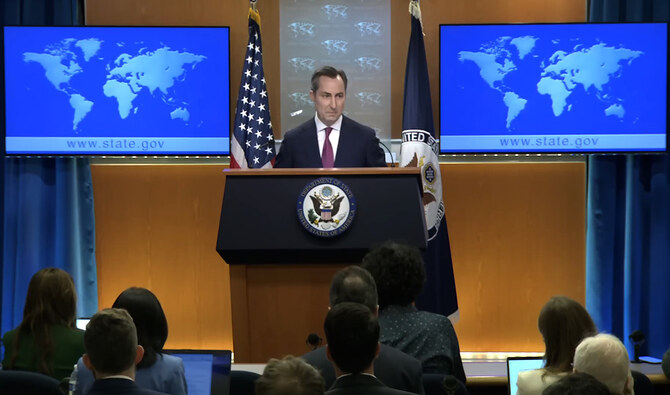
ISLAMABAD: Matthew Miller, the spokesperson for the US Department of State, said on Tuesday Washington would not advise any country, including Pakistan, of “considering business deals” with Iran, warning of “ramifications” such as sanctions.
The Pakistan-Iran gas pipeline, known as the Peace Pipeline, is a long-term project between Tehran and Islamabad, which has faced delays and funding challenges for over two decades. The pipeline would transport natural gas from Iran to neighboring Pakistan.
Pakistan said in March it would seek a US sanctions waiver for the pipeline, to which the US responded publicly, saying it did not support the project and cautioned about the risk of sanctions in doing business with Tehran.
Widespread media reports this week suggested Iran had slapped Pakistan with a final notice to finish its part of a cross-border gas pipeline or face international arbitration and possibly billions of dollars in fines.
“We will continue to enforce our sanctions against Iran. And as a matter of course, we also advise anyone considering business deals with Iran to be aware of the potential ramifications of those deals,” Matthew told reporters in response to a question about Pakistan’s push to complete the pipeline and seek a US sanctions waiver.
“At the same time, helping Pakistan address its energy shortage is a priority for the United States, and we continue to discuss energy security with the Government of Pakistan.”
The pipeline deal, signed in 2010, envisaged the supply of 750 million to a billion cubic feet per day of natural gas for 25 years from Iran’s South Pars gas field to Pakistan to meet its rising energy needs. The pipeline was to stretch over 1,900 kilometers (1,180 miles) — 1,150 km within Iran and 781 km within Pakistan.
Tehran says it has already invested $2 billion to construct the pipeline on its side of the border, making it ready to export. Pakistan, however, did not begin construction and shortly after the deal said the project was off the table for the time being, citing international sanctions on Iran as the reason.
Iran’s oil minister at the time responded by saying that Iran carried out its commitments and expected Pakistan to honor its own, adding that Pakistan needed to pick up the pace of work.
In 2014, Pakistan asked for a 10-year extension to build the pipeline, which expires in September this year. Iran can take Pakistan to international court and fine the country. Local media has reported Pakistan can be fined up to $18 billion for not holding up its half of the agreement.
Faced with a potential fine, Pakistan’s government earlier this year gave the go ahead in principle to commence plans to build an 80 km segment of the pipeline. In March, Pakistan announced it would seek the sanctions’ waiver.
Washington’s support is crucial for Pakistan as the country seeks approval from the IMF executive board for a 37-month $7 billion bailout program signed in July.
Pakistan, whose domestic and industrial users rely on natural gas for heating and energy needs, is in dire need for cheap gas with its own reserves dwindling fast and LNG deals making supplies expensive amidst already high inflation.
Iran has the world’s second-largest gas reserves after Russia, according to BP’s Statistical Review of World Energy, but sanctions by the West, political turmoil and construction delays have slowed its development as an exporter.
Originally, the Pakistan-Iran deal also involved extending the pipeline to India, but Delhi later dropped out of the project.
“I fully support the efforts by the US government to prevent this pipeline from happening,” US Assistant Secretary of State Donald Lu said as he gave testimony at a Congressional hearing earlier this year. “We are working toward that goal.”


![]()

US warns Pakistan of ‘ramifications’ of business deals with Iran amid gas pipeline dispute
Short Url
https://arab.news/bzwuj
US warns Pakistan of ‘ramifications’ of business deals with Iran amid gas pipeline dispute
- Iran has slapped Pakistan with final notice to finish its part of cross-border gas pipeline or face international arbitration
- Pakistan said in March it would seek US sanctions waiver for the gas pipeline but Washington says it does not support the project
Latest updates


© 2026 SAUDI RESEARCH & PUBLISHING COMPANY, All Rights Reserved And subject to Terms of Use Agreement.