

Norway wealth fund may divest companies that aid Israel in Gaza war, occupied territories

1 / 4
A Palestinian man lifts a national flag and flashes the victory sign as Israeli armoured vehicles including a bulldozer drive on a street during a raid in Tulkarem on September 3, 2024, amid a large-scale military offensive launched a week earlier in the occupied West Bank. (AFP)
2 / 4
An Israeli soldier takes position next to an army vehicle on a street damaged by bulldozers during a raid in the centre of Jenin in the occupied West Bank on September 3, 2024. (AFP)
3 / 4
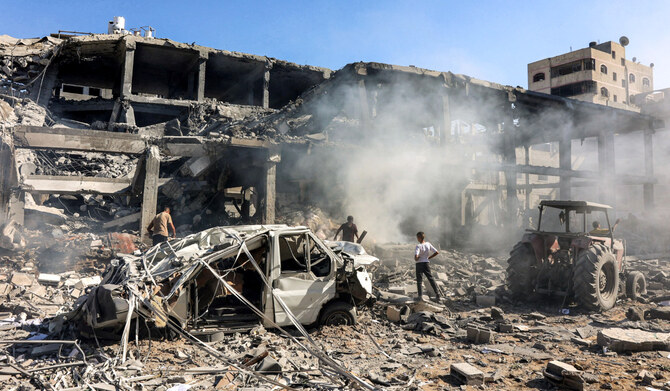
Men walk through debris in a building that was hit by Israeli bombardment in the Sheikh Radwan neighbourhood in the north of Gaza City on September 3, 2024 amid the ongoing war in the Palestinian territory between Israel and Hamas. (AFP)
4 / 4
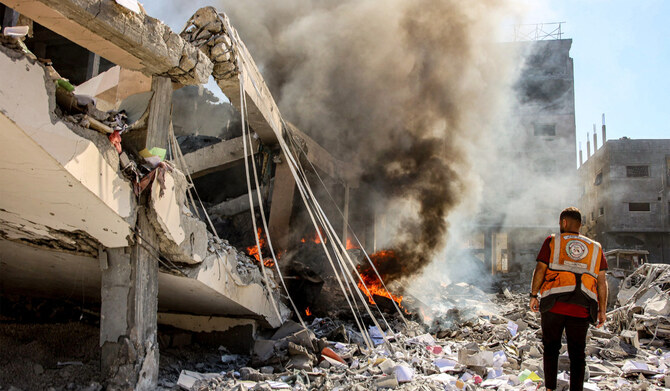
A Palestinian civil defence member stands near a building on fire that was hit by Israeli bombardment in the Sheikh Radwan neighbourhood in the north of Gaza City on September 3, 2024 amid the ongoing war in the Palestinian territory between Israel and Hamas. (AFP)
Short Url
Updated 04 September 2024
Follow

Norway wealth fund may divest companies that aid Israel in Gaza war, occupied territories

  • According to nongovernmental organizations, they make weapons used by Israel in Gaza, where its military offensive has killed nearly 41,000 Palestinians
  • The new definition of ethical breaches is based on the ICJ finding that “the occupation itself, Israel’s settlement policy and the way Israel uses the natural resources in the areas are in conflict with international law,” the letter said

OSLO: Norway’s $1.7 trillion wealth fund may have to divest shares of companies that violate the fund watchdog’s new, tougher interpretation of ethics standards for businesses that aid Israel’s operations in the occupied Palestinian territories.
The Council on Ethics for the world’s largest sovereign wealth fund sent an Aug. 30 letter to the finance ministry, seen by Reuters, that summarises the recently expanded definition of unethical corporate behavior. The change has not previously been reported.
The letter did not specify how many nor name companies whose stocks might be sold but suggested it would be a small number, should the board of the central bank, which has the final say, follow recommendations that the council makes.

HIGHLIGHTS

• Norway fund is world's largest sovereign wealth fund

• Companies active in occupied West Bank under review

• US arms producers being probed over Gaza war

• Watchdog expects to recommend "a few" companies for divestment

One company has already been identified for disinvestment under the new definition, it said. “The Council on Ethics believes the ethical guidelines provide a basis for excluding a few more companies from the Government Pension Fund Global in addition to those already excluded,” the watchdog wrote, giving the formal name for Norway’s sovereign wealth fund.
The fund has been an international leader in the environmental, social and governance (ESG) investment field. It owns 1.5 percent of the world’s listed shares across 8,800 companies, and its size carries influence.
Since the start of the war in Gaza in October, the fund’s ethics watchdog has been investigating whether more companies fall outside its permitted investment guidelines. The letter said that the scope of exclusions was “expected to increase somewhat” under the new policy.
Among the companies that the watchdog could be looking at are RTX Corp, General Electric and General Dynamics. According to nongovernmental organizations, they make weapons used by Israel in Gaza, where its military offensive has killed nearly 41,000 Palestinians. The companies did not immediately reply to requests for comment.
The fund held investments worth 16 billion crowns ($1.41 billion) in Israel as of June 30, across 77 companies, according to fund data, including companies involved in real estate, banks, energy and telecommunications. They represented 0.1 percent of the fund’s overall investments.

NEW LEGAL OPINION
On Gaza, the council is focusing on weapon producers in countries not participating in the Arms Trade Treaty, a 2014 agreement on conventional weapons trade. “This mainly concerns American companies,” the letter said, without naming any.
It added, “There are very few relevant companies remaining in the fund” partly because many US defense manufacturers were already barred for producing nuclear weapons or cluster munitions.
The fund’s ethical rules are set by Norway’s parliament. The updated ethics definition by the watchdog results partly from a July opinion by the International Court of Justice regarding Israel’s occupation of Palestinian territories.
The court took positions on “several new facts and legal issues” that could make “companies with a less direct connection to violations of norms” in breach of the ethics rules, the letter said without providing examples.
The new definition of ethical breaches is based on the ICJ finding that “the occupation itself, Israel’s settlement policy and the way Israel uses the natural resources in the areas are in conflict with international law,” the letter said.
The fund previously divested from nine companies operating in the occupied West Bank under its prior policy. Their operations include building roads and homes in Israeli settlements in East Jerusalem and the West Bank and providing surveillance systems for an Israeli wall around the West Bank.
The Council on Ethics makes recommendations to the board of the central bank, which operates the fund. The bank often follows the watchdog’s advice to exclude firms, but not always.
The bank can also put a company on notice to change its behavior or ask the fund’s management to engage with it directly. Companies designated for disinvestment are not named until the fund has sold the shares.



Political stability at stake as Malaysia’s Najib awaits verdict in biggest 1MDB trial

Updated 13 sec ago
Follow

Political stability at stake as Malaysia’s Najib awaits verdict in biggest 1MDB trial

  • A Malaysian high court will decide on Friday whether to convict Najib of four more charges of corruption and 21 counts of money laundering involving the illegal transfer of about 2.2 billion ringgit ($539 million) from 1MDB

KUALA LUMPUR: Jailed former Malaysian Prime Minister Najib Razak will hear a verdict ​on Friday in the biggest trial he faces over the multibillion-dollar 1MDB scandal, a ruling that could risk deepening tensions within the administration of current premier Anwar Ibrahim.
Investigators have said about $4.5 billion was allegedly stolen from 1Malaysia Development Berhad, a state fund co-founded by Najib in 2009, and that more than $1 billion allegedly made its way into his personal bank accounts. Najib, 72, last year apologized for mishandling the scandal while in office but he has consistently denied wrongdoing, saying he was misled by 1MDB officials and a fugitive ‌financier, Jho Low, on ‌the source of the funds. In 2020, Najib was ‌convicted ⁠of ​graft and ‌money laundering for illegally receiving funds from a 1MDB unit and began a 12-year prison sentence two years later after losing all his appeals. That sentence was later halved by a pardons board chaired by Malaysia’s king, with Najib due for release in 2028.
A Malaysian high court will decide on Friday whether to convict Najib of four more charges of corruption and 21 counts of money laundering involving the illegal transfer of about 2.2 billion ringgit ($539 million) from 1MDB.
If ⁠found guilty, he could face maximum jail terms of between 15 and 20 years on each charge, as ‌well as a fine of up to five times the ‍value of the alleged misappropriations.
The implementation ‍of the penalties, however, could be stayed pending further appeals.

VERDICTS TEST GOVERNMENT STABILITY

The decision ‍will be closely watched after another court this week dismissed a bid by Najib to serve the remainder of his sentence under house arrest.
That ruling reignited tensions in Anwar’s ruling administration, which includes Najib’s party, the United Malays National Organization.
UMNO campaigned against Anwar in a 2022 election but joined his coalition ​to form a government after the poll ended in a hung parliament.
Several UMNO leaders expressed disappointment with the decision to deny Najib house arrest, ⁠saying it risked diluting the powers of Malaysia’s rulers, while others were angered by social media posts by some members of Anwar’s coalition celebrating the ruling.
Anwar this week called for all parties to handle news of the verdict with patience and wisdom, adding that it was “inappropriate to muddy the atmosphere or add tension” even if there were those who chose not to sympathize with Najib and his family. A guilty verdict for Najib on Friday could strain ties further, with some UMNO leaders already calling for the party to review its pact with Anwar or withdraw from the government altogether. An acquittal, however, may weaken Anwar, who has been under pressure to uphold his credentials as an anti-graft campaigner. Anwar has been accused by critics of ‌betraying progressive voters and allies after prosecutors dropped some corruption charges against Najib and other UMNO figures. The premier has repeatedly said he does not interfere in court cases.