



NEW YORK: Columbia University resumed classes Tuesday with students sunbathing and eating ice cream on the lawn that was home to a pro-Palestinian encampment last spring. But there were also fresh demonstrations just off campus, and students and faculty say they’re planning for more as the new school year unfolds.
In recent weeks, the university’s new leadership has embarked on listening sessions aimed at cooling tensions, released a report on campus antisemitism and circulated new protest guidelines meant to limit disruption. But student organizers are undeterred, promising to ramp up their actions — including possible encampments — until the university agrees to cut ties with companies linked to Israel.
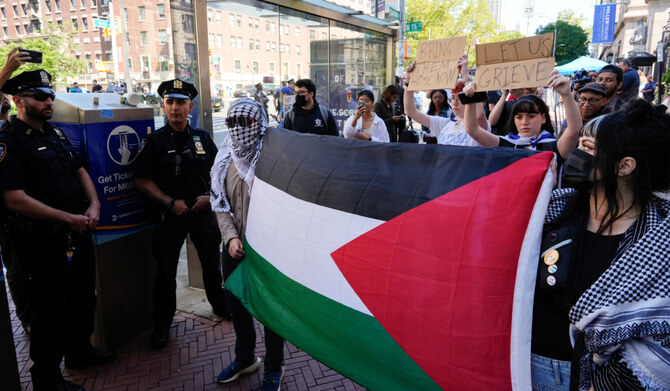
Someone splattered red paint Tuesday on a statue in front of the Low Memorial Library. Outside the gates of the university, a small group of protesters marched on a picket line and urged arriving students and faculty to join them rather than go to class.
“As long as Columbia continues to invest and to benefit from Israeli apartheid, the students will continue to resist,” Mahmoud Khalil, a graduate student who represented campus protesters in negotiations with the university, told The Associated Press last week ahead of the start of classes. “Not only protests and encampments, the limit is the sky.”
The new year begins less than a month after the resignation of Columbia’s president, Minouche Shafik, whose decision to bring police on campus to clear a protest encampment in April set off a wave of college demonstrations nationwide. After a second encampment was erected and a group of students occupied a university building, hundreds of police officers surged onto campus, making arrests and plunging the university into lockdown.
Since Shafik’s resignation, the interim president, Katrina Armstrong, has met with students on both sides of the issue, promising to balance students’ rights to free expression and a safe learning environment. While the message has inspired cautious optimism among some faculty, others see the prospect of major disruptions as all but inevitable.
“We are hoping for the best, but we are all wagering how long before we go into total lockdown again,” said Rebecca Korbin, a history professor who served on Columbia’s antisemitism task force. “There haven’t been any monumental changes, so I don’t know why the experience in the fall would look much different than what it did in the spring.”
In a report released Friday, the task force of Columbia faculty accused the university of allowing “pervasive” antisemitism to fester on campus following the Oct. 7 Hamas attack. The report recommended that the university revamp its disciplinary process and require additional sensitivity training for students and staff.
Demonstrations against the war have already started bubbling up on college campuses this semester, including one at the University of Michigan that resulted in multiple arrests.
The University of Maryland announced that it will not allow student organizations to hold any on-campus demonstrations on Oct. 7, the anniversary of the Hamas attacks in Israel. It took the action after at least one group reserved a location for a vigil commemorating Palestinians killed in Gaza.
“Numerous calls have been made to cancel and restrict the events that take place that day, and I fully understand that this day opens emotional wounds and evokes deeply rooted pain,” University of Maryland President Darryll Pines wrote in a letter Sunday. “The language has been charged and the rhetoric intense.”
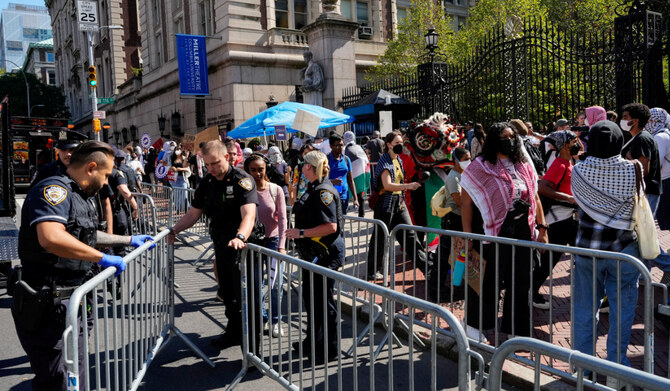
Columbia’s steps to limit protests this semester have included restricting access to campus.
The university’s tall iron gates, long open to the public, are now guarded, requiring students to present identification to enter campus. Inside, private security guards stand on the edge of the grassy lawns that students had seized for their encampment. A new plaque on a nearby fence notes that “camping” is prohibited.
On Tuesday morning, dozens of pro-Palestinian protesters demonstrated outside one entrance to the university, some beating drums, while a long line of students and staff made their way through the checkpoint. At another entrance, protesters used a megaphone to implore those in line to instead join their picket line.
Later, two protesters outside the gates of Barnard College, the university’s nearby sister school, were taken into custody by police. The New York Police Department did not immediately have any details on the arrests.
Speaking to the AP ahead of the start of classes, Layla Hussein, a junior at Columbia who helped to lead orientation programming, described the added security measures as an unwelcome and hostile distraction.
“We’re trying to cultivate a welcoming environment. It doesn’t help when you look outside and it’s a bunch of security guards and barricades,” Hussein said.
Others have accused the university of treating student protesters too leniently, arguing that a lack of clear guidelines would result in further turmoil. Though some of those disciplinary cases remain ongoing, prosecutors have dropped charges against many of the students arrested last semester, and the university has allowed them to return to campus.
“They violated every rule in the book, and they openly state they’ll continue to do so,” said Elisha Baker, a junior at Columbia who leads an Israeli engagement group, adding: “We need to have a serious reckoning with the disciplinary process to make sure students have a safe learning environment.”
After Jewish students sued Columbia, accusing them of creating a dangerous environment on campus, the university agreed in June provide a “safe passage liaison” to those concerned with protest activity.
In July, Columbia removed three administrators who exchanged private text messages disparaging certain speakers during a discussion about Jewish life in a manner Shafik said touched on “ancient antisemitic tropes.” One of the administrators had suggested in a text that a campus rabbi was going to turn concerns about antisemitism into a fundraising opportunity.
A spokesperson for Columbia said the university had since bolstered its guidelines around protests and developed new training for incoming students on antisemitism and Islamophobia.
The revised protest guidelines require organizers to inform the university of any scheduled protests, barring any demonstrations that pose “a genuine threat of harassment” or “substantially inhibit the primary purposes” of university space.
Like many universities, Columbia is also in the midst of a contentious debate about the definition of antisemitism, and whether anti-Zionist speech — common at the student protests — should be seen as a form of discrimination.
At New York University, which also saw large-scale protests and an encampment last spring, an updated code of conduct now warns students that speech critical of Zionism could run afoul of its anti-discrimination policy. The move has drawn praise from major Jewish groups, as well as backlash from student groups and some faculty.
The Columbia task force report defines antisemitism as “prejudice, discrimination, hate, or violence directed at Jews, including Jewish Israelis,” “double standards applied to Israel” and exclusion or discrimination based on “real or perceived ties to Israel.”
Eduardo Vergara, a graduate student at Columbia who teaches literature in the Spanish department, said many instructors were going into the semester uncertain about what they could and couldn’t say in the classroom. He said he fully expected to spend much of the semester discussing the war in Gaza and the reaction on campus.
“It feels like everything is calm now,” he added. “I don’t think that’s going to last long.”


