

Ukraine foreign minister resigns amid war’s biggest reshuffle

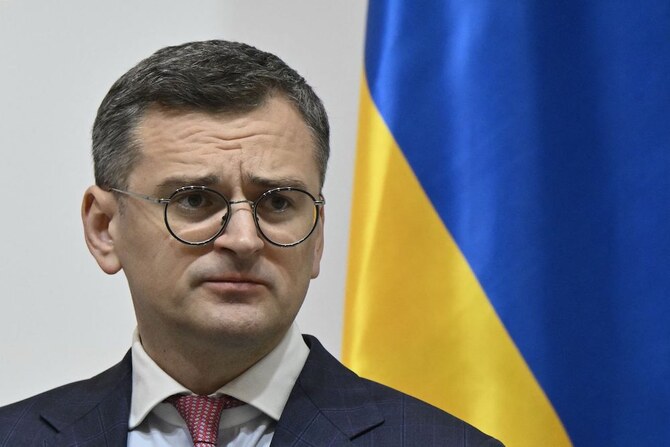
Ukrainian Foreign Minister Dmytro Kuleba’ resignation letter was posted on Facebook by the speaker of parliament, Ruslan Stefanchuk. (AFP)
Short Url
Updated 04 September 2024
Follow

Ukraine foreign minister resigns amid war’s biggest reshuffle

  • Dmytro Kuleba was the best-known face of Ukraine overseas, meeting leaders around the world and lobbying for military and political support in fluent English

KYIV: Ukrainian Foreign Minister Dmytro Kuleba resigned on Wednesday, the highest-profile casualty so far of a major government reshuffle ordered by President Volodymyr Zelensky at a crucial juncture in the 30-month war against Russia.

After Zelensky, 43-year-old Kuleba was the best-known face of Ukraine overseas, meeting leaders around the world and lobbying for military and political support in fluent English.

More resignations and appointments are expected over the coming days after five ministers stepped down on Tuesday, in what a senior Zelensky ally cast as the start of a government “reset” ahead of the cold autumn and winter seasons.

Kuleba’s resignation letter was posted on Facebook by the speaker of parliament, Ruslan Stefanchuk.

Zelensky has said changes to the government were necessary to achieve the results required by Ukraine.

“Autumn will be extremely important for Ukraine. And our state institutions should be configured so that Ukraine achieves all the results that we need — for all of us,” he said on Tuesday.

Russian forces are advancing in the east of Ukraine while Ukrainian troops have made a bold incursion into Russia’s Kursk region.

Moscow has intensified drone and missile attacks in recent weeks and Kyiv launched a mass drone attack on Russia’s energy infrastructure over the weekend.

On Tuesday, at least 50 people, including soldiers, were killed by two missiles in the central Ukrainian town of Poltava in the deadliest single attack of the war this year.

Later this month Zelensky travels to the United States, where he hopes to present a “victory plan” to US President Joe Biden, a key ally.

The Kremlin said that government changes in Ukraine would not affect a peace negotiation process in any way, although such talks appear a distant prospect with the two warring parties far apart in their objectives.

According to lawmaker Yaroslav Zheleznyak, parliamentary committees will consider the resignations and then parliament will vote on them in what is usually a formality. The new appointments are likely to be approved as soon as Thursday.

Zelensky is expected to nominate his candidate for a new foreign minister on Wednesday, with first deputy foreign minister Andrii Sybiha among the frontrunners.

On Tuesday, Strategic Industries Minister Oleksandr Kamyshin, Deputy Prime Minister Olha Stefanishyna and the justice, environment and reintegration ministers stepped down.

At least five portfolios have been vacant since ministers were fired or resigned earlier this year, including the important agriculture and infrastructure ministries.

Opposition lawmaker Iryna Herashchenko said: “It’s a government without ministers ... an intellectual and personnel crisis that the authorities are closing their eyes to.”

She called for a government of national unity that would end the tight grip on the reins of power held by Zelensky’s political team.


Polls open in Nepal’s first election after last year’s youth-led protests toppled the government

Updated 7 sec ago
Follow

Polls open in Nepal’s first election after last year’s youth-led protests toppled the government

KATMANDU: Polls opened across Nepal on Thursday in the first nationwide election since last year’s violent, youth-led uprising forced the government from power.
Security forces patrolled streets and guarded polling stations across the Himalayan nation of about 30 million people as voters lined up to cast their ballots. Counting of votes will begin later Thursday, with results expected over the weekend.
Authorities banned vehicles from the streets and prohibited political rallies and public gatherings. All forms of campaigning are barred on election day.
Nearly 19 million people are eligible to vote, according to the Election Commission.
Voters are directly electing 165 members to the House of Representatives, the lower chamber of Parliament. The remaining 110 seats in the 275-member body will be allocated through a proportional representation system, under which political parties nominate lawmakers based on their share of the vote.
The election is widely seen as a three-way contest, shaped by voter frustration over widespread corruption and demands for greater government accountability.
The National Independent Party, founded in 2022, is considered the front-runner, posing a strong challenge to two long-dominant parties — the Nepali Congress and the Communist Party of Nepal (Unified Marxist–Leninist).
The new party’s prime ministerial candidate is rapper-turned politician Balendra Shah, who won the 2022 Katmandu mayoral race and emerged as a leading figure in the 2025 uprising that ousted former Prime Minister Khadga Prasad Oli.
Shah, 35, has rode a wave of public anger toward traditional political parties. He highlighted health and education for poor Nepalis as a key focus during his campaign.
The youth-led protests against corruption and poor governance were triggered by a social media ban before snowballing into a popular revolt against the government. Dozens were killed and hundreds injured when protesters attacked government buildings and police opened fire on them.
While the Congress and the Communists retain loyal voter bases, Shah’s party has drawn larger crowds on the campaign trail, highlighting its growing appeal among younger voters seeking an alternative.
The next administration is expected to inherit daunting challenges. It must deliver on changes demanded by last year’s protests, tackle entrenched corruption and carefully manage ties with its powerful neighbors, India and China.