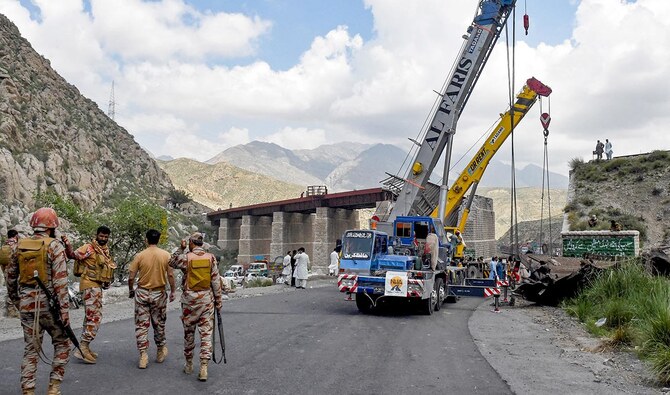
ISLAMABAD: Pakistan’s top army generals reviewed national security challenges on Tuesday following a series of coordinated militant attacks by a separatist outfit in the southwestern Balochistan province last month that killed more than 50 people, vowing not to let the “hard-earned” gains against such groups to be reversed.
The army has carried out a number of intelligence-based operations in Pakistan’s western region, including the province of Khyber Pakhtunkhwa (KPK), in recent months to quell extremist and separatist violence, killing a number of fighters from various armed factions while also sacrificing its soldiers.
The meeting of top officials, led by Chief of Army Staff (COAS) General Asim Munir, began with the remembrance of these soldiers, according to an official statement that said they had “laid down their lives in Balochistan and Khyber Pakhtunkhwa in pursuit of peace and stability of Pakistan.”
“The forum was briefed on the prevailing geo-strategic environment, national security challenges, and strategic and operational responses to emerging threats,” the statement by the Inter-Services Public Relations (ISPR), the military’s media wing, informed.
“In assessing the inimical forces, malicious actors, subversive proxies, and the facilitators of Pakistan’s external and internal adversaries, particularly those active in Balochistan and KPK, the forum deliberated on a range of measures to neutralize these threats,” it added. “The forum reaffirmed that the Pakistan Army, with the unwavering support of the people, will not allow the hard-earned successes against terrorism to be reversed.”
The statement highlighted the professionalism, integrity and loyalty to the state within the army, attributing these qualities to a “well-established and rigorous system of accountability” that ensures these values are preserved within its ranks.
The army has recently taken action against its own officials, including Lt. Gen. (retired) Faiz Hameed, the former director general of the country’s most powerful Inter-Services Intelligence (ISI) spy agency, by launching court martial proceedings on charges of extortion and meddling in politics.
“This strict adherence to accountability fortifies the Army’s integrity, ensuring that no individual is above the law or exempt from scrutiny,” it continued.
It also noted that law enforcement agencies would take “swift and lawful action against terrorists, anarchists, and criminal mafias” in the country.
The top army forum, which has previously highlighted the issue of “digital terrorists” spreading disinformation on social media, also reiterated the need to safeguard national cyberspace.


![]()

Pakistani generals vow to defend ‘hard-earned gains’ against militants after Balochistan attacks
Short Url
https://arab.news/zjff6
Pakistani generals vow to defend ‘hard-earned gains’ against militants after Balochistan attacks
- The meeting discussed the army’s ‘rigorous system of accountability,’ saying it ensures professionalism and loyalty
- Pakistani generals also reiterated the need to safeguard national cyberspace among concerns over disinformation
Latest updates




© 2026 SAUDI RESEARCH & PUBLISHING COMPANY, All Rights Reserved And subject to Terms of Use Agreement.