

Saudi fintech sector thriving as it balances regulatory challenges: top CEO

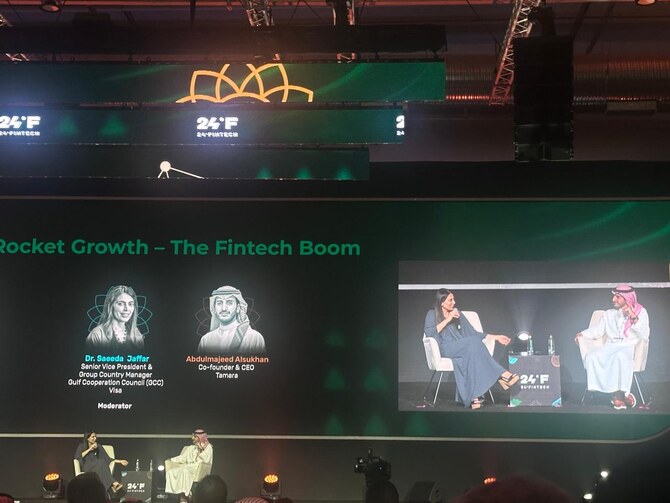
Abdulmajeed Al-Sukhan, co-founder and CEO of Tamara, speaking at the 24 Fintech conference. AN
Short Url
Updated 01 October 2024
Follow

Saudi fintech sector thriving as it balances regulatory challenges: top CEO

RIYADH: Saudi Arabia’s fintech sector provides a strong foundation for startups to succeed alongside strict regulatory challenges, according to a top entrepreneur. 

Speaking at the “Rocket Growth – The Fintech Boom” panel during the 24 Fintech conference in Riyadh, Abdulmajeed Al-Sukhan, co-founder and CEO of Tamara, emphasized the importance of balancing rapid growth with regulatory compliance. 

Saudi Arabia aims to have 525 active fintech entities by 2030, underscoring the Kingdom’s commitment to driving innovation in the sector. 

Launched in April 2018 by the Saudi Central Bank and the Capital Market Authority, Fintech Saudi has been pivotal in transforming the Kingdom into a leading fintech hub.

“It’s essential to strike a balance between rapid growth and maintaining proper regulation and compliance. If you expand quickly without building a solid foundation, you may face significant issues down the line,” said the top official of the Saudi Arabia-based buy now, pay later startup.  

Al-Sukhan pointed out that there is a “very open market” in Saudi Arabia, where the regulator is creating an environment that fosters innovation. 

He added that it is still a controlled environment, which can be limiting. 

“That is natural, and I believe it is healthy, too. If we hadn’t had a sandbox and instead launched a buy now, pay later service unregulated for years, then suddenly faced regulation, it would have caused significant issues. We’d be in a much worse position today,” said Al-Sukhan. 

Discussing the impact of artificial intelligence on the fintech sector, the CEO described AI as the most significant development of our lifetime. 

“In my opinion, it is even bigger than the Internet or anything else. It is changing our perception of reality, so it is impacting business. But the more practical answer is that AI is a force of something that we have never seen in the coding industry and engineering in general,” he said. 

Al-Sukhan believes AI will revolutionize productivity and accelerate development in unprecedented ways.

“When building a company, shipping is the most critical part. Artificial intelligence is going to enable companies like ours to ship features fast, to make sure we are ahead, to know what is the latest, and to do a lot of the things that used to take us a lot of time, even in the research side,” he said. 

He added that AI’s capability to analyze vast amounts of data will help companies like Tamara deliver products that customers want, at the right time, in the right way, and at the right place. 

“Indeed, we are on the brink of something very significant with AI,” Al-Sukhan said.


New Murabba seeks contractors for Mukaab Towers fit-outs: MEED

Updated 28 January 2026
Follow

New Murabba seeks contractors for Mukaab Towers fit-outs: MEED

RIYADH: Saudi Arabia’s New Murabba Development Co., a wholly owned subsidiary of the Public Investment Fund, has issued a request for information to gauge the market for modular and offsite fit-out solutions for its flagship Mukaab development, MEED reported on Wednesday.

The RFI was released on Jan. 26, with submissions due by Feb. 11. NMDC has also scheduled a market engagement meeting during the first week of February to discuss potential solutions with prospective contractors.

Sources close to the project told MEED that NMDC is “seeking experienced suppliers and contractors to advise on the feasibility, constraints, and execution strategy for using non-load-bearing modular systems for the four corner towers framing the Mukaab structure.” The feedback gathered from these discussions will be incorporated into later design and procurement decisions.

The four towers — two residential (North and South) and two mixed-use (East and West) — are integral to the Mukaab’s architectural layout. Each tower is expected to rise approximately 375 meters and span over 80 stories. Key modular elements under consideration include bathroom pods, kitchen pods, dressing room modules, panelized steel partition systems, and other offsite-manufactured fit-out solutions.

Early works on the Mukaab were completed last year, with NMDC preparing to award the estimated $1 billion contract for the main raft works. This was highlighted in a presentation by NMDC’s chief project delivery officer on Sept. 9, 2025, during the Future Projects Forum in Riyadh.

Earlier this month, US-based Parsons Corp. was awarded a contract by NMDC to provide design and construction technical support. Parsons will act as the lead design consultant for infrastructure, delivering services covering public buildings, infrastructure, landscaping, and the public realm at New Murabba. The firm will also support the development of the project’s downtown experience, which spans 14 million sq. meters of residential, workplace, and entertainment space.

The Parsons contract follows NMDC’s October 2025 agreements with three other US-based engineering firms for design work across the development. New York-headquartered Kohn Pedersen Fox was appointed to lead early design for the first residential community, while Aecom and Jacobs were selected as lead design consultants for the Mukaab district.

In August 2025, NMDC signed a memorandum of understanding with Falcons Creative Group, another US-based firm, to develop the creative vision and immersive experiences for the Mukaab project. Meanwhile, Beijing-based China Harbour Engineering Co. completed the excavation works for the Mukaab, and UAE-headquartered HSSG Foundation Contracting executed the foundation works.