

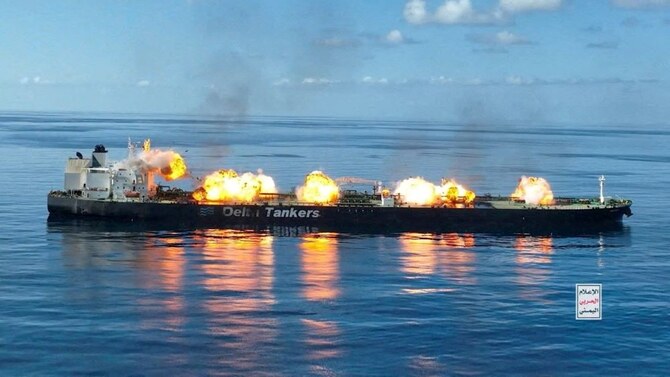
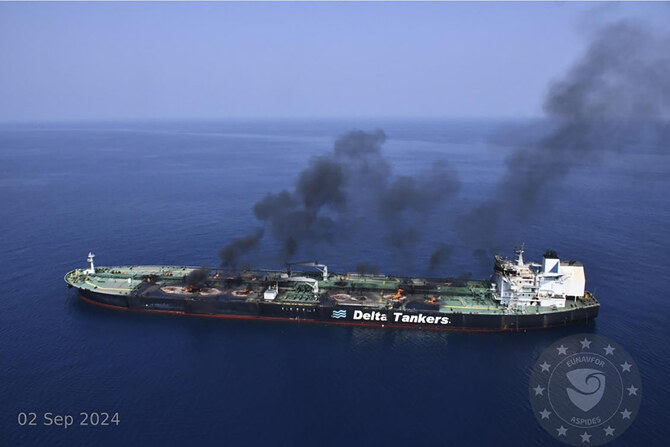
Burning oil tanker in Red Sea unsafe to tow, EU naval mission says

1 / 2
2 / 2
Greek-flagged oil tanker Sounion burns in the Red Sea following a series of attacks by the Houthis on Monday, Sept. 2, 2024. (AP Photo)
Short Url
Updated 03 September 2024
Follow

Burning oil tanker in Red Sea unsafe to tow, EU naval mission says

  • EUNAVFOR Aspides said that tugboats from private companies that arrived at the Sounion oil tanker in the Red Sea discovered that to move the ship from its current position is not viable
  • Greek-flagged Sounion, carrying 150,000 tonnes of crude oil, has been abandoned and engulfed in flames in the Red Sea since late last month

AL-MUKALLA: A burning oil tanker in the Red Sea loaded with almost a million barrels of oil cannot be moved to another position to be saved, the EU naval operation in the Red Sea said on Tuesday, dashing hopes of avoiding a tragedy in the important maritime channel.

The EU mission, known as EUNAVFOR Aspides, said that tugboats from private companies that arrived at the Sounion oil tanker in the Red Sea discovered that to move the ship from its current position is not viable and that rescuers are evaluating other on-site solutions. 

“The private companies responsible for the salvage operation have concluded that the conditions were not met to conduct the towing operation and that it was not safe to proceed. Alternative solutions are now being explored by the private companies,” the EU mission said on X.

The Greek-flagged Sounion, carrying 150,000 tonnes of crude oil, has been abandoned and engulfed in flames in the Red Sea since late last month, when the Houthis attacked it first with light arms fire, projectiles, and a drone boat, then boarded it and planted explosives that sparked fires on various parts of the ship.

The Houthi assault on the oil tanker has provoked worldwide condemnation, as well as warnings of a significant danger to Red Sea trade and marine life.

Wim Zwijnenburg of the Humanitarian Disarmament Project at the Dutch peace organization PAX told Arab News on Tuesday that the EU mission’s remark suggests that moving the tanker to another location is impossible and that rescuers may consider salvaging it at its current location, which will probably mean extinguishing the fires first.

“It means they can’t start with the rescue operations. The ship is probably not stable enough to tow it away and be salvaged at another location. So they are probably looking for on-site solutions, putting out the fire perhaps?” he said.

Earlier, the EU mission said on X that its warships had given protection to the tugboats that arrived at the scene of the burning ship, warning of an ecological disaster in the Red Sea if the ship was not salvaged.

“Since September 1st, 2024, EUNAVFOR ASPIDES assets have been engaged in protecting the tugs involved in the MV SOUNION salvage operation, aiming to facilitate the prevention of an unprecedented environmental disaster in the region.”

The post came as a Yemeni government official in the southern city of Aden, Yemen’s temporary capital, told Arab News on Tuesday that two tugboats from a port in Djibouti arrived at the Sounion’s location and started assessing the ship to determine how to rescue it.  

The US Central Command, which condemned the Houthis for assaulting two oil tankers in the Red Sea on Monday, also warned of an ecological catastrophe in the Red Sea from the burning ship.

“Currently, salvage efforts are underway in the southern Red Sea for the disabled MV Delta Sounion, which is still on fire and threatens the possibility of a major environmental disaster,” CENTCOM said on Tuesday morning.

CENTCOM said that its troops had destroyed two missile systems aimed at international ships in a Houthi-controlled part of Yemen.

On Monday, local media and people reported loud explosions and thick smoke billowing from the Al-Hamza military base in the Houthi-controlled Ibb governorate, reportedly attacked by the US military.  


IMF approves reviews, unlocks $240m in funding for Jordan

Updated 55 min 38 sec ago
Follow

IMF approves reviews, unlocks $240m in funding for Jordan

  • The decision allows Jordan to draw about $130 million under the EFF and about $110 million under the RSF

AMMAN: The International Monetary Fund’s executive board has completed the fourth review of Jordan’s Extended Fund Facility and the first review under the Resilience and Sustainability Facility, unlocking immediate access to about $240 million to support the kingdom’s economic program.

The decision allows Jordan to draw about $130 million under the EFF and about $110 million under the RSF, bringing total disbursements under the IMF arrangement to about $733 million.

In a statement issued on Saturday, the IMF said Jordan’s economy “remains resilient,” supported by sound macroeconomic policies and strong international backing.

Growth accelerated to 2.7 percent in the first half of 2025 and is expected to reach about 3 percent in the coming years, driven by major investment projects, deeper regional integration and continued structural reforms.

Inflation remains anchored at about 2 percent, while the current account deficit is projected to narrow to below 5 percent of GDP over the medium term. The IMF also noted that Jordan’s banking sector is stable and international reserves remain strong.

Fiscal performance continues to align with program targets, underpinned by robust revenue collection and disciplined current spending. The authorities remain committed to reducing public debt to 80 percent of GDP by 2028 through gradual fiscal consolidation, while protecting social and development spending and reducing losses at public utilities.

The IMF said progress under the RSF is ongoing, with reforms addressing vulnerabilities in the water and electricity sectors and strengthening health emergency preparedness. All reform measures scheduled for the current review have been completed.

Commenting after the board discussion, IMF Deputy Managing Director Kenji Okamura said Jordan’s continued macroeconomic stability amid persistent external headwinds reflects the authorities’ commitment to sound policies, supported by strong international assistance.

He said growth continues to recover, inflation remains low and reserve buffers are strong, stressing the importance of maintaining prudent fiscal and monetary policies amid regional tensions and global uncertainty.

Okamura added that accelerated structural reforms are essential to foster job-rich growth, improve the business environment, enhance labour market flexibility, tackle youth unemployment and low female labour force participation, and attract private investment.

He also underlined the importance of sustained donor support to help Jordan manage external challenges and the economic cost of hosting large numbers of refugees, while noting that progress under the RSF would help address long-term vulnerabilities and strengthen balance-of-payments stability.