

24 Fintech: Tabby CEO reveals expansion plans after acquisition of SAMA-licensed Tweeq

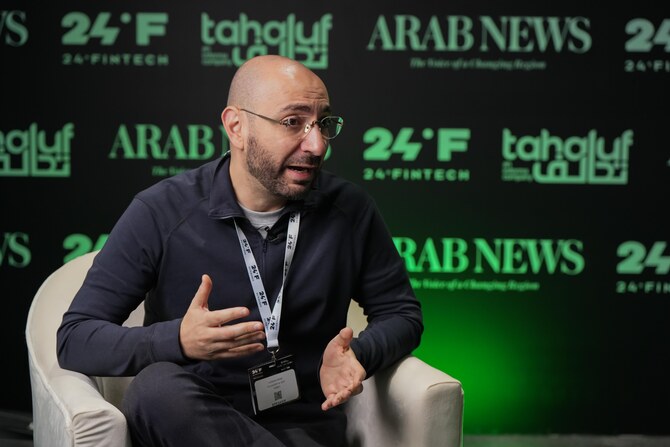
Hosam Arab, CEO of Tabby, said that the acquisition of Tweeq is a strategic move to broaden the company’s offerings beyond its core BNPL services. AN Photo
Short Url
Updated 01 October 2024
Follow

24 Fintech: Tabby CEO reveals expansion plans after acquisition of SAMA-licensed Tweeq

  • Tabby revealed that Tweeq will continue to operate independently following the acquisition
  • Currently serving over 7 million customers in the Kingdom, Tabby sees the integration with its new purchase as a significant advantage for both companies

RIYADH: Saudi buy now, pay later firm Tabby has entered into a definitive agreement to acquire digital wallet provider Tweeq, marking a key development in the Kingdom’s fintech sector. 

Announced during the 24 Fintech event in Riyadh, Tabby revealed that Tweeq, licensed by the Saudi Central Bank, will continue to operate independently following the acquisition. 

In an interview with Arab News during the conference, Hosam Arab, CEO of Tabby, emphasized that the acquisition of Tweeq is a strategic move to broaden the company’s offerings beyond its core BNPL services. 

“We have really grown and seen extremely strong demand and appetite from the consumer for what we have offered. But we believe that the consumer needs are a lot broader and a lot wider,” he said. 

“Tweeq’s acquisition really helps us to make the next step in our journey of starting to offer more than just a buy now, pay later solution and really getting into the financial needs of our everyday consumer,” Arab added. 

Currently serving over 7 million customers in Saudi Arabia, Tabby sees the integration with its new purchase as a significant advantage for both companies. 

“Tweeq benefits from access to that platform, access to that customer base, which otherwise would have been very difficult to obtain access to,” Arab said. 

Founded in 2020, Tweeq is one of the earliest electronic money institutions licensed to operate in Saudi Arabia, offering customers an alternative to traditional banking through its digital spending account, which provides enhanced control and ease.

The acquisition of Tweeq by Tabby aligns with Saudi Arabia’s broader objectives under the National Fintech Strategy, a key component of Vision 2030’s Financial Sector Development Program. 

This initiative targets the establishment of 525 fintech companies by 2030 to create 18,000 jobs and contribute $3.5 billion to the Saudi economy. 

Arab explained that while Tabby will continue to team up with other companies to manage savings and investments, the company’s platform will serve as the gateway for these services. 

“We would work with other licensed financial institutions in the markets as partners that are focused on these types of products and have expertise in these sorts of products to be able to offer our customers sustainably safe solutions. However, what we will be able to provide is that platform from which these services are going to be available,” he said. 

He added that Tabby is still considering integrating Tweeq and rebranding it under the BNPL giant. 

When asked about the impact of the acquisition on Tabby’s market cap, Arab replied: “I believe it’s less around the valuation of the business but more about the sustainability and the financial stability of Tabby as a business. And that’s what gave SAMA, the regulator, a lot more comfort in approving a transaction like this one.” 

He added that although the acquisition will not immediately impact the company’s valuation, the resulting benefits to consumers will be crucial in strengthening Tabby’s market position.

Arab confirmed that the company has reached profitability, an important milestone ahead of its planned initial public offering. 

He also expressed confidence in the company’s cash flow, indicating that Tabby is not actively seeking additional funding in the near future. 

Arab highlighted the significant growth potential within the Gulf, driven by a strong tradition of well-performing banks and a consumer base eager for financial innovation. 

He further clarified that the focus for Tabby is not on expanding beyond the region but on deepening its presence in existing markets. He added that these markets offer ample opportunities to enhance financial inclusion by expanding into additional services. 

As one of the region’s leading BNPL providers, Tabby relocated its headquarters from the UAE to Saudi Arabia in 2023. Shortly after, the firm secured over $200 million in funding, achieving unicorn status.


Saudi investment hits 32% of GDP, non-oil fixed capital reaches 40%, minister says

Updated 05 January 2026
Follow

Saudi investment hits 32% of GDP, non-oil fixed capital reaches 40%, minister says

RIYADH: Saudi Arabia’s investment now accounts for 32 percent of gross domestic product, with non-oil fixed capital at 40 percent, according to the minister responsible for portfolio.

Speaking during his visit to the Shoura Council, Khalid Al-Falih said that foreign direct investment is expected to grow fivefold, signaling strong Vision 2030 progress.

“Regarding cumulative performance, the Kingdom has exceeded all expectations, achieving high levels of investment,” Al-Falih said, according to a video posted on Al-Ekhbariya’s X account focused on economic matters.

The minister added: “Today, investment accounts for 32 percent of the total GDP. In terms of non-oil GDP, fixed capital represents 40 percent, compared with 41 percent in China, the highest globally.”

If we take the non-oil GDP, he said, fixed capital will make 40 percent. “China is the largest globally with 41 percent. So, we will rank second if we compare it to the non-oil economy and fourth when measured against total GDP,” Al-Falih said.

He emphasized that the Kingdom offers an investment-attractive environment, noting that when focusing on foreign direct investment rather than overall investment, Saudi Arabia ranks among the world’s highest.

The minister of investment added that FDI is expected to grow fivefold by the end of 2025, though these data require confirmation, stressing that this is “a big indicator for the success of Saudi Vision 2030.”

During his address to the session, Al-Falih emphasized that Saudi Vision 2030 prioritizes economic diversification and reducing dependence on oil, through boosting the private sector’s contribution to inclusive economic development, supporting national sectoral priorities, and driving growth in the Kingdom’s GDP.

He highlighted key initiatives enabling the private sector, including the establishment of the Ministry of Investment and the Saudi Investment Promotion Authority, the launch of the “Shareek” program, the development of the National Investment Strategy, and linking all stakeholders in the investment ecosystem.

“The Cabinet’s adoption of the National Investment Strategy, launched by Crown Prince in 2021 and implemented in 2022 as a comprehensive national framework, has played a major role in positioning investment as a driver of economic growth,” he said.

Al-Falih revealed that the ministry has identified more than 2,000 investment opportunities worth over SR1 trillion ($267 billion), noting that 346 of these opportunities have been converted into closed deals valued at over SR231 billion through the “Invest Saudi” platform.

He also highlighted the success of the regional headquarters attraction program, with licenses issued to more than 700 global companies by the end of 2025, surpassing the 2030 target of 500 companies, across diverse sectors that reinforce Saudi Arabia’s role as a regional business hub.

The minister revealed that active investment licenses have grown tenfold, rising from 6,000 in 2019 to 62,000 by the end of 2025, highlighting the role of companies in creating over one million jobs, including numerous positions for Saudi nationals.

Al-Falih noted the Kingdom’s success in attracting 20 of the world’s top 30 banks, as part of efforts to strengthen the presence of leading asset managers and international banks in support of the Saudi banking sector.

He also discussed reforms to enhance the business environment, such as the Civil Transactions Law, Companies Law, and the updated Investment Law issued in mid-2024, which contributed to Saudi Arabia moving up 15 places in the global competitiveness ranking.

The minister also announced the update of the National Investment Strategy in 2025, focusing on quality, productivity, and directing investments toward sectors with the highest economic impact, while developing financing solutions for SMEs.