

UN hosts talks in Tripoli to resolve Libya’s central bank crisis

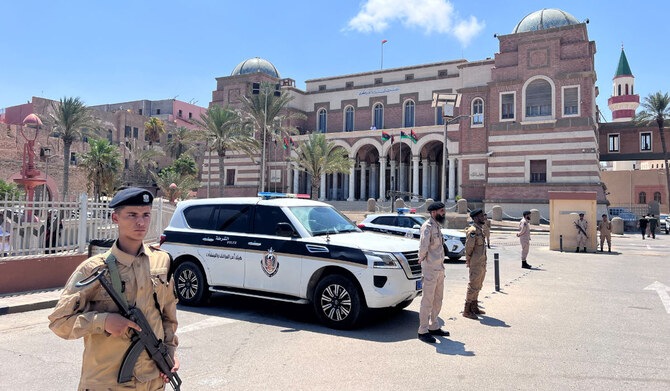
Libyan Ministry of Interior personnel stand guard in front of the Central Bank of Libya in Tripoli, Libya, August 27, 2024. (REUTERS)
Short Url
Updated 03 September 2024
Follow

UN hosts talks in Tripoli to resolve Libya’s central bank crisis

  • The representatives agreed to submit a draft agreement to their respective chambers for review, with the goal of finalizing and signing the agreement on Tuesday

TRIPOLI: The United Nations Support Mission in Libya said it held talks in Tripoli on Monday to help resolve a central bank crisis that sparked a blockade of oil production and threatens the worst crisis in years for the major energy exporter.
The standoff was triggered when Western factions moved last month to oust veteran governor Sadiq Al-Kabir and replace him with a rival board, leading Eastern factions to shut down all oil production.
In its statement, UNSMIL said the consultations were concluded with ‘significant’ understanding and the two sides agreed to submit a draft agreement to their respective chambers for review, with the goal of finalizing and signing the agreement on Tuesday.
Oil prices edged higher on Monday, recovering some losses from late last week, as Libyan oil exports remained halted and concerns about higher OPEC+ production from October eased.
Representatives from Libya’s House of Representatives and High Council of State on one side and the Presidential Council on the other participated in the talks hosted by UNSMIL which lasted from morning until late into the night, the statement said.
Libya’s central bank (CBL) is the sole legal repository for Libyan oil revenues and it pays state salaries across the country. If those functions are compromised by the current crisis, Libyans will soon feel the pinch.
If the struggle for control is prolonged, all state salaries, transfers between banks and letters of credit needed for imports will become impossible, freezing up the economy and Libya’s international trade.
Eastern factions, including the House of Representatives (HoR) parliament led by speaker Aguila Saleh and the Libyan National Army (LNA) under commander Khalifa Haftar, oppose the Tripoli-based Presidency Council’s bid to oust CBL governor Al-Kabir.
The eastern side’s oil blockade will gradually starve the CBL of new funds, as well as reducing condensate available for power plants, meaning long electricity blackouts may soon return.
As a result of the oilfields closures, the state-owned National Oil Corporation (NOC) said total production had plunged to just over 591,000 bpd by Aug. 28 from nearly 959,000 bpd on Aug. 26, amounting to losses of over $120 million over the three days. Production was at about 1.28 million bpd on July 20, NOC said.
The crisis threatens to end a four-year period of relative peace in the OPEC member that for a decade has been split between eastern and western factions that have drawn backing from Russia and Turkiye, respectively.
As the state crumbled between rival factions, the CBL and National Oil Corporation (NOC), the state energy producer, were held off limits, ensuring some governmental functions continued.


US condemns Houthi detention of embassy staff in Yemen. Guterres seeks release of all detained UN staff

Updated 22 min 25 sec ago
Follow

US condemns Houthi detention of embassy staff in Yemen. Guterres seeks release of all detained UN staff

  • US State Department says the sham proceedings only prove that the Houthis rely on the use of terror against their own people to stay in power
  • UN Secretary General says the continued Houthi detention and prosecution of UN personnel is a violation of international law

WASHINGTON/UNITED NATIONS: The US on Wednesday condemned the ongoing detention of current and former local staffers of the US embassy in Yemen by the Houthi movement.
“The United States condemns the Houthis’ ongoing unlawful detention of current and former local staff of the US Mission to Yemen,” US State Department spokesperson Tommy Pigott said in a statement.
“The Houthis’ arrests of those staff, and the sham proceedings that have been brought against them, are further evidence that the Houthis rely on the use of terror against their own people as a way to stay in power,” Pigott said.

Earlier, United Nations Secretary-General Antonio Guterres called on Houthi rebels not to prosecute detained UN personnel and to work “in good faith” to immediately release all detained staff from the UN and foreign agencies and missions.
Guterres condemned the referrals of the UN personnel to the Houthis’ special criminal court and called the detentions of UN staff a violation of international law, UN spokesman Stephane Dujarric said.
There are currently 59 UN personnel, all Yemeni nationals, detained by the Iranian-backed Houthis, in addition to dozens from nongovernmental organizations, civil society and diplomatic missions, he said.
He said a number of them have been referred to the criminal court in Yemen’s capital, Sanaa. “There were procedures going on in the court, I believe, today and all of this is very, very worrying to us,” Dujarric said.
The court in late November convicted 17 people of spying for foreign governments, part of a yearslong Houthi crackdown on Yemeni staffers working for foreign organizations.
The court said the 17 people were part of “espionage cells within a spy network affiliated with the American, Israeli and Saudi intelligence,” according to the Houthi-run SABA news agency. They were sentenced to death by firing squad in public, but a lawyer for some of them said the sentence can be appealed.
UN human rights chief Volker Türk said in a statement Tuesday that one of those referred to the court was from his office. He said the colleague, who has been detained since November 2021, was presented to the “so-called” court “on fabricated charges of espionage connected to his work.”
“This is totally unacceptable and a grave human rights violence,” Türk said.
He said detainees have been held in “intolerable conditions” and his office has received “very concerning reports of mistreatment of numerous staff.” Dujarric said some have been held incommunicado for years.
Dujarric said the UN is in constant contact with the Houthis, and the secretary-general and others have also raised the issue of the detainees with Iran, Saudi Arabia, Oman and others.
The Houthis seized Sanaa in 2014 and since then they have been engaged in a civil war with Yemen’s internationally recognized government, which is supported by a Saudi-led military coalition.
The November verdict was the latest in the Houthi crackdown in areas of Yemen under their control. They have imprisoned thousands of people during the civil war.