A Libyan human trafficker sanctioned by the UN has been killed in Tripoli, officials say

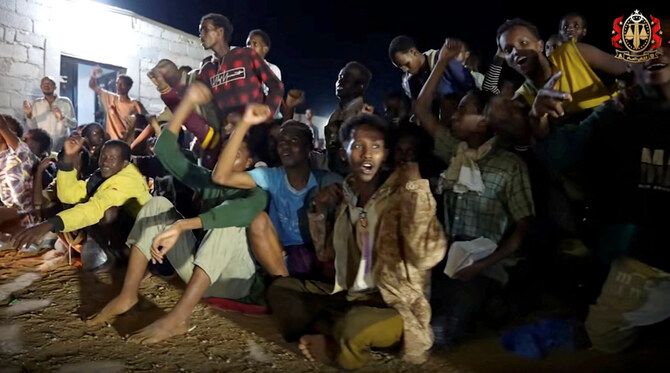
Victims react as authorities dismantle a human trafficking network, according to Libyan authorities, in what they say is Libya, in this still image from a handout video released on August 31, 2024. (Reuters)
Short Url
Updated 02 September 2024
Follow

A Libyan human trafficker sanctioned by the UN has been killed in Tripoli, officials say

  • Amid the chaos, the oil-rich country has emerged as a major conduit for people from Africa

CAIRO: One of Libya’s most wanted human traffickers was killed Sunday in the capital, Tripoli, Libyan officials said, fueling tension in the western part of the North African country.
Abdel-Rahman Milad, who commanded a coast guard unit in the western town of Zawiya and was sanctioned by the United Nations Security Council, was shot dead by unknown assailants, the officials said.
The circumstances of his death were not immediately known, and no group claimed responsibility for his killing.
Libyan media outlets reported that he was shot while he was in his vehicle in the Sayyad area, in the western part of Tripoli. Footage circulated online showed a white Toyota Land Cruiser for Milad with bullet marks on its side.
Both officials spoke on condition of anonymity for their safety. There was no comment from the Tripoli-based government of Prime Minister Abdul Hamid Dbeibah.
Moammar Dhawi, a militia leader in western Libya, mourned Milad’s death. In a statement, posted on Facebook, he called for an investigation to bring the perpetrators to account.
Libya has been plagued by corruption and turmoil since a NATO-backed uprising toppled and killed longtime dictator Muammar Qaddafi in 2011. The county has since then split between two administrations, each backed by armed groups and foreign governments.
Amid the chaos, the oil-rich country has emerged as a major conduit for people from Africa and the Middle East fleeing wars and poverty and hoping to reach Europe by crossing the Mediterranean Sea.
In June 2018, the Security Council imposed sanctions on Milad and five other leaders of criminal networks allegedly engaged in trafficking migrants and others from Libya. At the time, Milad was described as the head of a coast guard unit in Zawiya “that is consistently linked with violence against migrants and other human smugglers” from rival gangs.
UN experts monitoring sanctions claimed Milad and other coast guard members “are directly involved in the sinking of migrant boats using firearms.”
Milad had denied any links to human smuggling and said traffickers wear uniforms similar to those of his men. He was jailed for about six months between October 2020 and April 2021 on human trafficking and fuel smuggling charges.


IMF approves reviews, unlocks $240m in funding for Jordan

Updated 55 min 38 sec ago
Follow

IMF approves reviews, unlocks $240m in funding for Jordan

  • The decision allows Jordan to draw about $130 million under the EFF and about $110 million under the RSF

AMMAN: The International Monetary Fund’s executive board has completed the fourth review of Jordan’s Extended Fund Facility and the first review under the Resilience and Sustainability Facility, unlocking immediate access to about $240 million to support the kingdom’s economic program.

The decision allows Jordan to draw about $130 million under the EFF and about $110 million under the RSF, bringing total disbursements under the IMF arrangement to about $733 million.

In a statement issued on Saturday, the IMF said Jordan’s economy “remains resilient,” supported by sound macroeconomic policies and strong international backing.

Growth accelerated to 2.7 percent in the first half of 2025 and is expected to reach about 3 percent in the coming years, driven by major investment projects, deeper regional integration and continued structural reforms.

Inflation remains anchored at about 2 percent, while the current account deficit is projected to narrow to below 5 percent of GDP over the medium term. The IMF also noted that Jordan’s banking sector is stable and international reserves remain strong.

Fiscal performance continues to align with program targets, underpinned by robust revenue collection and disciplined current spending. The authorities remain committed to reducing public debt to 80 percent of GDP by 2028 through gradual fiscal consolidation, while protecting social and development spending and reducing losses at public utilities.

The IMF said progress under the RSF is ongoing, with reforms addressing vulnerabilities in the water and electricity sectors and strengthening health emergency preparedness. All reform measures scheduled for the current review have been completed.

Commenting after the board discussion, IMF Deputy Managing Director Kenji Okamura said Jordan’s continued macroeconomic stability amid persistent external headwinds reflects the authorities’ commitment to sound policies, supported by strong international assistance.

He said growth continues to recover, inflation remains low and reserve buffers are strong, stressing the importance of maintaining prudent fiscal and monetary policies amid regional tensions and global uncertainty.

Okamura added that accelerated structural reforms are essential to foster job-rich growth, improve the business environment, enhance labour market flexibility, tackle youth unemployment and low female labour force participation, and attract private investment.

He also underlined the importance of sustained donor support to help Jordan manage external challenges and the economic cost of hosting large numbers of refugees, while noting that progress under the RSF would help address long-term vulnerabilities and strengthen balance-of-payments stability.