

Pope Francis’ Asia trip marks 60 years of papal visits to the region

Priests, religious seminarians and Catechists touch the hands of Pope Francis as he leaves after meeting them at Saint Peter's Parish on the outskirts of Bangkok, Thailand, on November 22, 2019. (AP/File)
Short Url
Updated 02 September 2024
Follow

Pope Francis’ Asia trip marks 60 years of papal visits to the region

  • Papal travel is a thing of the modern era, starting with Pope Paul VI who became the first pontiff to leave Italy in more than 150 years 
  • Paul VI visited India in 1964, marking first time a pope ever visited Asia, he was first pope to fly in an airplane, first to leave Europe 

BANGKOK, Thailand: Pope Francis’ visit to Southeast Asia, the longest trip in his papacy, is the latest in decades of regular papal visits to the Asia-Pacific region.

Papal travel is a thing of the modern era, starting with Pope Paul VI, who became the first pontiff to leave Italy in more than 150 years when he made his famous pilgrimage to the Holy Land in 1964, shortly after becoming pope.

His next visit was to India later that same year, marking the first time a pope had ever visited Asia. It was one of many firsts for Paul VI, who was also the first pope to fly in an airplane, the first to leave Europe and the first to visit countries on six continents, earning him the nickname “the Pilgrim Pope.”
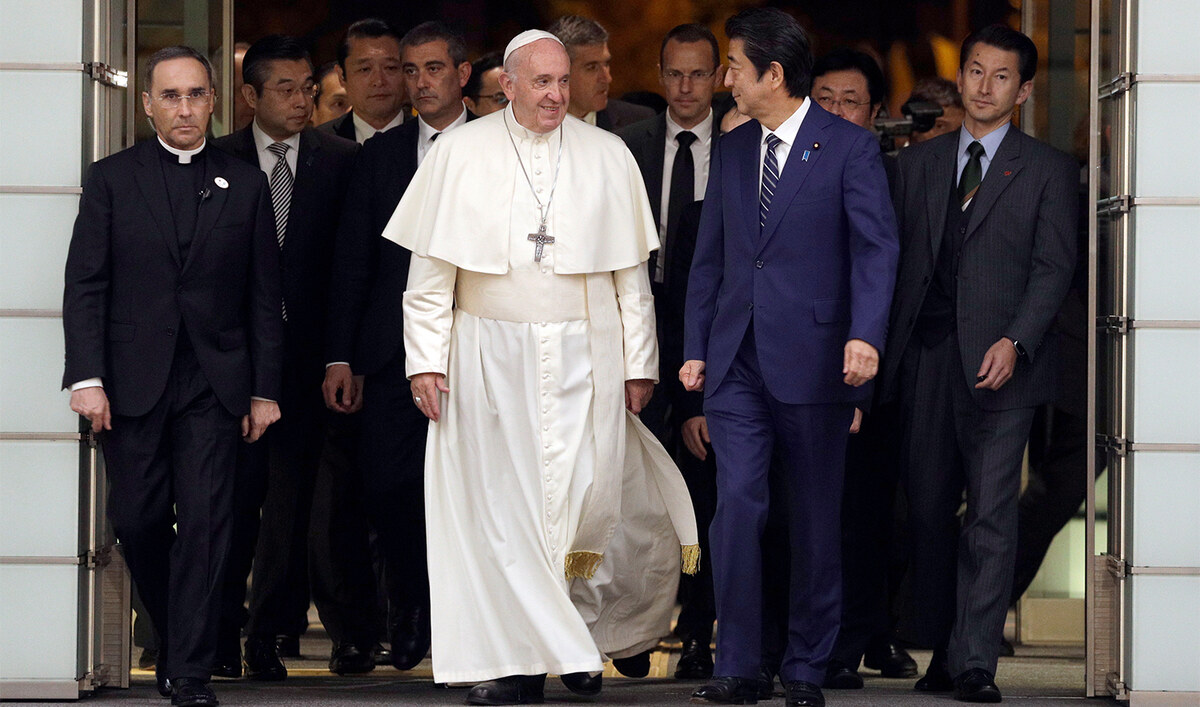


Pope Francis meets with Japanese Prime Minister Shinzo Abe at the Kantei in Tokyo, Japan, on November 25, 2019. (AP)

Others by Paul VI, according to the Vatican, included a 1970 trip with stops in Australia, Hong Kong, Indonesia, Ceylon — today Sri Lanka — and the Philippines, where a would-be assassin unsuccessfully attempted to stab him at Manila airport.

His successor, Pope John Paul I, never got the chance to travel, dying just over a month after he ascended to the papacy.

But Pope John Paul II, who followed in 1978, picked up where Paul VI left off and by the time of his death in 2005, was the most traveled pope in history; a title he holds to this day.

He made his first of two visits to the Philippines, one of Asia’s most Catholic countries, in 1981 in a trip that also took him to Pakistan, Guam, Japan and Anchorage, Alaska, according to the Vatican.

Over the years he would visit Asia many times, including trips to South Korea, Bangladesh, India, Sri Lanka, East Timor, Indonesia, Singapore and Thailand.

In a notable moment from his 1986 trip to India, he was accompanied by Mother Teresa to her home for the poor in Kolkata, meeting and blessing its residents. Reports at the time said the pope was visibly moved by the visit, and Mother Teresa later called it “the happiest day of my life.”

John Paul II also visited Australia, New Zealand, and the Pacific island nations of Fiji, Papua New Guinea and the Solomon Islands.

His successor, Benedict XVI, became pope at an advanced age and did not travel as frequently or as far afield, but did visit Australia in 2008 for World Youth Day, according to the Vatican.
Francis, who took over from Benedict after he resigned in 2013 due to declining health, has already been to the Asia-Pacific region several times, with visits to countries including South Korea, Sri Lanka, the Philippines, Bangladesh, Thailand, Japan, Kazakhstan and Mongolia.

In his 2017 visit to Myanmar, also known as Burma, Francis famously met with Nobel Peace Prize winner Aung San Suu Ky i, the democratically-elected leader who was ousted in the military in 2021, which has given rise to today’s civil war.

This time his Sept. 2-13 trip takes him to Indonesia, Papua New Guinea, East Timor and Singapore.

Of interesting historical note: the last pope to have left Italy before Paul VI was Pius VII, though he did so involuntarily.

Captured by French forces in Rome in 1809, Pius VII had been captive for three years when the French emperor, Napoleon Bonaparte, ordered him moved near Paris in 1812. As Napoleon’s empire crumbled, he was released and returned to Rome in 1814.


Ancient cures and AI: WHO seeks evidence for traditional medicine

Updated 2 sec ago
Follow

Ancient cures and AI: WHO seeks evidence for traditional medicine

  • The World Health Organization opens a major conference on traditional medicine on Wednesday, arguing that new technologies, including artificial intelligence
NEW DELHI: The World Health Organization opens a major conference on traditional medicine on Wednesday, arguing that new technologies, including artificial intelligence, can bring scientific scrutiny to centuries-old healing practices.
The meeting in New Delhi will examine how governments can regulate traditional medicine while using emerging scientific tools to validate safe and effective treatments.
The UN body hopes this push will help make ancestral practices more compatible with modern health care systems.
“Traditional medicine is not a thing of the past,” WHO chief Tedros Adhanom Ghebreyesus said in a video released ahead of the three-day conference.
“There is a growing demand for traditional medicine across countries, communities, and cultures.”
Indian Prime Minister Narendra Modi, in his own message, said the summit would “intensify efforts to harness” the potential of traditional medicine.
Modi is a longtime advocate of yoga and traditional health practices and has backed the WHO Global Center for Traditional Medicine, launched in 2022 in his home state of Gujarat.
Shyama Kurvilla, the head of the center, said reliance on traditional remedies was “a global reality,” noting that 40-90 percent of populations in 90 percent of WHO member states used them.
“With half the world’s population lacking access to essential health services, traditional medicine is often the closest — or only care — available for many people,” she told AFP in New Delhi.
’Evidence-informed’
The UN agency defines traditional medicines as the accumulated knowledge, skills and practices used over time to maintain health and prevent, diagnose and treat physical and mental illness.
But many lack proven scientific value, while conservationists warn that demand for certain products drives trafficking in endangered wildlife, including tigers, rhinos and pangolins.
“WHO’s role, therefore, is to help countries ensure that, as with any other medicine, traditional medicine is safe, evidence-informed, and equitably integrated in systems,” Kurvilla added.
Kurvilla, who studied at the London School of Hygiene and Tropical Medicine, and taught global health policy at Boston University, said that “40 percent or more of biomedical Western medicine, pharmaceuticals, derive from natural products.”
She cited aspirin drawing on formulations using willow tree bark, contraceptive pills developed from yam plant roots and child cancer treatments based on Madagascar’s rosy periwinkle flower.
The WHO also lists the development of the anti-malaria treatment artemisinin as drawing on ancient Chinese medicine texts.
’Frontier science’
“It’s a huge, huge opportunity — and industry has realized this,” Kurvilla.
Rapid technological advancements, including artificial intelligence, had pushed research to a “transformative moment,” to apply scientific rigour to traditional remedies.
The WHO will also launch what it calls the world’s largest digital repository of research on the subject — a library of 1.6 million scientific records intended to strengthen evidence and improve knowledge-sharing.
Dr. Sylvie Briand, WHO’s chief scientist, said AI can assist in analizing drug interactions.
“Artificial intelligence, for instance, can screen millions of compounds, helping us understand the complex structure of herbal products and extract relevant constituents to maximize benefit and minimize adverse effects,” she told reporters ahead of the conference.
Briand said advanced imaging technologies, including brain scans, were shedding light on how practices such as meditation and acupuncture affect the body.
Kurvilla said she was excited by the possibilities.
“It is the frontier science that’s allowing us to make this bridge... connecting the past and the future,” she said.