
Ton-up Das helps Bangladesh thwart Pakistan in second Test

Pakistan's Khurram Shahzad (R) celebrates after taking the wicket of Bangladesh's captain Najmul Hossain Shanto during the third day of the second and last Test cricket match between Pakistan and Bangladesh, at the Rawalpindi Cricket Stadium in Rawalpindi on September 1, 2024. (AFP)
Short Url
Updated 01 September 2024
Follow

Ton-up Das helps Bangladesh thwart Pakistan in second Test

  • The 29-year-old hit 138 over the course of a marathon 333 minutes and brought Bangladesh back into the match
  • At close on 3rd day, Bangladesh struck back to leave Pakistan on 9-2, with Abdullah Shafique dismissed for three

RAWALPINDI: Liton Das hit a fighting hundred to lift Bangladesh from a precarious 26-6 to 262 all out on Sunday, in a remarkable turnaround that left the second Test in Rawalpindi within either team’s grasp.
The 29-year-old hit 138 over the course of a marathon 333 minutes and brought Bangladesh back into the match with a fighting 165-run seventh-wicket stand alongside Mehidy Hasan Miraz, who scored a pugnacious 78.
At close on the third day, Bangladesh struck back to leave Pakistan on a sluggish 9-2, with opener Abdullah Shafique dismissed for three and nightwatchman Khurram Shahzad falling without scoring — both to pacer Hasan Mahmud.
Saim Ayub was not out on six as the home team lead by 21 runs, and Pakistan will need to bat smartly to clinch a series-levelling win after losing the first Test, also in Rawalpindi, by 10 wickets.
Bangladesh’s win last week was their first in 14 attempts against Pakistan.
The highlight of the day was Das and Mehidy’s match-turning stand.
On top of that, Das added 69 with tail-ender Mahmud (13 not out) in a 24.5-over ninth wicket stand, equalling the partnership record against Pakistan and leaving the home team frustrated.
Das, dropped on 90 by spinner Abrar Ahmed off his own bowling, hit a late cut off the same bowler to reach his fourth Test hundred. He finally holed out to Agha Salman at long-on.



Bangladesh’s Litton Das celebrates after scoring century during the third day of second test cricket match between Pakistan and Bangladesh, in Rawalpindi September 1, 2024. (AP)

Das, who came to the crease with Bangladesh tottering at 26-5, cracked 13 boundaries and four sixes, adding a big 236 for the last four wickets.
Earlier, Pakistan were put in a strong position by pacer Shahzad’s career-best 6-90 and Mir Hazma (2-50) in the morning session, but they were left wanting thereafter.
Das and Mehidy’s solid stand took advantage of an eased-out Rawalpindi stadium pitch in the second session of the rain-affected Test, which saw Friday’s first day washed out.
Shahzad, who had taken 4-15 in his first spell, had Mehidy caught and bowled off a miscued drive two overs before tea to end Pakistan’s long and frustrating wait for the seventh wicket.
Das and Mehidy are the first pair in Tests to add 150 or more runs for the seventh or lower wicket from a team total under 50 runs.
Mehidy, who took 5-61 on Saturday, hit 12 boundaries and a six as he passed 50 for the eighth time in Tests.
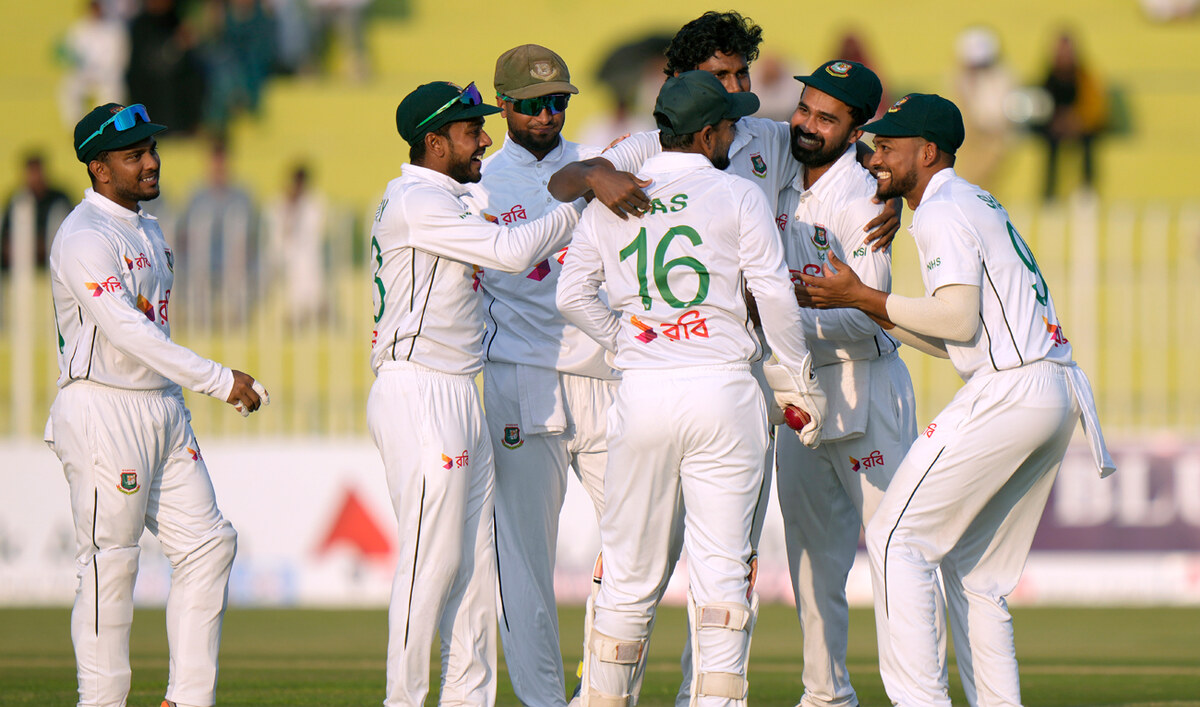


Bangladesh's Hasan Mahmud, third right, celebrates with teammates after taking the wicket of Pakistan's Abdullah Shafique during the third day of second test cricket match between Pakistan and Bangladesh, in Rawalpindi on September 1, 2024. (AP)

Bangladesh resumed at the start of the day on 10-0, but Shahzad soon had opener Zakir Hasan caught by Abrar Ahmed at short midwicket for one in the fourth over.
Shahzad then bowled Shadman Islam (10) and skipper Najmul Hossain Shanto (four) in the space of four deliveries to reduce Bangladesh to 20-3.
At the other end, Hamza had Mominul Haque caught by Mohammad Ali at mid-on for one and then removed first Test centurion Mushfiqur Rahim for three, caught behind by Mohammad Rizwan from a beautiful outswinger.
Shahzad made it 26-6 by trapping Shakib Al Hasan lbw for two before Mehidy and Das dug in.
Shahzad’s previous best figures were 3-45 in his debut Test against Australia at Perth last year.


Pakistan finance chief calls for change to population-based revenue-sharing formula

Updated 14 February 2026
Follow

Pakistan finance chief calls for change to population-based revenue-sharing formula

  • Muhammad Aurangzeb criticizes current NFC formula, says it is holding back development
  • Minister says Pakistan to repay $1.3 billion debt in April as economic indicators improve

ISLAMABAD: Pakistan’s Finance Minister Muhammad Aurangzeb said on Saturday the country’s revenue-sharing formula between the federal and provincial governments “has to change,” arguing that allocating the bulk of funds on the basis of population was holding back long-term development.

The revenue-sharing is done under the National Finance Commission (NFC) Award that determines how federally collected taxes are divided between the center and the provinces. Under the current formula, much of the distribution weight is based on population, with smaller weightages assigned to factors such as poverty, revenue generation and inverse population density.

“Under the NFC award, 82 percent allocation is done on the basis of population,” Aurangzeb said while addressing the Federation of Pakistan Chambers of Commerce & Industry’s regional office in Lahore. “This has to change. This is one area which is going to hold us back from realizing the full potential of this country.”

Economists and policy analysts have long suggested broadening the NFC criteria to give greater weight to tax effort, human development indicators and environmental risk, though any change would require political consensus among provinces, making reform politically sensitive.

Aurangzeb also highlighted the economic achievements of the country in recent years, saying Pakistan’s import cover had improved from roughly two weeks just a few years ago to about 2.5 months currently, adding that the government had repaid a $500 million Eurobond last year.

“The next repayment is of $1.3 billion in April,” he continued, adding that “we will pay these obligations, which are the obligations of Pakistan, as we go forward.”

The minister also noted that unlike in 2022, when devastating floods forced Pakistan to seek international pledges at a Geneva conference, the government did not issue an international appeal during more recent flooding, arguing that fiscal buffers had strengthened.

“This time, the prime minister and the cabinet decided that we do not need to go for international appeal because we have the means,” he said.

He reiterated the government was pursuing export-led growth to avoid repeating past boom-and-bust cycles driven by import-led expansion that quickly depleted foreign exchange reserves and pushed Pakistan back into International Monetary Fund programs.