

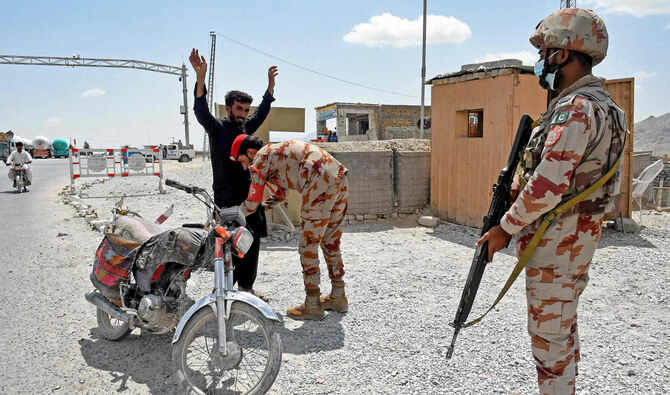

ISLAMABAD: Prime Minister Shehbaz Sharif on Friday ruled out talks with militants who were behind separatist attacks in Pakistan’s southwest last week, urging authorities to address the grievances of young ethnic Baloch people and bring them into the mainstream.
The premier was addressing a federal cabinet meeting a day after he visited Quetta, the provincial capital of Balochistan province where militants carried out a string of coordinated attacks on Aug 26, killing over 50, including 19 security personnel.
The latest surge in violence comes amid protests led by young ethnic Baloch against what they describe as a pattern of enforced disappearances and other human rights abuses in Balochistan by security forces, who deny the charge.
The insurgency and the protests continue to keep the mineral rich province of some 15 million people unstable and impoverished and have created security concerns around Pakistan’s plans to access untapped resources in Balochistan’s desert and mountainous terrain.
“One thing was sure that those who are terrorists and enemies who are against peace in Pakistan, there is no question of holding a dialogue with them,” Sharif told cabinet, giving details of his meetings with political religious and military officials in Quetta on Thursday.
“But as some political elements said, a few [ethnic Baloch] youngsters have been detracted through a different narrative, we should try to bring them to the mainstream.”
While in Quetta, the PM said he had received a detailed presentation by Balochistan Corps Commander Lt Gen Rahat Naseem on how “terrorists are sowing the seeds of hatred and also receiving help from abroad.”
On Wednesday, top Pakistani officials said militants had used the territory of neighboring Afghanistan and received support from India’s Research & Analysis Wing (RAW) spy agency to launch Sunday’s attacks. Delhi and Kabul have not commented on the allegations.
The attacks began on Sunday evening when separatist militants in the country’s largest province took control of a highway and shot dead 23 people, mostly laborers from the eastern Punjab province. They also blew up a railway bridge that connects Balochistan to the rest of Pakistan and tried to separately storm camps of the paramilitary Frontier Corps and Levies forces.
The attacks were the most widespread in years by ethnic militants fighting a decades-long insurgency to win secession of the resource-rich province, home to major China-led projects such as a port and a gold and copper mine. The Pakistani state denies it is exploiting Balochistan and says it is working for the uplift of the region through development schemes.
“SABOTAGING SCO SUMMIT”
Separately, while speaking in the upper house of parliament, Interior Minister Naqvi ruled out a military operation in Balochistan and vowed that those responsible for Sunday’s attacks would face justice.
“There is no operation,” he said. “There can be differences, we will try to address them, we have done so in the past and will keep doing it in the future also … but those who pick up weapons are terrorists and we will take care of them.”
He said the Aug. 26 attacks were carried out by at least two militant outfits who had worked together.
“We even know that it was a planning to sabotage the SCO [Shanghai Cooperation Organization] conference,” Naqvi said about the summit which Islamabad will host on October 15-16. “They don’t want it to take place. This is a conspiracy against even that too.”
On Thursday, Sharif called the separatist attacks in Balochistan a “wicked scheme” launched by the “external enemies of Pakistan and their internal infiltrators.” On Tuesday he had said the assaults were aimed at stopping development projects in Balochistan that form part of the China-Pakistan Economic Corridor (CPEC).
CPEC, said to have development commitments worth $65 billion, is part of Chinese President Xi Jinping’s Belt and Road initiative.
Beijing has also flagged concerns about the security of its citizens working on projects in Pakistan, particularly in Balochistan. Six Chinese engineers working on a dam project were killed in March in the northwest.
Separatist militants have also targeted Balochistan’s deepwater Gwadar port, which is run by China.
Chinese targets have previously come under attack by several Baloch militant groups, who say they have been fighting for decades for a larger share in the regional wealth of mines and minerals denied by the central government.


