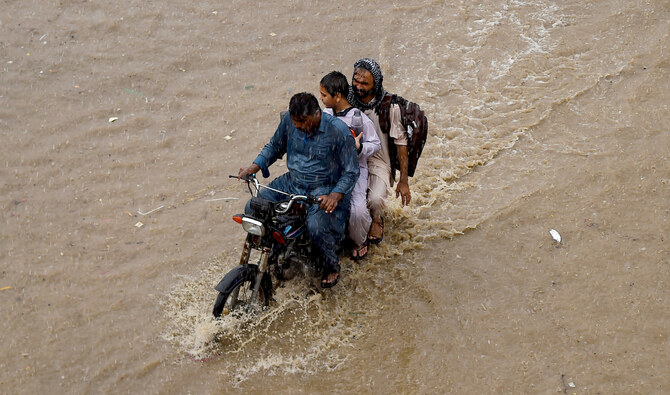
KARACHI: Heavy rains and stormy winds forced authorities in Pakistan’s largest city, Karachi, to close schools on Friday, after a deep depression in the Arabian Sea that the weather office says could develop into a cyclonic storm.
Parts of Karachi received 147 mm (5.79 inches) of rain overnight, the local weather office said, and the city’s mayor, Murtaza Wahab, in a post on X, asked residents to avoid “unnecessary movement.”
The deep depression which is off the Rann of Kutch in India’s Gujarat, is expected to intensify into a cyclonic storm on Friday, India’s weather office said, adding that it would move north-west over the Arabian Sea in the next two days.
Authorities in Pakistan asked fishermen and sailors not to venture out to sea, and warned that the storm is likely to result in flooding in cities as well as flash floods in hilly areas in coming days.
More than 28 people died and around 18,000 have been evacuated since Sunday from cities near the Gujarat coast, disaster management authorities said on Thursday, even as more rain was expected in the state as the cyclonic storm builds up.
The formation of a cyclonic storm over the Arabian Sea in August was a rare occurrence, the Indian Express newspaper reported, saying the last such storm was in 1964.

Schools in Pakistan’s Karachi closed as rare August cyclone builds up
https://arab.news/m3q5q
Schools in Pakistan’s Karachi closed as rare August cyclone builds up
- Weather office says deep depression in the Arabian Sea could develop into a cyclonic storm
- Authorities in Pakistan asked fishermen not to venture out to sea, storm could trigger floods
Pakistani president arrives in Iraq to deepen trade, energy cooperation
- Visit follows recent high-level contacts as Islamabad seeks to expand limited commercial ties with Baghdad
- Talks are expected to cover investment, manpower and facilitation of Pakistani pilgrims visiting holy sites in Iraq
ISLAMABAD: President Asif Ali Zardari arrived in Iraq on Saturday on an official visit aimed at expanding cooperation in trade, energy and investment, as Pakistan seeks to deepen ties with Baghdad after years of limited engagement.
Pakistan and Iraq established diplomatic relations in 1947 and have traditionally maintained cordial ties, though commercial links remain modest, with officials and business groups identifying scope for cooperation in construction services, pharmaceuticals, manpower and agricultural exports.
“President Asif Ali Zardari arrived in Baghdad on a four-day official visit to Iraq,” his office said in a post on X. “He was received by Culture Minister Dr. Ahmed Fakkak Al-Badrani. During the visit, meetings with senior Iraqi leadership are expected to advance cooperation and further strengthen Pakistan-Iraq relations.”
Zardari’s visit follows a series of recent high-level contacts between the two countries, reflecting efforts to broaden bilateral engagement beyond traditional diplomatic ties and explore collaboration across economic, political and people-to-people domains.
According to Pakistan’s foreign office, the president is expected to hold meetings with Iraq’s senior leadership to discuss cooperation in various areas such as trade and investment, energy, technology, education and manpower.
He is also expected to discuss regional and international issues with Iraqi officials.
Earlier this month, Pakistan’s Interior Minister Mohsin Naqvi met his Iraqi counterpart, Abdul Ameer Al-Shammari, on the sidelines of meetings in Brussels, where both sides agreed to enhance cooperation on security and facilitate travel for Pakistani Shia pilgrims to Najaf and Karbala.
The two officials discussed measures to ensure the smoother movement of these pilgrims and their compliance with visa regulations.


