Algeria opposition figure released under judicial supervision

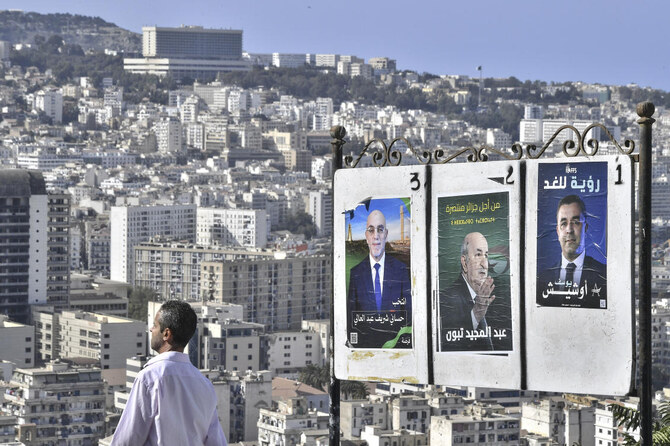
A man walks past electoral banners of presidential candidate, including President Abdelmadjid Tebboune, center, Tuesday, Aug. 27, 2024, in Algiers. (AP)
Short Url
Updated 29 August 2024
Follow

Algeria opposition figure released under judicial supervision

  • Ghares, a secular leftist opposition figure, was charged with “insulting the president of the republic”

ALGIERS: An Algerian court on Thursday released opposition figure Fethi Ghares and his wife under judicial supervision pending an investigation into the alleged insulting of President Abdelmadjid Tebboune and other charges, his lawyer said.
Ghares, a secular leftist opposition figure, was charged with “insulting the president of the republic” and “spreading false news and hate speech through posts on social media,” Abdelghani Badi, his lawyer, told AFP.
Messaouda Cheballah, Ghares’s wife who is also a political activist, was charged with “partaking” in the main defendant’s alleged wrongdoing, Badi added.
Badi said the couple are required to “report to the court every 15 days” pending a trial date.
The couple were also banned from posting information on social media or speaking to the media, said the lawyer, ahead of elections on September 7.
Fethi Ghares, 49, a former coordinator of the now-banned leftist Democratic and Social Movement party, was arrested on Tuesday by plain-clothes police at his home in the capital Algiers.
In a video posted on Facebook and titled “Where’s Fethi Ghares?,” his wife had said police asked her husband to follow them for what they said was “an interrogation” and that he had had no summons order.
Ghares, 49, was previously arrested in 2021 and later sentenced to prison — also on charges including insulting President Tebboune.
In January 2022, he was sentenced to two years behind bars for “harming the person of the president of the republic” and “spreading information that could harm national unity” and public order.
He was released in March 2022 after his sentence was reduced on appeal.
A figure from Algeria’s secular leftist opposition, Ghares in 2019 joined the pro-democracy Hirak movement — mass protests that swept veteran president Abdelaziz Bouteflika from power.
His Democratic and Social Movement party — a successor of the Algerian Communist Party — had all its activities indefinitely frozen by the authorities in February 2023.


Editorial: The threat of Yemen’s fragmentation is far reaching

President of Yemen’s Presidential Leadership Council Rashad Mohammed Al-Alimi. (SABA Net)
Updated 7 sec ago
Follow

Editorial: The threat of Yemen’s fragmentation is far reaching

  • The southern issue is a just cause — one that must be addressed in any future political settlement and not reduced to the ambitions of any single individual, including the likes of Aidarous Al-Zubaidi

RIYADH: As Yemen’s political landscape continues to shift at a dizzying pace, it is worth pausing to reflect on the official Saudi position — and the commentary of some of our leading Saudi columnists — regarding the recent unilateral moves by the Southern Transitional Council (STC) in the governorates of Hadramout and Al-Mahrah. These actions, taken without the consent of the Presidential Leadership Council (PLC) or coordination with the Arab Coalition, represent a dangerous gamble with the future of a fragile nation — one that Saudi Arabia, like its Arab neighbors, wishes only peace, stability, and prosperity.
There is no ambiguity in the Kingdom’s stance: it has worked tirelessly to preserve calm in Hadramout and Al-Mahrah, steering both regions away from military escalation and toward peaceful solutions. In a bid to contain the situation, Saudi Arabia, in coordination with its brothers and partners in the United Arab Emirates and the PLC, dispatched a joint team to negotiate with the STC. The goal was clear — facilitate the withdrawal of STC forces and hand over military sites to the National Shield Forces.
Yet despite Riyadh’s call for de-escalation and its appeal to the STC to prioritize national interest and social cohesion, the Council has persisted in its confrontational posture, seemingly indifferent to the grave consequences of its actions.
Observers in Riyadh will note that the Kingdom remains steadfast in its support for the PLC and Yemen’s internationally recognized government. Its commitment to Yemen’s stability is not rhetorical — it is political, economic, and developmental. Saudi Arabia’s vision is to shepherd Yemen from the shadows of conflict into an era of peace, prosperity, and regional integration. This is not merely a function of geography or shared borders; it is a reflection of the Kingdom’s religious, political, and economic responsibilities in the Arab and Islamic world.
From this vantage point, the newspaper firmly believes that the STC’s unilateral actions in Hadramout constitute a blatant violation of Yemen’s transitional framework. They undermine the legitimacy of the recognized government, threaten the fragile peace, and jeopardize the political process. Worse still, they echo the very tactics employed by the Houthi militias — an alarming parallel that should not be ignored.
It is therefore essential to reiterate the Kingdom’s position: the STC must withdraw its forces from Hadramout and Al-Mahrah, restoring the status quo ante. This is not a punitive demand, but a necessary step to safeguard national security and prevent further military flare-ups.
At the same time, Saudi Arabia has consistently affirmed that the southern issue is a just cause — one that must be addressed in any future political settlement. It is enshrined in the outcomes of Yemen’s National Dialogue and must be resolved inclusively, reflecting the aspirations of all southern Yemenis — not reduced to the ambitions of any single individual, including the likes of Aidarous Al-Zubaidi or other STC figures.
Ultimately, we urge the separatists to choose reason over recklessness. Partitioning Yemen will not bring peace — it will sow the seeds of future wars, embolden extremist actors, and pose a threat not only to Yemen’s internal cohesion but to regional and international stability. As Western and American policymakers know all too well: what happens in Yemen never stays in Yemen.