

Algeria seeks youth support as Tebboune, 78, seeks reelection

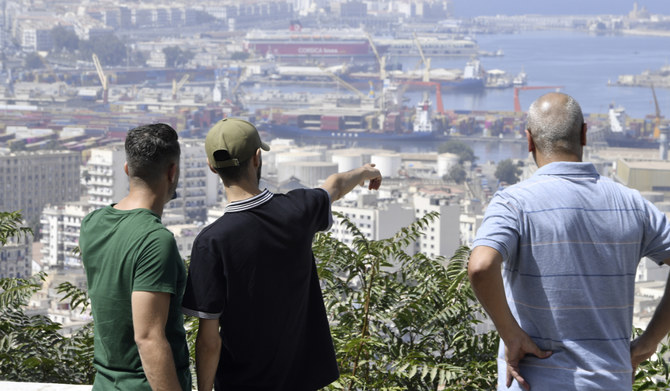
A youth point towards the ports in Algiers, Algeria, Monday, July 29, 2024. (AP)
Short Url
Updated 02 August 2024
Follow

Algeria seeks youth support as Tebboune, 78, seeks reelection

  • There is a big gap between the new generation and the existing political structures, says journalism professor

ALGIERS: A few years after taking to the streets with hundreds of thousands of other Algerians, Kaci Taher says he feels so disengaged that he will not even vote in the country’s presidential elections next month.

The 28-year-old from Kabylia is precisely the kind of voter that President Abdelmadjid Tebboune has targeted as he vies for a second term in office, describing himself as a “candidate of youth” in his campaign announcement last month.
Most of the young people who make up more than half of the population in Algeria are so disenchanted that, like Taher, they may not vote in next month’s presidential election.

FASTFACT

Voter turnout has long been low in Algeria, particularly among people under 30, who make up 51 percent of the population, according to the National Statistics Bureau.

Though he is almost certain to win, a low turnout could doubt the legitimacy of Tebboune’s victory.
“Voting has no meaning in Algeria like in the big democracies,” he said.
“Where I come from, the results and quotas are fixed in advance in the back room of the government, so what’s the point of taking part in the electoral farce?”
Taher said he is politically suffocating and has little confidence in elections securing the type of democratic outcome that people demanded in 2019.
In that year, massive street protests throughout the country known as the Hirak led to the ouster of octogenarian President Abdelaziz Bouteflika after two decades leading Algeria, Africa’s largest nation by area and a key security partner for Western nations.
Like many young people in Algeria, Taher struggles with unemployment, boredom, and malaise.
Voter turnout has long been low in Algeria, particularly among people under 30, who comprise 51 percent of the population, according to the country’s National Statistics Bureau.
Though little data exists on why people in Algeria abstain from voting, experts say that the aging political elite — including politicians who wrested independence from France more than 60 years ago — are not reaching young people.
“There is a big gap between the new generation and the existing political structures — political parties and institutions,” said Redouane Boudjema, a professor at the Algiers Institute of Journalism who has researched youth and social movements.
“Young people no longer identify with the political elites who occupy the public arena.”
Hirak activists like Taher were disappointed when authorities called for quick elections amid protests in 2019. The timeline, demonstrators said, offered little opportunity to reach a consensus on deep reforms, allowing then-74-year-old Tebboune, seen as close to the military, to win in a low-turnout race.
Journalists have faced prosecution throughout his tenure, and the economic challenges afflicting many of the country’s 45 million people have persisted.
The government has juggled competing priorities, trying to combat inflation while maintaining state spending, subsidies, and price controls that keep people afloat.
Tebboune continues to refer to the Hirak movement in speeches in which he overtures disaffected Algerian youth, claiming their voices have been heard and changes implemented.
Now 78, Tebboune is among dozens of leaders far older than most voters scheduled to cast ballots in more than 50 countries this year. In addition to leaders like 81-year-old US President Joe Biden, the discrepancy is particularly pronounced in Africa, the world’s youngest continent home to 11 of the world’s 20 oldest heads of state.
This year’s analysis from the Pew Research Center concluded that countries classified as “not free,” like Algeria, tend to have older leaders.
Tebboune’s changes include the establishment of a national youth council to advise the government to better integrate young people into politics, an electoral law requiring parties to put forth younger candidates, and interest-free loans for tech start-ups.
“Algeria belongs to everyone, and young people must live its present, build its future, get involved in the political process, and leave their mark,” Mustapha Hidaoui, the youth council president, said last month.
But despite an earnest effort from Tebboune and other government officials, the question of whether young people will be persuaded to vote in the election remains to be seen.
If not, there are fears about increasing Algerians voting with their feet.
More than 100 makeshift boats have traversed the Mediterranean Sea from Algeria to southern Spain’s coast this year, according to Francisco Jose Clemente Martin, an active member of the International Center for Migrant Identification.
“Algeria’s over. We’re leaving it to you. Adios!” a group of young Algerians packed into a crowded boat say in a video that has gone viral on social media.


Israeli soldiers fired 900 bullets during massacre of Palestinian aid workers, investigation finds

Updated 12 sec ago
Follow

Israeli soldiers fired 900 bullets during massacre of Palestinian aid workers, investigation finds

  • Researchers use visual and audio analysis to reconstruct Gaza ambush of emergency vehicles that left 15 people dead
  • Israeli troops executed some victims at close range, according to recordings and witnesses

LONDON: Israeli soldiers fired more than 900 bullets during a massacre of Palestinian aid workers that included “execution-style” killings, a detailed reconstruction of one of the worst atrocities of the Gaza war has found.

The investigation recreated a 3D digital version of the scene of the killings and used audio analysis of recordings to pinpoint how the attack unfolded in March last year.

Fifteen Palestinian aid workers were killed when Israel troops ambushed their vehicles in Tel Al-Sultan, near Rafah, southern Gaza. The victims included ambulance crews from the Palestinian Red Crescent Society, rescue teams from the Palestinian Civil Defense sent to help, and a member of the UN agency for Palestinian refugees UNRWA.

Israel tried to hide evidence of the killings by crushing the vehicles left at the scene and burying them in the sand, along with the victims’ bodies.

The joint investigation published on Monday was carried out by London-based researchers Forensic Architecture and Earshot, an audio analysis agency.

Israeli soldiers “subjected Palestinian aid workers to continuous assault by gunfire for over two hours” in an attack that started shortly after 5 a.m. on March 23, the study found.

The position of each vehicle in the convoy as the shooting began. (Forensic Architecture)

Contrary to Israel’s initial claims that events unfolded in a combat zone, “there was no exchange of fire in the area, and no tangible threat to the safety of those soldiers,” the report said. 

The researchers documented at least 910 gunshots from three recordings from the scene. At least 844 shots were recorded within a five-and-a-half-minute period in video taken by paramedic Refaat Radwan, one of the victims.

More than 90 percent of the bullets were fired directly toward the emergency vehicles and aid workers during the initial period of the attack, with at least five soldiers firing simultaneously.

The investigation concluded that the emergency lights and markings of the vehicles ambushed would have been clearly visible to the soldiers.

Israeli troops continued shooting as they advanced on the vehicles before carrying out perhaps the most disturbing act of the attack.

“Upon reaching them, they moved through the vehicles and shot several of the aid workers at close range,” the report said.

One of the shots was fired between one and four meters away from paramedic Ashraf Abu Libda and coincided with the last time his voice was heard on recordings, “suggesting that these were the shots that killed him.”

A 3D reconstruction of Asaad Al-Nasasra and Muhammad al-Hila embracing while under Israeli fire. Muhammad was shot and killed while in this position while Asaad survived, researchers found. (Forensic Architecture)

The initial attack started at about 4 a.m. when Israeli forces opened fire on an ambulance sent to the scene of an Israeli airstrike, killing the two crew members inside.

Three more ambulances were sent to search for the missing crew. Once they found the vehicle, they were joined by a Palestinian Civil Defense ambulance and a fire truck.

“All vehicles were clearly marked and had their emergency lights on,” the report said.

Within minutes of the five vehicles arriving at the scene, and as the aid workers approached their fallen colleagues, the Israeli soldiers opened fire.

The driver of a UN Toyota truck that passed the site about an hour later was also killed.

Researchers were able to map the positions and movements of the Israeli troops throughout the attack with the help of echolocation and audio-ballistic analysis.

Opinion

This section contains relevant reference points, placed in (Opinion field)

This enabled them to work out the distance and the direction of the source of the gunshots from the devices making the recordings.

Researchers also detailed the extent of the Israeli military’s efforts to “conceal and disrupt evidence of the attack.”

This included burying the victims’ bodies, burying mobile phones, and crushing and partially burying the victims’ vehicles. 

Analysis of satellite images revealed how Israel transformed the site with earth-moving machinery in the hours following the attack.

One of the two survivors of the ambush was detained for more than a month, tortured, and interrogated.

The bodies of 14 of the victims were found in a mass grave near the site on March 30, while the remains of another victim were found a few days earlier nearby.

A forensic doctor who examined some of the bodies told The Guardian newspaper that there was evidence of execution-style killing given the location of the wounds. 

Coming during the height of Israel’s two-year war on Gaza that has killed more than 72,000 Palestinians, the massacre of aid workers sparked international outcry.

In the aftermath, Israel gave varying accounts of what happened, initially claiming that its troops thought they were facing an attack.

On April 20, the Israeli military said an inquiry into the attack had identified “several professional failures, breaches of orders, and a failure to fully report the incident.”

A duty commander was dismissed for “providing an incomplete and inaccurate report during the debrief,” but there have been no further measures against those who carried out the attack.