Olympic gold medalist Arshad Nadeem gets Pakistan’s Hilal-i-Imtiaz award

1 / 2
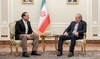
Pakistan President Asif Ali Zardari (right) awards Hilal-e-Imtiaz award to Olympic gold medalist Arshad Nadeem (left) in Islamabad, Pakistan on August 29, 2024. (President Office)
2 / 2
Olympic gold medalist Arshad Nadeem (second right) calls on President Asif Ali Zardari in Islamabad, Pakistan on August 29, 2024. (President Office)
Short Url
Updated 29 August 2024
Follow

Olympic gold medalist Arshad Nadeem gets Pakistan’s Hilal-i-Imtiaz award

  • Nadeem made history at the Paris Olympics by setting a new record for the longest javelin throw 
  • His triumph is all the more impressive since Nadeem was born poor, trained in wheat fields with homemade javelins

ISLAMABAD: Arshad Nadeem on Thursday received the Hilal-e-Imtiaz, the second-highest civilian award of Pakistan, for making history at the Paris Olympics by setting a new record for the longest javelin throw and winning a gold medal for his country.

Nadeem’s triumph is seen by Pakistanis, struggling with an economic crisis and rising militancy, as all the more impressive since he was born and raised in a mud brick house in an impoverished corner of rural Punjab and as a young man trained in wheat fields with homemade javelins.

Nadeem, who compared his Olympic clash with India’a Neeraj Chopra to the two nations’ legendary rivalry in cricket, has previously said it is challenging being a non-cricket athlete in Pakistan, where resources and facilities for his sport are scarce.

But now his record-breaking 92.97 meter javelin throw in Paris has earned Pakistan its first Olympic medal since the 1992 Barcelona Games and its first gold medal since the 1984 Los Angeles Games.

“President Asif Ali Zardari has conferred Hilal-i-Imtiaz upon Olympic Gold Medalist Arshad Nadeem in recognition of his outstanding achievement in Paris Olympics-2024,” Radio Pakistan reported. “The award was given at a special investiture ceremony in Islamabad today [Thursday].”

Nadeem, 27, married with two children, comes from a poor family of eight children in the central Pakistani region of Khanewal, where he first began to dream of Olympic greatness.

His district barely had reliable water and electricity supplies, let alone proper sports facilities for him to train.

“I am thankful to God almighty. I thank my parents and Pakistani nation,” Nadeem said as he returned home from Paris to a water canon salute and chants from thousands of supporters. “There is lot of hard work by me and my coach Salman Butt behind this.”



ADB, Pakistan sign over $300 million agreements to undertake climate resilience initiatives

Updated 11 sec ago
Follow

ADB, Pakistan sign over $300 million agreements to undertake climate resilience initiatives

  • Pakistan ranks among nations most vulnerable to climate change and has seen erratic changes in weather patterns
  • The projects in Sindh and Punjab will restore nature-based coastal defenses and enhance agricultural productivity

ISLAMABAD: The Pakistani government and the Asian Development Bank (ADB) have signed more than $300 million agreements to undertake two major climate resilience initiatives, Pakistan’s Press Information Department (PID) said on Tuesday.

The projects include the Sindh Coastal Resilience Sector Project (SCRP), valued at Rs50.5 billion ($180.5 million), and the Punjab Climate-Resilient and Low-Carbon Agriculture Mechanization Project (PCRLCAMP), totaling Rs34.7 billion ($124 million).

Pakistan ranks among nations most vulnerable to climate change and has seen erratic changes in its weather patterns. In 2022, monsoon floods killed over 1,700 people, displaced another 33 million and caused over $30 billion losses, while another 1,037 people were killed in floods this year.

The South Asian country is ramping up climate resilience efforts, with support from the ADB and World Bank, and investing in climate-resilient infrastructure, particularly in vulnerable areas.

“Both sides expressed their commitment to effectively utilize the financing for successful and timely completion of the two initiatives,” the PID said in a statement.

The Sindh Coastal Resilience Project (SCRP) will promote integrated water resources and flood risk management, restore nature-based coastal defenses, and strengthen institutional and community capacity for strategic action planning, directly benefiting over 3.8 million people in Thatta, Sujawal, and Badin districts, according to ADB.

The Punjab project will enhance agricultural productivity and climate resilience across 30 districts, improving small farmers’ access to climate-smart machinery, introducing circular agriculture practices to reduce residue burning, establishing testing and training facilities, and empowering 15,000 women through skills development and livelihood diversification.

Earlier this month, the ADB also approved $381 million in financing for Pakistan’s Punjab province to modernize agriculture and strengthen education and health services, including concessional loans and grants for farm mechanization, Science, Technology, Engineering and Mathematics (STEM) education, and nursing sector reforms.