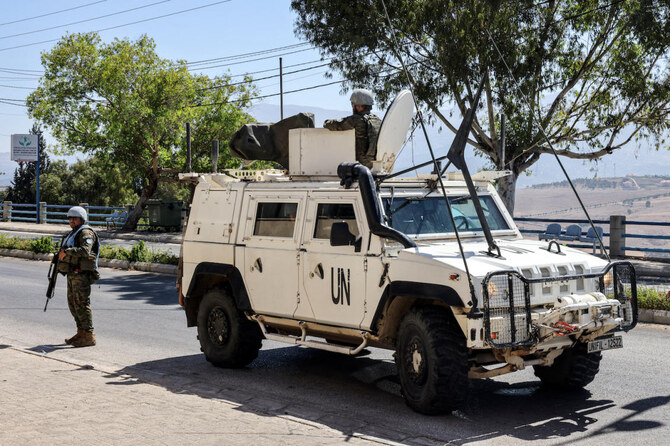
UNITED NATIONS: The United Nations Security Council on Wednesday extended the mandate of the UN peacekeeping force in Lebanon for a year, calling for a “de-escalation” of a recent surge in violence between Israel and armed group Hezbollah.
A unanimously adopted resolution said the council “decides to extend the present mandate of UNIFIL until 31st August 2025,” referring to the United Nations Interim Force in Lebanon.
With more than 10,000 personnel, the peacekeeping force has been stationed in Lebanon since 1978, with its role strengthened after a 33-day conflict between Hezbollah and Israel in 2006.
Tensions have risen again since the October start of Israel’s war in Gaza, with Hezbollah supporting the Palestinian armed group Hamas with operations in southern Lebanon, including daily exchanges of fire with Israeli troops.
On Sunday, Hezbollah carried out a major drone and rocket attack against Israel, in retaliation for the death of one of its military leaders, Fuad Shukr, killed in an Israeli strike near Beirut on July 30.
In response, Israel launched air strikes into Lebanon on Sunday, saying it destroyed “thousands” of Hezbollah rocket launchers and thwarted a major attack.
The UN Security Council resolution said the body “strongly urges that all relevant actors implement immediate measures toward de-escalation, including with a view to restoring calm, restraint and stability across the Blue Line,” referring to the demarcation line between Israel and Lebanon.
UN Secretary-General Antonio Guterres, in a letter to the council at the end of July, had supported Beirut’s request to extend UNIFIL’s mandate unchanged.
While the mandate has not been amended, the resolution adopted on Wednesday “encourages the Secretary-General to ensure that UNIFIL remains ready to adapt its activities to support de-escalation, within its mandate and its rules of engagement.”
Danny Danon, the Israeli ambassador to the UN, criticized what he termed the “failure” of UNIFIL.
“What good does this mandate do when it fails so miserably to meet any of its objectives?” he told reporters.
Danon described a rocket attack that killed 12 children in the Israeli-annexed part of the Syrian Golan Heights at the end of July as “a direct result of the failure of UNIFIL and the Lebanese government to implement” the Security Council’s resolutions.


With tensions high, UN extends Lebanon peacekeeping force’s mandate
https://arab.news/pcnr5
With tensions high, UN extends Lebanon peacekeeping force’s mandate

- With more than 10,000 personnel, the peacekeeping force has been stationed in Lebanon since 1978
- Tensions have risen again since the October start of Israel’s war in Gaza, with Hezbollah supporting Hamas


Major airlines suspend, reroute flights amid US-Israel strikes on Iran
- Saudia says decision taken in line with aviation safety and security standards
- Emirates says regional airspace closures cause disruption to several of its flights
RIYADH: Major international airlines across the Middle East and South Asia have suspended, canceled or rerouted flights following ongoing US-Israel attacks on Iran and the resulting airspace closures, according to official statements issued via X.
Saudia said in an official statement that it had canceled a number of flights due to developments in the region and the closure of airspace. The airline said the decision was taken in line with aviation safety and security standards, noting that its Emergency Coordination Center is closely monitoring developments with relevant authorities. Saudia urged passengers to verify the status of their flights before heading to the airport and said guests would be notified of updates through the contact details associated with their bookings. The carrier added that further information would be announced in a subsequent statement if available.
بيان رسمي من #الخطوط_السعودية pic.twitter.com/CHfjKj9yLX
— Saudia Group | مجموعة السعودية (@SaudiaGroup) February 28, 2026
Air Arabia said its flights were experiencing cancellations, delays or rerouting as a result of the evolving situation and airspace closures. The airline advised passengers to check the status of their flights before traveling to the airport by visiting its website or contacting its call center. Customers booked on affected flights will be notified directly, the airline said, adding that further updates would be provided as the situation develops.
Air India announced a broader suspension, stating that “in view of the developing situation in parts of the Middle East, all Air India flights to all destinations in the Middle East have been suspended.” The airline said it remains committed to maintaining the highest standards of safety for passengers and crew and will continue to assess the safety and security environment for flight operations, adjusting services proactively as required. Air India said its teams would extend necessary support to passengers and advised customers to check flight status online or contact its 24/7 call center for assistance.
#TravelAdvisory
— Air India (@airindia) February 28, 2026
In view of the developing situation in parts of the Middle East, all Air India flights to all destinations in the Middle East have been suspended. We remain committed to maintaining the highest standards of safety for our passengers and crew. We will continue to…
Dubai-based Emirates reported that regional airspace closures had caused disruption to several of its flights. The airline said it is actively monitoring the situation, engaging with relevant authorities and adjusting operations in line with the latest developments. Emirates said it adheres to all regulatory requirements and follows guidance issued by aviation authorities. The carrier apologized to affected customers and said it is assisting them with rebooking, refunds or alternative travel arrangements, reiterating that the safety and security of passengers and crew remain its highest priority.
Due to multiple regional airspace closures, Emirates has temporarily suspended operations to and from Dubai.
— Emirates Support (@EmiratesSupport) February 28, 2026
Emirates urges customers to check https://t.co/Ucm3UswfVh and https://t.co/yehFUeWZQq for the latest updates before proceeding to the airport.
We are actively monitoring… pic.twitter.com/SLDC7iNaUN
Qatar Airways confirmed a temporary suspension of flights to and from Doha due to the closure of Qatari airspace. The airline said it is working closely with government stakeholders and relevant authorities to support impacted passengers and will resume operations once the airspace reopens. It warned that delays are anticipated when usual operations resume and said additional ground staff have been deployed at Hamad International Airport and other key airports to assist passengers.
Temporary Suspension of Qatar Airways Flights due to Qatari Airspace Closure
— Qatar Airways (@qatarairways) February 28, 2026
Qatar Airways Group confirms the temporary suspension of its flights to, and from, Doha due to the closure of Qatari airspace.
The airline is working closely with government stakeholders and the…
Meanwhile, Al Jazeera reported that British Airways had canceled flights to Tel Aviv and Bahrain, adding to the list of carriers adjusting operations.
Across their statements, airlines consistently cited airspace closures and safety considerations as the primary reasons for suspensions and disruptions, while urging passengers to monitor official channels for updates as the situation continues to evolve.


