WASHINGTON: Prosecutors on Tuesday filed a revised indictment of Donald Trump, pressing ahead with bombshell charges that he tried to overturn the 2020 US election after losing to Joe Biden.
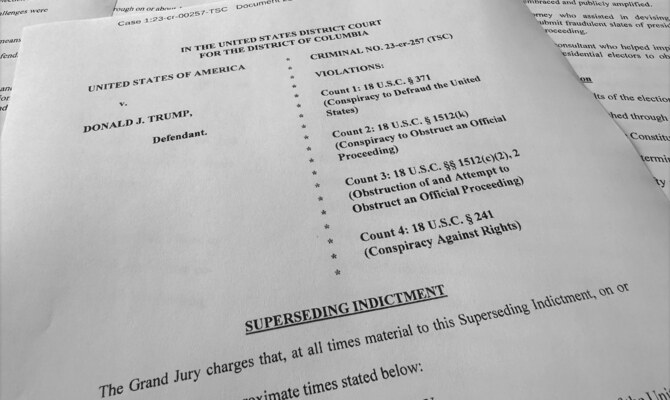
The superseding indictment retains the same four charges against Trump as in an earlier version but takes into account a recent Supreme Court ruling that a former president has broad immunity from criminal prosecution.
The new indictment of the 78-year-old Republican White House candidate is 36 pages long, down from 45 pages previously, and removes material affected by the immunity ruling from the conservative-dominated top court.
It retains the same core, stating that Trump lost in 2020 but “was determined to remain in power” and attempted to subvert the results.
The Supreme Court ruled in July that an ex-president has broad immunity from prosecution for official acts conducted while in office, but can be pursued for unofficial acts.
This threw into doubt the historic prosecution of the ex-president.
Trump referred to the new indictment as an “act of desperation” that was part of a “witch hunt” against him.
“The illegally appointed ‘Special Counsel’ Deranged Jack Smith, has brought a ridiculous new Indictment against me, which has all the problems of the old Indictment, and should be dismissed IMMEDIATELY,” he posted on his Truth Social platform.
The new indictment comes three days before Special Counsel Jack Smith, who brought the charges against Trump, and lawyers for the former president had been set to file a schedule for pre-trial proceedings.
Judge Tanya Chutkan, who is presiding over the case, had also scheduled a status hearing for September 5 in Washington and it was not immediately clear if that would go ahead now, following the filing of the superseding indictment.
Trump’s lawyers have been seeking to delay a trial until after November’s election between Trump and Vice President Kamala Harris, the Democratic presidential candidate.
Trump is accused of conspiracy to defraud the United States and conspiracy to obstruct an official proceeding — the January 6, 2021 joint session of Congress that was attacked by Trump supporters.
Trump is also accused of seeking to disenfranchise US voters with his campaign of false claims that he won the 2020 election.
He was originally scheduled to go on trial on March 4, but that was put on hold while his lawyers pushed his claim of presidential immunity all the way up to the Supreme Court.
It will be up to Chutkan, an appointee of former Democratic president Barack Obama, to decide which of Trump’s actions regarding the 2020 election were official acts and which were unofficial acts subject to potential prosecution.
That and other pre-trial issues are expected to take months, making it unlikely the case will go to trial before the November 5 presidential vote.
The new indictment drops references to Jeffrey Clark, a former senior Justice Department official who was one of six co-conspirators listed in the original indictment allegedly enlisted by Trump to press his false claims of election fraud.
The Supreme Court, in its immunity ruling, said a president’s communications with members of the Justice Department should be considered official acts.
The remaining co-conspirators, who include Trump’s former personal lawyer Rudy Giuliani, “were acting in a private capacity,” the indictment said, “to assist him in his criminal efforts to overturn the legitimate results of the 2020 presidential election and retain power.”
Regarding the ruling on Trump’s immunity, Supreme Court Judge Ketanji Brown Jackson said that she was “concerned” about the July verdict, according to an interview released by CBS news on Tuesday.
“I was concerned about a system that appeared to provide immunity for one individual under one set of circumstances, when we have a criminal justice system that had ordinarily treated everyone the same,” she said.
Jackson was among three justices to dissent from the court’s ruling.
Trump was convicted in New York in May of 34 counts of falsifying business records to cover up hush money payments made to porn star Stormy Daniels.
Sentencing has been scheduled for September 18, but Trump’s lawyers have asked for his conviction to be tossed, citing the Supreme Court immunity ruling, and sentencing to be delayed.
Trump also faces charges in Georgia related to efforts to overturn the 2020 election.
Trump was also charged in Florida with mishandling top-secret documents after leaving the White House.
The judge presiding over the documents case, Aileen Cannon, a Trump appointee, dismissed the charges on the grounds that Smith, the special counsel, was unlawfully appointed.
Smith has appealed Cannon’s ruling.


![]()

Prosecutors resubmit charges that Trump tried to overturn election
Short Url
https://arab.news/rh79x
Prosecutors resubmit charges that Trump tried to overturn election
- Trump referred to the new indictment as an “act of desperation” that was part of a “witch hunt” against him


Latest updates


Recommended


© 2026 SAUDI RESEARCH & PUBLISHING COMPANY, All Rights Reserved And subject to Terms of Use Agreement.