

Daesh supporters turn to AI to bolster online support

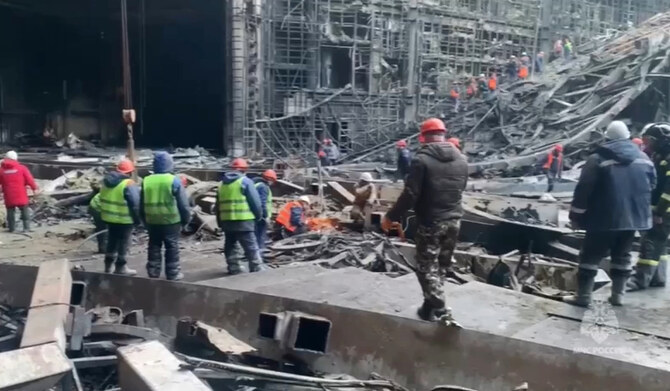
In this photo taken from video released by Russian Emergency Ministry Press Service on Tuesday, March 26, 2024, rescuers work in the burned concert hall after a terrorists attack on the building of the Crocus City Hall on the western edge of Moscow, Russia. (AP)
Short Url
Updated 28 August 2024
Follow

Daesh supporters turn to AI to bolster online support

  • A January study by the Combating Terrorism Center at West Point said AI could be used to generate and distribute propaganda, to recruit using AI-powered chatbots, to carry out attacks using drones or other autonomous vehicles, and to launch cyber-attacks

BEIRUT: Days after a deadly Daesh attack on a Russian concert hall in March, a man clad in military fatigues and a helmet appeared in an online video, celebrating the assault in which more than 140 people were killed.
“The Daesh delivered a strong blow to Russia with a bloody attack, the fiercest that hit it in years,” the man said in Arabic, according to the SITE Intelligence Group, an organization that tracks and analyzes such online content.
But the man in the video, which the Thomson Reuters Foundation was not able to view independently, was not real — he was created using artificial intelligence, according to SITE and other online researchers.
Federico Borgonovo, a researcher at the Royal United Services Institute, a London-based think tank, traced the AI-generated video to an Daesh supporter active in the group’s digital ecosystem.
This person had combined statements, bulletins, and data from Daesh’s official news outlet to create the video using AI, Borgonovo explained.
Although Daesh has been using AI for some time, Borgonovo said the video was an “exception to the rules” because the production quality was high even if the content was not as violent as in other online posts.
“It’s quite good for an AI product. But in terms of violence and the propaganda itself, it’s average,” he said, noting however that the video showed how Daesh supporters and affiliates can ramp up production of sympathetic content online.
Digital experts say groups like Daesh and far-right movements are increasingly using AI online and testing the limits of safety controls on social media platforms.
A January study by the Combating Terrorism Center at West Point said AI could be used to generate and distribute propaganda, to recruit using AI-powered chatbots, to carry out attacks using drones or other autonomous vehicles, and to launch cyber-attacks.
“Many assessments of AI risk, and even of generative AI risks specifically, only consider this particular problem in a cursory way,” said Stephane Baele, professor of international relations at UCLouvain in Belgium.
“Major AI firms, who genuinely engaged with the risks of their tools by publishing sometimes lengthy reports mapping them, pay scant attention to extremist and terrorist uses.”
Regulation governing AI is still being crafted around the world and pioneers of the technology have said they will strive to ensure it is safe and secure.
Tech giant Microsoft, for example, has developed a Responsible AI Standard that aims to base AI development on six principles including fairness, reliability and safety, privacy and security, inclusiveness, transparency, and accountability.
In a special report earlier this year, SITE Intelligence Group’s founder and executive director Rita Katz wrote that a range of actors from members of militant group Al-Qaeda to neo-Nazi networks were capitalizing on the technology.
“It’s hard to understate what a gift AI is for terrorists and extremist communities, for which media is lifeblood,” she wrote.

CHATBOTS AND CARTOONS
At the height of its powers in 2014, Daesh claimed control over large parts of Syria and Iraq, imposing a reign of terror in the areas it controlled.
Media was a prominent tool in the group’s arsenal, and online recruitment has long been vital to its operations.
Despite the collapse of its self-declared caliphate in 2017, its supporters and affiliates still preach their doctrine online and try to persuade people to join their ranks.
Last month, a security source told Reuters that France had identified a dozen Daesh-K handlers, based in countries around Afghanistan, who have a strong online presence and are trying to convince young men in European countries, who are interested in joining up with the group overseas, to instead carry out domestic attacks.
Daesh-K is a resurgent wing of Daesh, named after the historical region of Khorasan that included parts of Iran, Afghanistan and Central Asia.
Analysts fear that AI may facilitate and automate the work of such online recruiters.
Daniel Siegel, an investigator at social media research firm Graphika, said he came across chatbots that mimicked dead or incarcerated Daesh militants in earlier research he conducted before joining the firm.
He told the Thomson Reuters Foundation that it was unclear if the source of the bots was the Daesh or its supporters, but the risk they posed was still real.
“Now (Daesh affiliates) can build these real relationships with bots that represent a potential future where a chatbot could encourage them to engage in kinetic violence,” Siegel said.
Siegel interacted with some of the bots as part of his research and he found their answers to be generic, but he said that could change as AI tech develops.
“One of the things I am worried about as well is how synthetic media will enable these groups to blend their content that previously existed in silos into our mainstream culture,” he added.
That is already happening: Siegel had tracked videos of popular cartoon characters, like Rick and Morty and Peter Griffin, singing Daesh anthems on different platforms.
“What this allows the group or sympathizers or affiliates to do is target specific audiences because they know that the regular consumers of Sponge Bob or Peter Griffin or Rick and Morty, will be fed that content through the algorithm,” Siegel said.

EXPLOITING PROMPTS
Then there is the danger of Daesh supporters using AI tech to broaden their knowledge of illegal activities.
For its January study, researchers at the Combating Terrorism Center at Westpoint attempted to bypass the security guards of Large Language Models (LLMs) and extract information that could be exploited by malicious actors.
They crafted prompts that requested information on a range of activities from attack planning to recruitment and tactical learning, and the LLMs generated responses that were relevant half of the time.
In one example that they described as “alarming,” researchers asked an LLM to help them convince people to donate to Daesh.
“There, the model yielded very specific guidelines on how to conduct a fundraising campaign and even offered specific narratives and phrases to be used on social media,” the report said.
Joe Burton a professor of international security at Lancaster University, said companies were acting irresponsibly by rapidly releasing AI models as open-source tools.
He questioned the efficacy of LLMs’ safety protocols, adding that he was “not convinced” that regulators were equipped to enforce the testing and verification of these methods.
“The factor to consider here is how much we want to regulate, and whether that will stifle innovation,” Burton said.
“The markets, in my view, shouldn’t override safety and security, and I think — at the moment — that is what is happening.”


Analysis: Understanding the illegitimacy of Somaliland independence

Updated 5 sec ago
Follow

Analysis: Understanding the illegitimacy of Somaliland independence

  • Israel’s recognition of Somaliland has drawn condemnation as a violation of international law and Somalia’s sovereignty
  • Regional and global critics warn the move risks militarizing the Red Sea and destabilizing the Horn of Africa

LONDON: For 34 years, the breakaway state of Somaliland, which declared independence from Somalia in 1991, has wandered in the diplomatic wilderness, its claim to sovereignty unrecognized by the entire world.

All that changed on Dec. 26 with the surprise announcement by the Israeli government that it was establishing full diplomatic relations with the territory, which occupies a strategically sensitive position along the northern coast of the Horn of Africa, overlooking the Gulf of Aden and the mouth of the Red Sea.

On Dec. 28, Israel’s Foreign Minister Gideon Sa’ar, took to Facebook to publish the declaration of recognition, signed by himself and Prime Minister Benjamin Netanyahu.

The recognition, it read, had been made “in light of the shared values, strategic interests, and the spirit of mutual respect that binds our people.”


The relationship, it added, “will contribute to advancing peace, stability, and prosperity in the Horn of Africa, the Middle East, and beyond.”

But for the many international critics of the move, including Turkiye, Saudi Arabia, the EU, the UK, China and the African Union, the Israeli recognition of Somaliland’s sovereignty is likely to only increase tensions in an already turbulent region.

Somalia’s President Hassan Sheikh Mohamud has claimed that, as the price for Israel’s recognition, Somaliland has agreed to accept Palestinians displaced from Gaza by Israel. The Somaliland regime has denied this, but pro-Palestinian states are not convinced.

On Dec. 27, Saudi Arabia was among 21 Arab, Islamic and African nations that issued a joint statement declaring their “unequivocal rejection of Israel’s recognition of the ‘Somaliland’ region of the Federal Republic of Somalia.”

They rejected “any potential link between such a measure and any attempts to forcibly expel the Palestinian people out of their land, which is unequivocally rejected in any form as a matter of principle.”

Israel’s recognition of Somaliland, they added, constituted “a grave violation of the principles of international law and the UN Charter, which explicitly stipulates the imperative of protecting the sovereignty of states and their territorial integrity.”

There would, they added, be “serious repercussions of such an unprecedented measure on peace and security in the Horn of Africa, the Red Sea, and … serious effects on international peace and security as a whole.”

Much of the rest of the world, including Europe, is in lockstep with the Arab states on the issue.


On Dec. 26, the EU issued a statement in which it “reaffirms the importance of respecting the unity, the sovereignty and the territorial integrity of the Federal Republic of Somalia pursuant of its constitution, the Charters of the African Union and the UN.”

It added: “This is key for the peace and stability of the entire Horn of Africa region.”

China, too, has criticized the Israeli move. In a statement, the Foreign Ministry said that “no country should encourage or support other countries’ internal separatist forces for its own selfish interests.”

At a meeting of the UN Security Council on Dec. 29, Khaled Khiari, assistant secretary-general for the Middle East, Asia and the Pacific, relayed Somalia’s indignation at what it called “a deliberate attack” on its sovereignty.

Khiari said Somalia had “also underscored that it would not permit the establishment of any foreign military bases or arrangements that would draw the country into proxy conflicts.”

Somalia declared that “no external actor has the authority” to alter its territorial configuration.


The UK was among numerous countries that spoke up for Somalia, with its charge d’affaires reaffirming his country’s continuing “support for the sovereignty, territorial integrity, political independence, and unity of Somalia.”

The UK, added Ambassador James Kariuki, “does not recognize Somaliland’s independence.

“We maintain that any change to Somaliland’s status depends on mutual agreement between Mogadishu and Hargeisa, through dialogue, and must conform to the purposes and principles of the UN Charter.”

Israel’s Sa’ar, who visited Somaliland on Tuesday, brushed aside the chorus of criticism. “Somaliland was not created this past weekend,” he wrote on Facebook. “It has existed as a functioning state for more than 34 years.

“The attacks on Israel’s recognition of Somaliland are hypocritical. Only Israel will decide who to recognize and with whom to maintain diplomatic relations.”

Netanyahu, meanwhile, has said he only wants to “support a democratic, moderate country, a Muslim country, that wants to join the Abraham Accords.”


But some observers believe Israel may be planning to use Somaliland as a military base from which to attack the Houthis in Yemen. Since 2023, the Houthis have launched several missile attacks on Israel, and Israel has struck many targets in Yemen in response.

Now the Houthis have warned that any Israeli military presence in Somaliland would be considered a target, which puts Somalis in the firing line of a war that has nothing to do with them.

Israel’s act of recognition appears likely to stoke tensions in the region.

For example, relations between Somalia and Ethiopia, its western neighbor, are already fraught following talks between Somaliland and Addis Ababa aimed at giving the landlocked state access to the Red Sea.

Ethiopia lost its own coastline in 1993 when its northern region of Eritrea declared independence.

The plan to give Ethiopia a naval base on Somaliland’s Red Sea coast is bitterly opposed by Somalia, which resents what it sees as its territory being given away.

It has also angered Egypt. Cairo has its own dispute with Ethiopia over the Grand Ethiopian Renaissance Dam, which the country has built on the Blue Nile and which Egypt says is threatening its water supplies.

The region’s current crisis is rooted in colonialism.


Before the European “scramble for Africa,” there was no central “Somalian” state. Instead, a region roughly equivalent to modern-day Somaliland, Somalia, Djibouti, the eastern Ogaden region of Ethiopia and parts of northern Kenya was occupied by scattered groups of Somali-speaking pastoral tribes.

In the 19th century, European powers divided up the area into French Somaliland (Djibouti) in the extreme northwest, British Somaliland (today’s Somaliland), and Italian Somaliland (now Somalia).

The British and Italian-held territories gained their independence in 1960 and came together briefly as the Somali Republic. The union proved fragile, however, and in 1969 ended with the assassination of President Abdirashid Ali Sharmarke and a subsequent military coup.

The leader of the coup was Mohamed Siad Barre, the commander of the army, who declared himself president.

In 1991, widespread anger at the regime escalated into civil war. Barre fled to Kenya (reportedly in a tank loaded with millions of dollars of the state’s money), and the government collapsed.

This was the moment, in May 1991, that political leaders in the former British Somaliland declared independence as the Republic of Somaliland, an entity that until now had received no international recognition.

Abdirahman Sahal Yusuf, former media adviser to the Office of the Prime Minister of Somalia and editor of the Qiraat Somali online news platform, says it is clear that “Israel has no right to recognize Somaliland. It is a move that violates international law.”


In doing so, he told Arab News, he believes Israel has two strategic goals: “Establishing a military base in this region to confront the Houthis, but at the same time there is an agreement to transfer Palestinians to Somaliland, which is a red line.”

Establishing an Israeli military base in Somaliland, he said, “would pose a threat to the national security of Egypt and Saudi Arabia, since this region is very sensitive.

“Israel wants to move its battles to this region, ruining Arab national security and dividing countries. The unity of Somalia must be protected.”

For Abdihakim Kalale, an Ethiopian political and security analyst, “the core issue is not recognition itself. States recognize one another, exchange interests, and recalibrate alliances as part of normal international politics.

“The problem lies in how Israel recognized Somaliland and the assumptions that informed that decision.”

Israel, he told Arab News, “appears to have treated Somaliland as a single, unified separatist movement. In reality, it is neither politically nor socially homogeneous. Fragmentation exists, not only in the east, but also in the west.”

In western Somaliland, two major clans inhabiting territories that represent roughly 15-20 percent of the claimed area have not fully integrated into the Somaliland system.

“These groups are actively pursuing the creation of a separate federal member state aligned with Mogadishu rather than Hargeisa. This alone demonstrates that Somaliland lacks internal political cohesion.”


In the east, the situation is even more fragmented. Here, following clan-based fighting in 2023, “a new federal member state, the Northeastern State of Somalia, emerged from territories internationally referred to as Somaliland.

“This entity is now aligned with Mogadishu and exercises effective control over large areas where the Somaliland government has no presence. These eastern territories account for approximately 40 to 45 percent of the land Somaliland claims.”

Furthermore, he said: “Somaliland is neither institutionally nor socially prepared to be integrated into larger geopolitical frameworks such as the Abraham Accords,” which Netanyahu has suggested is on the cards.

“Israel engaged with a leadership eager for recognition but lacking the capacity to manage the profound internal and regional consequences that recognition entails. This creates a governance vacuum that radical and violent actors are well positioned to exploit.

“There is a real risk that this decision could accelerate radicalization and a region long regarded as relatively stable compared to southern Somalia could, in the coming years, evolve into a new security hotspot.”

Liban Abd Ali, a consultant and former media and communications director in the Office of the Prime Minister of Somalia, agrees that Israeli recognition of the breakaway territory is “a very bad move.

“It’s a violation of a sovereign state and a violation of international laws and norms, and Israel is going to divide Somalia’s territorial integrity, fuel conflicts and destroy domestic cohesion,” he told Arab News.


He believes “the main objective is to forcibly move over 1.5 million Palestinians from their own land to northern Somalia.

“They also want to use this area as a launchpad for their fight against the Houthis in Yemen, and beyond that to control the Gulf of Aden and the Red Sea. Israel’s main goal is to destabilize the region by dividing countries.”